The short version
- Most garage door openers last 10–15 years with normal residential use — that range is the consensus of the 2025–2026 trade sources, and it is driven by cycles, not the calendar.
- The real rating is 10,000–25,000 cycles, where one cycle is a full open-and-close. At the typical household's four cycles a day (1,460 a year) that is about 6.8 to 17 years; at eight cycles a day a builder-grade unit is a 5–7 year item.
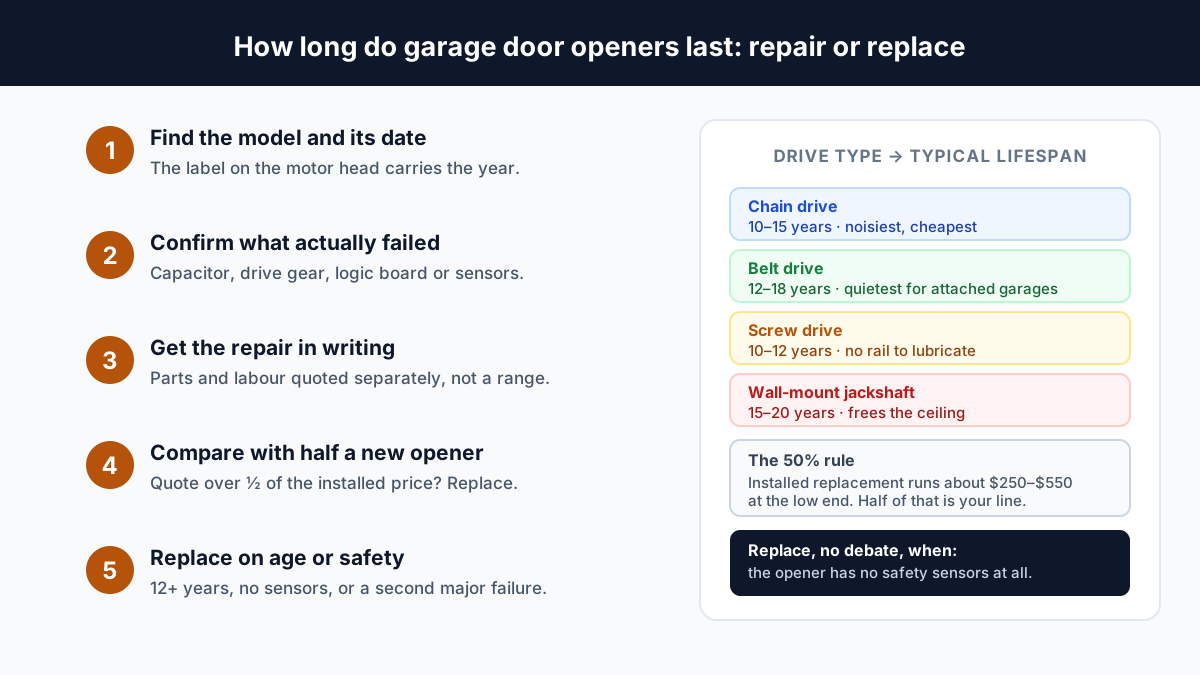
- Drive type is the biggest single predictor: chain 10–15 years, belt 12–18, screw 10–12, wall-mount jackshaft 15–20.
- The failures are mostly cheap and predictable. A degraded run capacitor is 40–60% of opener service calls and the cheapest real repair; a drive gear kit is $75–$150 and a logic board $120–$220. Opener repairs average about $174 nationally.
- Decide with a ratio, not a dollar figure: replace when the repair quote exceeds roughly 50% of a new opener installed ($300–$900, typical $250–$550) — and replace without any arithmetic at 12–15+ years, after a motor failure, or on any opener with no photo-eye safety sensors.
How long do garage door openers last? Usually 10 to 15 years — but the number that actually decides it is the cycle rating, not the model year. Residential openers are engineered for somewhere between 10,000 and 25,000 cycles, where one cycle is a full open-and-close of the door, and a household running the door four times a day gets through 1,460 cycles a year. Do the division and the same opener lasts 6.8 years in one house and 17 in the next, which is exactly why "openers last about twelve years" is an average and not a specification.
This guide gives you the lifespan by drive type and by brand, the cycle arithmetic for your own household, the six signs that an opener is on its way out, and the 2025–2026 prices for every common repair. It also settles the question homeowners actually lose sleep over: repair or replace. That decision has a defensible answer — a 50% ratio plus an age test — and it needs two numbers you can get in one service visit.
How long do garage door openers last?
Most garage door openers last 10–15 years under normal residential use, and belt drives, wall-mount jackshaft units and direct-drive models sit at the top of that band while screw drives sit at the bottom. The trade has converged on that range because it is what the cycle ratings work out to for an average household: 10,000–25,000 cycles at four cycles a day is 6.8 to 17 years of service, and the components that fail first — the capacitor, the drive gear, the logic board — usually go before the motor itself reaches its rating.
| Drive type | Typical lifespan | Why it lands there |
|---|---|---|
| Chain drive | 10–15 years | The metal chain stretches and needs tension and lubrication, and the plastic or nylon main drive gear is the usual failure point, typically wearing out between year 8 and year 12. Loudest and cheapest of the drives. |
| Belt drive | 12–18 years (15–20 by some sources) | A steel-reinforced belt has no metal-on-metal contact, so far less vibration reaches the motor and gears. The belt itself needs no lubrication and does not stretch like a chain. |
| Screw drive | 10–12 years | The threaded rod has fewer parts, but the plastic carriage wears and the lubricant dries out faster in heat and dry air. Sensitive to temperature swings. |
| Direct drive | 15–20 years | The motor travels along a stationary chain inside the rail — effectively one moving part. |
| Wall-mount / jackshaft | 15–20 years | It drives the torsion bar directly, so there is no rail, trolley, chain or belt to wear and no drive-gear failure mode at all. The most common US example, the LiftMaster 8500W class, also carries a lifetime motor warranty. |
Two caveats keep the table honest. First, the drive mechanism is the biggest predictor but not the only one: an opener is also judged by how often it runs and what it is being asked to lift. Second, the sources genuinely disagree at the edges — on belt drives the trade splits between 12–18 years and 15–20, and one outlier puts chain drives at the top of the range instead of below belt. What every source agrees on is the order of magnitude and the reason for it: fewer wear points, longer life.
And the years are always a translation. An opener advertised as lasting "10 to 15 years" is expressing the same 10,000–25,000-cycle band at typical residential use. The years change with your household; the cycles do not.
Cycles, not years: the number that actually decides
One cycle is the door going from closed to fully open and back to closed — not one movement. That is the industry definition in the same ANSI/DASMA counting the spring-lifespan guide uses, and it matters here because a lot of opener content counts one open as one cycle, which doubles the perceived cycle count of a household and halves every lifespan it reports.
"Out in the morning, back in at night" is two cycles. A family of four coming and going, a delivery, and one trip back in for a forgotten bag is realistically four to six cycles a day, or 1,460–2,190 a year. Multiply your own number by 365, divide the opener's rating by it, and you have your answer:
| Household pattern | Cycles/day | Cycles/year | 10,000 cycles | 20,000 cycles | 25,000 cycles |
|---|---|---|---|---|---|
| One car, retirees, garage used for storage | 2 | 730 | 13.7 yrs | 27.4 yrs | 34.2 yrs |
| Typical family, garage used for errands | 4 | 1,460 | 6.8 yrs | 13.7 yrs | 17.1 yrs |
| Busy family, garage as the front door | 6 | 2,190 | 4.6 yrs | 9.1 yrs | 11.4 yrs |
| Two drivers, separate trips, deliveries | 8 | 2,920 | 3.4 yrs | 6.8 yrs | 8.6 yrs |
| Three cars, kids, lawnmower, home business | 10 | 3,650 | 2.7 yrs | 5.5 yrs | 6.8 yrs |
Read the middle column against a real household and the practical consequences fall out. A standard builder-grade opener in a busy home cycling eight to ten times a day is a 5–7 year item, not a 15-year one, which is why the same failure at the same age can be normal in one garage and premature in another. It also explains why an opener that "died young" at six years was often not defective: it was doing twice the work of the one the lifespan table assumed.
If you have a Wi-Fi LiftMaster or Chamberlain unit, the opener may already be counting for you — the myQ app's diagnostics report door cycles, and the Maintenance Alert System flashes its LEDs at a set cycle milestone. Everyone else has to count for a week and multiply.
Lifespan by brand and what the warranty tells you
The brand matters far less than the drive type for lifespan, but it shows up clearly in the warranty — and the warranty is the manufacturer's own estimate of how long the unit should run. Genie is the most explicit: its premium series carries a limited-lifetime motor and gearbox warranty, its mid-tier models ten years, and its entry model five.
| Brand / series | Motor & gearbox | Belt / chain | Parts |
|---|---|---|---|
| Genie 3033–7155 series (incl. 3155, 7055, 7155) | Limited lifetime | Belt 15 years; limited lifetime on the 3155, 7055, 7155; chain 5 years | Core unit 5 years; accessories 1 year |
| Genie 2033, 2035, 2053, 2055 | 10 years | Belt 15 years; chain 5 years | Core unit 1 year |
| Genie 2036 | 7 years | Belt 15 years; chain 5 years | Core unit 1 year |
| Genie 1035 | 5 years | Belt 15 years; chain 5 years | Core unit 1 year |
| LiftMaster Elite tier and the 8500W wall-mount | Lifetime | Varies by model | 1–5 years depending on tier; battery generally 1 year |
| Chamberlain | Shorter consumer terms on the same Chamberlain Group platform as LiftMaster | Varies by model | Check the model's warranty sheet — terms change by model year |
Three caveats matter more than the table itself:
- It is a first-purchaser, original-house warranty. Genie's "limited lifetime" means for as long as the original purchaser owns the home the opener was installed in, and it is not transferable. A ten-year-old opener in a house you have just bought is out of warranty on day one.
- It excludes the door. Springs, rollers, hinges, cables, alignment and the door itself are not covered, and neither is labour or the battery. An opener that died because a spring broke is not a warranty claim — it is the exact failure this site's broken spring guide warns about twice over.
- Unbranded parts can void it. Genie's terms prohibit unauthorised or unbranded components, specifically because aftermarket safety sensors undermine the entrapment protection its UL 325 certification rests on. Save the receipts and stay with brand parts while the unit is under warranty.
One practical note on brands: LiftMaster, Chamberlain and myQ are the same company — the Chamberlain Group — and Craftsman openers have been built by Chamberlain for decades, so parts for all three are cheap and everywhere. Genie is GMI Holdings. The consequence for lifespan is that in the US either brand family can be repaired rather than replaced when the problem is a forty-dollar part, and an opener is usually retired because of age and electronics rather than because parts ran out.
What kills an opener early
The five things that shorten an opener's life are an undersized motor on a heavy door, heavy daily use, power surges, no maintenance and a hot garage — in roughly that order. All five are visible before the unit dies, and four of them are things you can change.
- A heavier door than the opener was matched to. A standard uninsulated single-car door weighs around 90 lb; an insulated two-car door is 200–300 lb or more. Upgrading to an insulated door without upgrading the opener leaves the motor straining on every single cycle, which wears the gears, the capacitor and the windings together.
- Frequent daily use. This is the cycle arithmetic in practice: an opener that lasts 15 years at normal use can be done in eight under heavy use, and 5–7 years in a house that treats the garage as the front door.
- Power surges. Surges from lightning, grid fluctuation or large appliances cycling are the single biggest cause of logic-board failure — the expensive repair on the list. A surge protector rated at at least 1,000 joules between the outlet and the opener's cord costs $15–$40 and can save a $200–$400 board; replace it every 3–5 years or after a known surge.
- No maintenance. A dry chain, a loose mounting bracket and a misaligned sensor all compound into early failure, and the single highest-value fix is a lubricated drive mechanism and tightened hardware once a year.
- Heat, then cold. Garages in hot regions sit at 120–140°F in summer, which dries out lubricants and cooks capacitors and circuit boards; electrolytic capacitors inside these units are rated for a finite life measured in years even in ideal conditions. Cold works the other way — it thickens the grease and strains the motor, which is why a cold-weather lubricant and a garage kept above about −10 °C can add two to three years.
- Tired springs, which is a door problem wearing an opener costume. The springs do about 95% of the lifting. When they lose tension the door becomes heavy, and the opener starts doing work it was never designed to do — burning out boards, gears and motors. Test it before you blame the opener.
Six signs an opener is on its way out
Openers rarely fail without warning: new noises, slow or struggling movement, intermittent response and physical debris are the advance notices. Each one points at a specific component, and most of them are cheap to fix if you catch them early.
- New noises — grinding, squealing, a straining hum. Grinding usually means the internal plastic or brass gears are wearing thin or the motor bearings are failing; a sudden rattle often turns out to be a loose rail bracket or a dry trolley, which sounds far more expensive than it is.
- Slow movement. If the door used to open in ten seconds and now takes twenty, the motor is losing torque — or the door has gone out of balance and the opener is compensating.
- Intermittent or unresponsive operation. A door that starts and then randomly reverses, or a remote that works half the time, points at the logic board or ageing wiring. An opener that only works after it has cooled down is a classic failing capacitor.
- The motor hums but the door does not move. The signature capacitor failure — the hum is the motor's start-attempt loop. It can equally be a stripped drive gear, or a broken spring, so check the door by hand before ordering a part.
- It reverses for no apparent reason with a clear path. Usually a misaligned or obstructed safety sensor, occasionally a force or travel-limit setting. Frequently a zero-parts fix.
- Physical evidence. Plastic shavings or dust below the motor head means a stripped gear; scorch marks, a burnt smell or bulging capacitors mean a board that has taken a surge; an opener that shakes in its brackets is loose or unbalanced and is a safety issue as well as a wear one.
| What you see | Most likely cause | Typical fix |
|---|---|---|
| Motor hums or runs, door does not move | Run capacitor, or a stripped drive gear — or a broken spring making the door immovable | Capacitor swap (cheapest repair on the list); gear kit $75–$150 |
| Nothing at all — no light, no sound | Power, outlet or breaker first, then capacitor or logic board | Check the outlet and breaker before calling anyone |
| Door reverses the moment it touches the floor | Travel limit or down-force setting | Adjustment, often no parts cost |
| Door reverses before it reaches the floor | Safety sensor misalignment or an obstruction in the beam | Realignment or a wiped lens — often $0 |
| Opens fine, will not close, indicator light blinks | Safety sensor fault; both sensor LEDs must be solid, not blinking | Realignment; sensor pair replacement if one has genuinely failed |
| Remote dead, wall button fine | Remote battery or pairing, occasionally the receiver board | ~$60 for battery and pairing; $100–$200 if the receiver needs replacing |
| Neither remote nor wall button responds | Logic board or power | $120–$220 on mainstream models |
| Runs, then reverses partway through travel | Force setting, or a binding and unbalanced door | Adjustment; check springs and rollers first |
| Very loud but otherwise fine | Chain age, worn rollers, dry hardware | Lubrication and a roller inspection — the cheapest line here |
Many openers also count for you: the indicator light flashes a code when the door will not close, and the count maps to a fault class. The counts are model-specific and you should read your own manual, but on the common LiftMaster and Chamberlain units a repeated four-flash pattern points at misaligned or obstructed sensors (a $0 fix), and several models signal a sensor fault with a ten-flash pattern while a wall-control or wiring fault lights up differently. A count that lands past sensors, limits and motor usually means the board.
Repair or replace: the five-step test
Repair when the quote is under roughly half the installed price of a new opener and the unit is under about ten to twelve years old; replace when either test fails, when the motor itself has failed, or when the opener has no safety sensors. The whole method is five steps and takes half an hour, most of it finding the date label and asking two questions.
1. Find the model and its manufacture date
Age is half the decision, and it is not the age of the house. Almost every manufacturer prints a date code on the label at the motor head; if the plate is worn off, the model and serial number will usually resolve to a production date on the manufacturer's support site, and a technician can often date the unit from the motor housing and board design. If the label predates 1993, the decision is already made — see the safety section below.
2. Confirm which component actually failed
Most "dead openers" are one inexpensive part away from working, and the diagnosis changes the arithmetic completely:
- Run capacitor — the motor hums but the door does not move, starts slowly, or works only sometimes. Roughly 40–60% of opener service calls come back to this part by one large Atlanta service company's own on-truck data; it is a small cylinder about the size of a roll of quarters, a 30-minute swap, and the cheapest real repair on the list.
- Drive gear — the motor runs at full speed while the door barely moves, sometimes with a grinding noise and plastic shavings under the unit. A brass or nylon main gear wearing with cycles, most commonly between year 8 and year 12. Belt drive and wall-mount jackshaft units do not have this failure mode at all.
- Logic board — dead to the remote and the wall button, ghost operation, or a unit that stopped after a storm. Surges are the leading cause. Mainstream boards are replaceable; on some discontinued brands the board is fused into the motor housing, and at that point replacement is the honest answer.
- Sensors, travel limits, force settings — usually an adjustment rather than a part. If the door opens normally and will not close, suspect the sensors before the opener.
One rule overrides all of it: check the door by hand first. Pull the emergency release and lift the door to waist height. If it crashes down or feels like it weighs 200 lb, the opener has been dragging a door it was never meant to carry, and the springs are the real failure. Replacing the opener will not fix that.
3. Get the repair quoted in writing
Ask for parts and labour broken out separately rather than a range, and ask whether the part is in stock or discontinued — a discontinued board triples the wait and can push a quote from $120–$220 to $250–$450 or more. National averages put a typical opener repair at about $174, with most common fixes between $100 and $200. Anything far above that band on a unit under ten years old deserves a second opinion.
4. Compare it with half a new opener
The industry rule of thumb is a ratio, not a dollar figure: replace when the repair quote exceeds roughly 50% of what a new opener costs installed. A 2025–2026 installed replacement runs $300–$900 depending on drive type and features, with typical residential jobs at $250–$550 and national averages near $329. The popular "$300 rule" is simply half of the ~$600 a belt drive with battery backup costs installed — which is why you should run the ratio against the specification you would actually buy rather than memorise a number.
Two caveats, both from the trade: the rule assumes the door itself is sound and balanced, and it assumes the repair is the last repair. On a unit that has already had two service calls this year, the next quote is not $250 — it is $250 plus the one after it.
5. Replace on age, safety or a repeat failure
Cost is one axis; age and safety are the others, and they resolve the ambiguous cases:
| Situation | Verdict | Why |
|---|---|---|
| Under ~7–8 years, single failed component | Repair | Most of the unit's life is left and the parts are current; a gear kit or capacitor is a fraction of a new opener |
| 8–12 years, minor fault (sensor, remote, belt, settings) | Repair | Accessories and adjustments are cheap and the motor is still viable |
| 8–12 years, stripped gear or a motor problem | Case by case | Gear kits exist, but motor damage often follows the gear |
| 12–15+ years, any failing component | Replace | You are buying time on a machine whose other parts are the same age |
| Motor or gearbox failure, any age | Replace | The motor is most of the unit's value |
| Second logic-board failure on the same unit | Replace | The first board was the newest part in an old machine |
| Board discontinued or hard to source | Replace | Cost and wait both climb past the point of sense |
| No photo-eye safety sensors (pre-1993) | Replace | Entrapment protection cannot be retrofitted onto a unit that was not built with it |
| Opener pulled off the ceiling or impact damage | Replace | Motor, rail and internals are usually a total loss |
There is one more case that is really an upgrade decision rather than a repair decision: a chain-drive opener under a bedroom. If you are spending $150 on it anyway, replacing with a belt, direct-drive or wall-mount unit removes most of the wear points and most of the noise, which is the trade's standard recommendation in that layout.
What each repair costs, and the 50% rule in numbers
Most opener repairs land between $100 and $200, averaging about $174 nationally — and most of that list sits comfortably under the replacement threshold, which is why a contractor reaching for a new unit on a $120 gear kit is selling rather than diagnosing.
| Failure | Typical repair | Notes |
|---|---|---|
| Run capacitor | Cheapest real repair on the list (part around $80, 30-minute swap) | The 40–60% case; most 2005–2018 LiftMaster and Genie units use one of a few standard specs |
| Stripped or worn drive gear (gear kit) | $75–$150 | The most repairable failure on the list; chain and screw drive only |
| Logic board, mainstream models | $120–$220 | Heat, humidity and surges are what go after it |
| Logic board, older or discontinued | $250–$450+ | The case where repair and replacement meet |
| Board-level repair (capacitor, relay, cold joint) | $100–$200 | Only where a shop offers it; usually a shorter warranty |
| Receiver board only (remotes dead, wall button fine) | $100–$200 | Distinguish from a simple pairing issue first |
| Reprogramming remotes and keypad after a board swap | $50–$100 | Ask for it in the same visit |
| Safety sensor alignment or a dirty lens | $0–$150 | Most sensor calls need no parts at all |
| Travel limit or down-force adjustment | $0–$150 | A door that reverses before it closes is usually a setting |
| Remote battery or pairing | ~$60 | Not an opener failure at all |
| Average opener repair, all kinds | ~$174 (most fixes $100–$200) | The number to hold a quote against |
| Annual tune-up (the maintenance that protects the opener) | $100–$240, average $190; $75–$150 for a basic 25-point service | Annual plans run $120–$250 |
Against that, a full replacement, installed:
| Specification | Installed price | Notes |
|---|---|---|
| Chain drive, installed | $250–$450 | Unit alone $150–$250; loudest, and the bottom of the range |
| Belt drive, installed | $350–$600 | The usual default for an attached garage; unit alone $200–$400 |
| Belt drive with battery backup | ~$600 | The specification the 50% rule is usually measured against |
| Wall-mount jackshaft, installed | $500–$900 | Unit alone $300–$600; no rail, no drive gear, longest life |
| Labour only, customer-supplied unit | $130–$300 | Usually includes haul-away of the old unit |
| National average ~$329 | Wider surveys run $206–$700 most paying around $383; full range $300–$900 | |
| Add-ons | Battery backup +$75–$150 · built-in Wi-Fi +$50–$100 · extra remote or keypad +$25–$90 each | In California, battery backup is not optional: SB-969 has required it on newly sold or installed residential openers since July 1, 2019 |
Seen as a rate rather than a bill, the arithmetic that decides most cases is simple: a $174 repair on an eight-year-old opener buys you years; the same $174 on a fifteen-year-old unit with a second fault waiting behind it is a deposit on the replacement you are going to buy anyway.
Opener grinding, humming or refusing to close?
A technician can identify the failed component on site, quote the part and labour in writing, and tell you straight which side of the 50% line your opener falls on — capacitor, gear kit, logic board or full replacement with a quieter belt or wall-mount unit. One visit, one number.
Request ServiceMaintenance that adds years to an opener
Lubricate the drive mechanism twice a year, tighten the mounting hardware once a year, test the safety reverse monthly and keep the door balanced — and the opener can run years past the point where a neglected one quits. Trade estimates put the gain from consistent care at three to five years of motor life, and on the cold-weather side two to three years from proper lubrication alone.
- Lubricate the drive and the door hardware with a garage-door-rated silicone or white lithium lubricant — chain or screw rail, rollers, hinges, springs and bearings. Twice a year (spring and autumn) is the routine that actually happens; once a year is the stated minimum, quarterly in extreme heat, dry air or humidity. Never use WD-40 as the lubricant — it is a solvent and degreaser that strips the protective oil. Clean with it if you must, then apply a real lubricant.
- Do not lubricate a belt drive. The belt needs friction to move the trolley; greasing it is a way to create the problem you were trying to prevent. Grease inside the gearbox is not a homeowner job on any drive type.
- Check chain tension yearly (chain drive only) and adjust the slack as the manufacturer specifies; lubricate the chain, the front pulley assembly and the rear sprocket every six months.
- Tighten the hardware once a year. The bolts holding the opener to the ceiling and the arm to the door loosen with every cycle of vibration, and a loose rail is both a noise and a safety issue.
- Test the safety reverse monthly with the 2×4 test and wave a broom handle through the photo-eye beam while the door is closing. Test the battery backup monthly by unplugging the opener and running it from the remote; if a Wi-Fi unit starts beeping every 30 seconds, the backup battery is the usual culprit.
- Fit a surge protector rated 1,000 joules or more ($15–$40) and replace it every 3–5 years. This is the cheapest insurance against the most expensive repair on the list.
- Test the balance monthly. Pull the emergency release with the door closed and lift it halfway by hand. If it stays put, it is balanced; if it slams or shoots upward, the springs are the problem and they are currently killing the motor.
- Book an annual tune-up. $100–$240 (average $190) covers lubrication, balance, sensor alignment, force and travel settings and a look at the internal gears, on a schedule rather than after a symptom. The full annual tune-up checklist covers what a good visit includes.
⚠ Never bypass the photo-eyes
Taping over, unplugging or removing the safety sensors to make a stubborn door close disables a federally required entrapment-protection layer and creates liability on your own property. If the door only closes while you hold the wall button down, the sensors are reading "blocked" — that is a cue to clean and realign them, not to defeat them.
Safety: why a pre-1993 opener has to go
If your opener has no photo-eye sensors at the base of the tracks, the decision has already been made for you: it predates the federal requirement and there is no repair that adds entrapment protection to a unit that was not built with it. The Consumer Product Safety Commission's final rule, published in December 1992 and effective for openers manufactured on or after January 1, 1993, requires every residential automatic opener to include either a non-contact external entrapment-protection device — the familiar electric-eye photo-eye or a door-edge sensor — or a constant-contact wall button that must be held for the door to close, with remote transmitters unable to close the door at all. The CPSC cited 54 child deaths from automatic-opener entrapment since 1982 in publishing it, and a separate congressional mandate had already required openers made on or after January 1, 1991 to conform to UL 325's entrapment-protection requirements.
What that means in practice, under UL 325 and its federal counterpart 16 CFR Part 1211, is two independent layers of protection:
- An internal automatic reverse that responds to resistance while the door is closing — the control the standards text describes as reversing within two seconds of contact with an obstruction.
- External entrapment protection — photo-eyes mounted no higher than 6 in above the floor (4–6 in is typical) so a small child or pet cannot pass beneath the beam undetected, projecting a beam that stops and reverses the door when it is broken.
- The monthly test that proves both layers still work: lay a flat 2×4 in the door's path, press close, and confirm the door reverses. The CPSC's own advice to consumers is to test the reversing feature monthly.
Two other things go with the pre-1993 vintage. Openers of that era generally use fixed-code remotes that broadcast the same code every press, where modern units use rolling codes that change each time — Genie's Intellicode arrived in 1995, followed by LiftMaster's Security+ and Security+ 2.0. A fixed-code opener on an attached garage is a door into your house that broadcasts its own key. The practical version of the era test the trade uses: if the opener was installed before roughly 2011, it is missing a decade of safety and security features, and at 15 years it is at the end of its expected life anyway.
If your opener is newer than that but simply lacks app control, that is not a reason to replace the unit — retrofit kits exist for openers made since 1993, and the site's opener troubleshooting guide covers the connectivity and remote cases separately from the lifespan question.
When to call a professional
Reading the date label, counting cycles, lubricating the rail, tightening hardware, testing the reverse and cleaning sensors are all homeowner work. These are not:
- The door is heavy, drifts or slams — that is a spring or balance problem, and it is what is currently killing the opener. Springs are professional work only.
- The motor hums but the door will not move, and the door lifts fine by hand. The capacitor lives inside a mains-powered housing; the gear kit lives behind it.
- The opener is dead to both the remote and the wall button, or stopped working after a storm — that is a board diagnosis, and the right answer depends on whether the board is available.
- The opener has no photo-eyes, or the sensors cannot be made to hold a solid LED on both sides. Both are safety decisions, not repair decisions.
- You have already spent money on it twice this year. The third call is the moment the 50% rule is really asking about.
- You are comparing a repair against a replacement and want both numbers on the same visit rather than a quote for the repair today and a second quote for the install next week.
Finally, the scope of this page in one line: it is about when an opener runs out and how to decide what to do about it. A working opener that is simply due for replacement and an opener that has just failed outright are different phone calls — if the door is stuck right now, the opener troubleshooting guide and the emergency repair guide cover the immediate problem first.
Frequently asked questions
How long do garage door openers last?
Most residential openers last 10 to 15 years with normal use, and the trade consensus figure has barely moved in a decade. Measured properly the answer is a cycle rating: manufacturers design residential units for 10,000 to 25,000 cycles, and one cycle is a full open-and-close. At four cycles a day (1,460 a year) that is about 6.8 to 17 years; at eight cycles a day a builder-grade unit is a 5-7 year item. Drive type, daily use, maintenance and garage heat all move the number inside that range.
Should I repair or replace my garage door opener?
Use the ratio, not a memorised dollar figure: replace when the repair quote exceeds roughly 50% of what a new opener costs installed. In practice that means repair almost any single-component failure on a unit under about 8-10 years old (a $75-$150 gear kit, a $120-$220 logic board, an $80 capacitor), and lean toward replacement past 12-15 years, after a motor failure at any age, after a second board failure on the same unit, when the board is discontinued, and always on a pre-1993 opener with no safety sensors.
How many cycles does a garage door opener last?
Residential openers are rated for roughly 10,000 to 25,000 cycles, where one cycle is one complete open-and-close of the door. Multiply your household's cycles per day by 365 to get annual cycles, then divide the rating: 10,000 cycles is about 13.7 years at two cycles a day, 6.8 years at four, 4.6 years at six and 3.4 years at eight. That is why two identical openers in the same street fail years apart.
Does a belt drive opener last longer than a chain drive?
Yes, by most trade accounts. Belt drives run 12-18 years (some sources say 15-20) against 10-15 for chain, because a steel-reinforced belt has no metal-on-metal contact, so less vibration reaches the motor and gears. Screw drives are the shortest at 10-12 years, and wall-mount jackshaft units the longest at 15-20 years because they delete the rail, trolley and drive gear entirely. Belt drives also have one quirk: never lubricate the belt - it needs friction to move the trolley.
How long do LiftMaster, Chamberlain and Genie openers last?
Expect the same 10-15 years: all three use the same drive mechanisms, and the brand difference shows up in the warranty rather than the lifespan. Genie's premium series (3033 through 7155) carries a limited-lifetime motor and gearbox warranty, core-unit parts for 5 years, a 15-year belt (limited lifetime on the 3155, 7055 and 7155) and 5 years on the chain; its 2033/2035/2053/2055 models get 10 years on the motor, the 2036 seven and the 1035 five. LiftMaster's Elite tier and the 8500W wall-mount carry a lifetime motor warranty with shorter parts coverage. Every one of these is original-purchaser, original-residence, excludes labour and excludes the door and its springs.
What kills a garage door opener early?
Five things, in order of how often they show up: heavy or undersized doors, heavy daily use, power surges, no maintenance, and garage heat. A standard single-car door weighs around 90 lb and an insulated two-car door 200-300 lb, so an opener matched to the original light door strains against a heavier replacement. Surges are the leading killer of logic boards - a surge protector rated at least 1,000 joules costs $15-$40 and can save a $200-$400 board. Garages that sit at 120-140F dry out lubricants and cook capacitors and boards; cold thickens grease and strains the motor.
How much does it cost to replace a garage door opener in 2025-2026?
Installed replacement runs about $300-$900 depending on drive type and features, with typical residential jobs at $250-$550 and national averages around $329 (some surveys put the figure nearer $383-$450). Chain drive installed lands around $250-$450, belt drive $350-$600, belt drive with battery backup about $600, and a wall-mount jackshaft unit $500-$900. Labour alone on a customer-supplied unit is $130-$300. Add-ons: battery backup +$75-$150, built-in Wi-Fi +$50-$100, an extra remote or keypad +$25-$90 each.
How do I know how old my garage door opener is?
The manufacture date is printed on the label at the motor head. Failing that, look the model and serial number up on the manufacturer's support site - LiftMaster and Chamberlain publish production dates by model, and Genie keys its warranty terms off the serial prefix. Wi-Fi LiftMaster and Chamberlain units also report their status and cycle counts in the myQ app's diagnostics. Two quick era markers: rolling-code remotes arrived in 1993-1996 (Genie's Intellicode launched in 1995), and Security+ 2.0 or built-in Wi-Fi means the unit is recent. A failed motor or gearbox at any age means replacement rather than repair, because the motor is most of the unit's value - what is worth replacing individually is the capacitor, the drive gear kit and, on mainstream models, the logic board.
A note on scope
This is general homeowner guidance, not a substitute for a technician's on-site assessment. Lifespan figures are trade consensus and cycle arithmetic, not ratings published by a standards body: UL 325 and 16 CFR Part 1211 govern entrapment protection, not service life, and no standard sets a replacement interval for openers. Costs are national-average 2025–2026 ranges from published trade and consumer pricing and vary with region, drive type, door weight and access. Warranty terms are the manufacturer's own published US/Canada terms, are limited to the original purchaser at the original residence, exclude labour and exclude the door, springs, rollers and alignment — check your model's current warranty sheet. Capacitor, logic board and drive gear work involves mains voltage and moving machinery: isolate the power at the breaker before removing the housing, and leave spring, cable and bottom-bracket work to a qualified technician.