The short version
- Springs are rated in cycles, not years. A cycle is one full open-and-close (closed → open → closed), per ANSI/DASMA 102. Almost every "how long do garage door springs last" answer quietly switches to counting each open separately, which halves the lifespan it reports.
- The default spring is a 10,000-cycle spring. At the US average of four cycles a day that is about 6.8 years; at six cycles a day it is 4.6 years; at two it is nearly 14. Extension springs usually carry 7,000–10,000 cycles, high-cycle torsion springs 25,000–50,000+.
- Your door may already be counting for you. Wi-Fi LiftMaster/Chamberlain openers report door cycles in the myQ app's diagnostics screen, and the Maintenance Alert System flashes its yellow and red LEDs at about 4,500 opener cycles.
- Wear shows up before the break: a door that feels heavy, will not hold position at waist height, or squeals and grinds at the coils. Deep rust is a documented cycle-life killer (DASMA TDS 190), and cold weather reveals wear rather than causing it.
- Plan the pair at 75–80% of the rating. Replace both springs together, on your schedule, rather than at 6am with a car inside. A single job runs $150–$350; the high-cycle upgrade adds only about $25–$80 per spring because the labour is the same.
How long do garage door springs last? The useful answer is not a number of years but a number of cycles divided by your own daily usage. A standard builder-grade torsion spring is rated for about 10,000 cycles, and since one cycle is a complete open-and-close of the door, a household running the door four times a day burns through it in about 6.8 years, while a busy family at six cycles a day gets 4.6 years and a retired couple at two cycles a day gets nearly 14. That single piece of arithmetic explains why two identical-looking doors in the same street lose their springs a decade apart, and why "springs last about seven years" is an average rather than a specification.
This guide gives you the cycle math, shows you how to read the rating of the spring you already own, explains the genuinely useful ways to count the cycles your door has done, and sets out the wear signs that precede a break. It also prices the decision most homeowners end up facing: replace a 10,000-cycle spring with the same thing, or spend a little more on a high-cycle spring that outlives the house's next owner. If your door is already broken — a bang from the garage, a door that will not move — that is the broken spring guide's territory, and the two pages are deliberately split so neither one wastes your time.
How long do garage door springs last?
Most garage door springs last about 10,000 cycles, which is roughly 7 years for an average household using the door four times a day — and the number is set by the spring's cycle rating, not by its age. Extension springs are typically rated lower (7,000–10,000 cycles), high-cycle torsion springs considerably higher (25,000–50,000+). Nothing in UL 325, 16 CFR part 1211 or ANSI/DASMA 102 sets a service life for springs; the standards cover balance, containment and entrapment protection, which is why the honest schedule is one you calculate rather than one somebody quotes you.
| Spring | Cycle rating | @ 2 cycles/day | @ 4 cycles/day | @ 6 cycles/day |
|---|---|---|---|---|
| Extension (standard) | 7,000–10,000 | 9.6–13.7 yrs | 4.8–6.8 yrs | 3.2–4.6 yrs |
| Torsion (builder-grade) | 10,000 | 13.7 yrs | 6.8 yrs | 4.6 yrs |
| Torsion (high-cycle) | 25,000 | 34.2 yrs | 17.1 yrs | 11.4 yrs |
| Torsion (high-cycle) | 50,000 | 68.5 yrs | 34.2 yrs | 22.8 yrs |
| Torsion (max-life / commercial) | 80,000+ | 109+ yrs | 54.8+ yrs | 36.5+ yrs |
Two caveats keep those figures honest. First, they assume the spring was sized to the door's actual weight: an undersized spring on a heavy door runs at a higher stress index and dies well before its rating, which is why a technician weighs the door rather than copying the old spring's number. Second, they assume reasonable conditions — no deep rust, some lubrication, and a door that stays in balance.
And the lifetime quoted in years is always a translation. A torsion spring advertised as "7–12 years" is expressing the same 10,000–20,000-cycle range at typical residential use; the years change with your household, the cycles do not.
What a cycle actually is (and why "years" misleads)
One cycle is the door going from closed to fully open and back to closed — one up-and-down, not one movement. That is the industry definition, not a convention: ANSI/DASMA 102 §1.2 states that "one cycle of a door is complete when it is moved from the closed position to the fully open position and returned to the closed position," and DASMA's technical data sheet on spring life (TDS 190) uses the same counting.
The confusion is widespread and it matters, because a large amount of consumer-facing spring content counts one open as one cycle — which doubles the apparent cycle count of a household and halves every lifespan it publishes. "Out in the morning, back in at night" is two cycles, not four. A family of four coming and going, plus a delivery, plus one trip back in for a forgotten bag, is realistically 4–6 cycles a day, or 1,460–2,190 a year.
| Household pattern | Cycles/day | Cycles/year | 10,000-cycle spring lasts |
|---|---|---|---|
| One car, one or two drivers, retirees | 2 | 730 | 13.7 years |
| Typical family, garage used for errands | 4 | 1,460 | 6.8 years |
| Busy family, garage as the front door | 6 | 2,190 | 4.6 years |
| Two vehicles, separate trips, deliveries | 8 | 2,920 | 3.4 years |
| Home business, kids' cars, constant use | 10 | 3,650 | 2.7 years |
That is the whole reason this article is built around cycles: a spring that fails in 4 years and one that fails in 14 can be the identical part, and the difference is how often the door moves. It also explains the winter phenomenon. Cold does not usually create the wear, it reveals it — steel grows more brittle as the temperature drops, and a spring that was a few hundred cycles from fatigue failure all autumn chooses the first hard frost to let go.
The cycle math: working out your own date in five steps
Divide the spring's cycle rating by the cycles your household puts on the door in a year, and you have the expected lifespan in years. The whole method is five steps and twenty minutes, and every step of it is safe for a homeowner: you look, you count, you calculate, and you test balance. You never touch the spring.
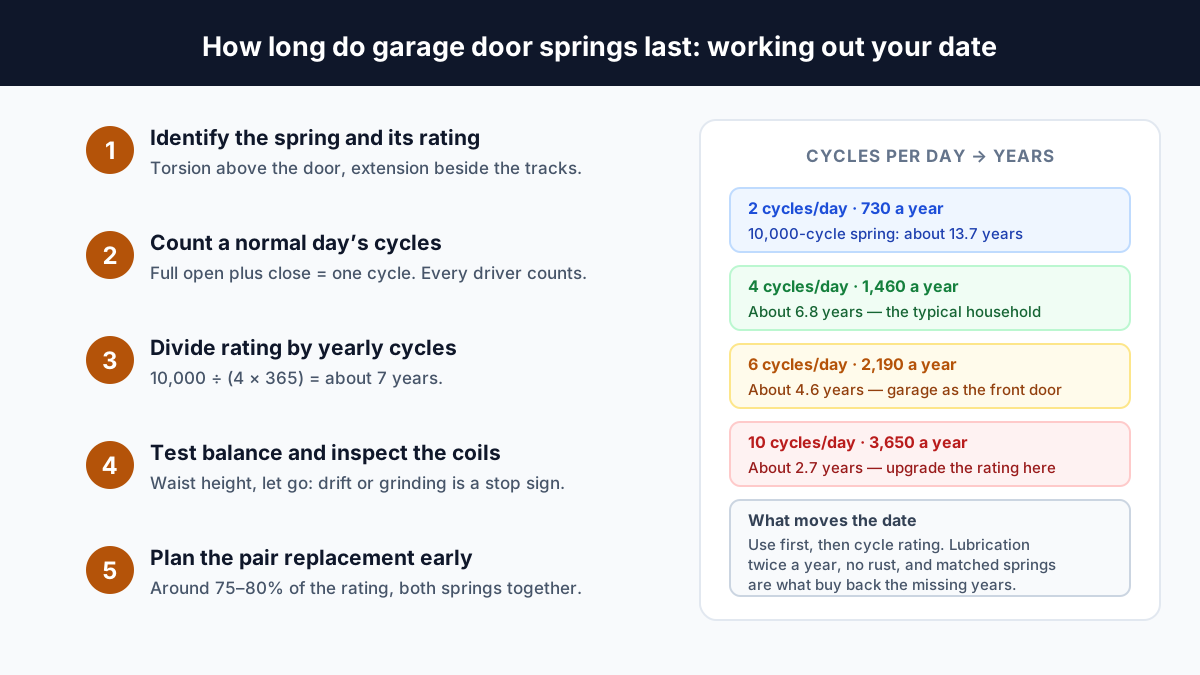
1. Identify the spring type and its cycle rating
Find out what you have before you do any arithmetic. Torsion springs mount horizontally above the door on a steel shaft and twist; extension springs run along the horizontal tracks either side of the door and stretch. Torsion is the modern arrangement and the one that can be specified at a high cycle rating; extension springs are typically the 7,000–10,000-cycle class and are common on older, lighter doors.
Then read the rating, or the data that determines it:
- The painted stripe on the coil body. Under the DASMA colour standard the stripe identifies the wire size (a gold stripe, for example, is 0.207 in wire), and the supplier's wire-size table converts that to a cycle rating.
- The colour on the winding cone end tells you the wind direction — black for right-wound, red for left-wound in the usual chart. It is not the cycle rating; people misread it constantly.
- Measure the wire. Count and measure exactly 10 or 20 coils along the body and divide: 20 coils spanning 2.00 in is 0.1000 in wire. Spring suppliers publish wire gauge to cycle-rating tables, and that is how a technician prices the job.
- The invoice. Most replacement springs are standard 10,000-cycle parts unless the customer asked and paid for more. If the door was built with the house, assume builder-grade 10,000.
One engineering footnote that explains why the rating is not just a marketing tier: springs are wound from oil-tempered carbon steel to ASTM A229 (or chrome-silicon ASTM A401 for high-cycle work), and the stress ratio between the door's load and the wire's strength decides the number of cycles the spring survives. More wire, or better wire, spreading the same load means more cycles. It also means the same size spring is not interchangeable between a light door and a heavy one.
2. Count the cycles your household puts on the door
Pick a normal weekday and add up every complete open-and-close: your commute, your partner's, the school run, the delivery, the bin run, the "did I lock it?" check. Each of those is one cycle if the door went up and came back down. Most US households land between four and six — a figure that surprises people who have never counted, and the single number that changes the answer most.
3. Divide the rating by your yearly cycles
Multiply cycles per day by 365, then divide the spring's rating by the result:
The formula
Years of life = cycle rating ÷ (cycles per day × 365). A 10,000-cycle spring with a four-cycle-a-day household: 10,000 ÷ 1,460 = 6.8 years. The same spring at six cycles a day: 10,000 ÷ 2,190 = 4.6 years. A 25,000-cycle spring in that same busy household: 25,000 ÷ 2,190 = 11.4 years.
Write the year down, because it is a plan rather than a prediction. Real springs do not fail politely on the calculated date: the rating is a design target under good conditions, and lubrication, rust, door weight and installation quality all move it in one direction.
4. Run the balance test and inspect the coils
The cycle count tells you how much life the spring has used. The balance test tells you how it is currently behaving, and the two together are the real answer.
- Close the door fully and release the opener using the red emergency release cord — with the door down, never raised (the manual-open guide covers the procedure and why the order matters).
- Lift the door to about waist height, 3–4 ft, and let go. A properly balanced door stays where you put it and takes about 10 lb of effort to move.
- Read the result. Drifts or sinks down = worn or under-tensioned springs. Rises on its own = over-tensioned. Grinding, squealing or moving one corner first = stop the test and treat the door as out of service.
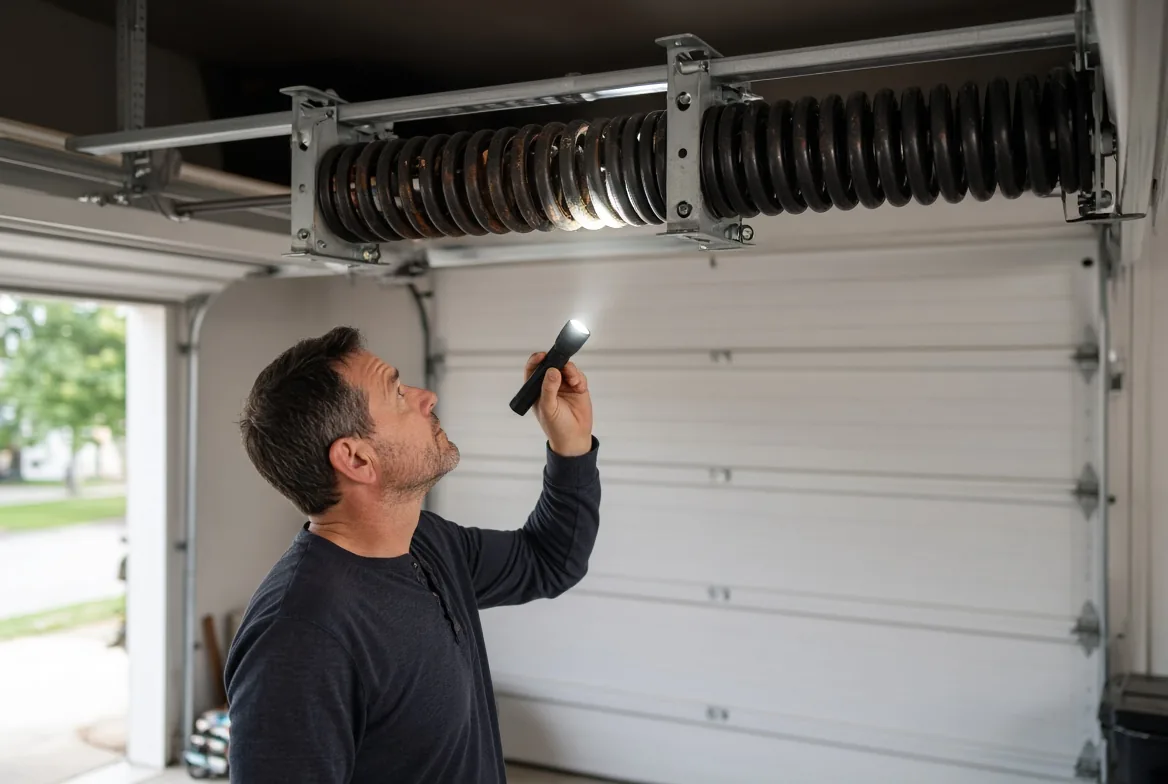
- Look at the coils with the door closed and a flashlight: even spacing, no gap, no deep pitting or flaking rust, no scored or flattened coils, no slippage marks at the winding cones.
Nothing in that test involves touching the spring, the cables or the bottom brackets. That boundary is worth stating plainly: the winding device has a torsional safety factor of 4 and the lifting cables a factor of 5 under ANSI/DASMA 102 §9.3 precisely because both hold the door's stored energy, and DASMA's own guidance is that high-tension spring components are technician work.
5. Plan a pair replacement at 75–80% of the rating
When your arithmetic says the spring is at roughly 75–80% of its rated cycles — about 8,000 cycles on a 10,000-cycle spring, or five or six years for an average household — that is the moment to book the work, and to book both springs. Replacing at the rating means waiting for the bang: the door is then fully unsupported, it happens with a car inside more often than not, and the bill becomes an emergency call-out plus whatever the opener suffers in the meantime.
Finding your real cycle count (your door may already keep it)
You do not always have to estimate: two features of modern openers record cycles, and one of them is a hard odometer. Both are on LiftMaster/Chamberlain hardware, which is the largest installed base in the US.
| Method | What it gives you | Notes |
|---|---|---|
| myQ app → door card → three-dot menu → "myQ diagnostics" | Door cycles, Wi-Fi strength, remote count, sensor status | Wi-Fi LiftMaster/Chamberlain openers (most built after 2017; older units with the Smart Garage Hub). The counter increments only on a completed full cycle, so it matches the DASMA definition |
| Maintenance Alert System LED flash | A service reminder at roughly 4,500 opener cycles | The yellow command and red service LEDs flash alternately. MAS is factory-set OFF and has to be enabled by your dealer — worth switching on at the next service |
| Invoice or installation date | A start date to multiply by your daily usage | The most common method, and perfectly adequate once you have counted your cycles per day |
| Visual inspection alone | Damage, not remaining life | A clean, shiny spring can be exhausted; fatigue happens inside the wire where you cannot see it |
If your opener is not Wi-Fi capable, the myQ Smart Garage Hub adds the same diagnostics to older units for about $30 — a reasonable purchase for exactly this reason, and the same hub that tells you the door was left open. Failing all of that, the estimate from step 2 is good enough to plan with: the difference between 6.8 years and 7.2 is not a decision, and the difference between 6.8 and 4.6 is.
How long should a garage door spring last?
It should last the cycle rating you paid for — and the lever you control is which rating gets installed. Almost every home gets a 10,000-cycle spring because that is what the builder ordered, not because it suits the household. The upgrade is the most cost-effective decision in the whole counterbalance system, because the labour is identical whether the spring on the truck is a standard or a high-cycle part.
| Rating | Upgrade premium | Installed (pair) | Life at 4 cycles/day | Cost per year |
|---|---|---|---|---|
| 10,000 (standard) | — | $250–$400 | 6.8 yrs | $56–$89 |
| 20,000 | +$25–$50 per spring | $310–$480 | 13.7 yrs | $34–$53 |
| 25,000 | +$80–$150 per pair | $395–$550 (a firm's high-cycle price) | 17.1 yrs | $26–$40 |
| 50,000+ (or 30,000 commercial) | +$40–$80 per spring | $370–$560 | 34 yrs | lower still |
The arithmetic is blunt: the upgrade typically costs 20–40% more in materials, is a rounding error against the labour, and takes a busy household past the second failure. If your door cycles more than six times a day — or you plan to stay in the house — a 25,000-cycle spring is the default worth asking for. If you are selling in two years, the standard spring is not wrong.
Two material details decide how well even a high-cycle spring ages. Springs are normally oil-tempered steel, which holds tension consistently and resists fatigue; galvanized wire is chosen for corrosion resistance in coastal or humid environments, and it is the right call there even though it is not the higher-cycle part. Where salt air or a damp garage is the dominant threat, that choice buys more years than a rating bump does.
What shortens spring life (and what does not)
Four things genuinely shorten spring life: use, an undersized spring, corrosion, and dry coils. DASMA's TDS 190 catalogues them, and the list is short enough to act on.
- Use. The dominant factor, and the one in the table above. Nothing you apply to a spring cancels a hundred thousand cycles of fatigue — lubrication slows the rate, it does not reset the odometer.
- An undersized or mismatched spring. Springs work at a stress ratio between the door's load and the wire's strength; push the ratio up and the cycle life drops sharply. A "same size" replacement on a door whose weight was never measured is how a spring ends up failing at half its rating.
- Rust and pitting. DASMA is explicit that rust "reduces the effective area of spring wire, which in turn reduces its overall strength" and that corrosion pits are where "fatigue cracks can accelerate and reduce cycle life." Coastal air, a humid garage, and a door that is never lubricated all feed it. If your springs already show corrosion, the rust guide covers stopping it, but pitting on the spring wire itself is a replacement question, not a cleaning one.
- Dry coils. An unlubricated spring grinds against itself at every coil-to-coil contact as it winds and unwinds, wearing away the protective film and running hotter and harder. Two applications of a garage-door lubricant a year is the whole fix, and using a solvent-based spray like WD-40 instead actively strips the lubrication that is there.
Two things that are usually blamed and mostly are not: cold weather alone (it reveals fatigue, it does not create it — but a frozen door with a manual lock still engaged is a real cause of damage), and noise by itself. DASMA's safety material notes that squeaky springs are caused by normal use and do not necessarily indicate a problem; noise becomes a signal when it arrives with a change in how the door moves.
Wear signs that show up before the break
The warning signs are behavioural, not visual: a door that has quietly got heavier to lift, drifts instead of holding position, or sounds different is telling you the spring has less stored energy than it should. Roughly the last few weeks of a spring's life are the period when most homeowners actually notice something.
- Heavy or reluctant lifting. The opener strains, or the door takes real effort by hand; the spring is no longer carrying the door's weight. Never answer this by raising the opener's force setting — that spends the margin the safety reverse needs and does not fix the counterbalance.
- Lost balance. The door will not stay at waist height, sinks on its own, or slams down faster than it used to.
- New noise. Persistent squeaks, groans, creaks or grinding at the coils. Lubricate first; if the noise stays on an older spring, have it assessed.
- Coil condition. Surface rust on an intact, evenly wound coil is a monitoring item; deep flaking rust, scoring, flattened or deformed coils, or any movement at the winding cone is not.
- An expired cycle budget. The one sign you cannot see. A spring that looks perfect and is at 9,500 of its 10,000 cycles is the one that fails next month — which is exactly why the arithmetic in step 3 exists.
A practical rhythm that catches all of this in time: look at the coils every three months, run the balance test twice a year, calculate your cycle budget once a year once the springs pass five years old, and have the door professionally serviced annually — the annual tune-up checklist is the sequence to follow.
⚠ A gap, a bang or a door that will not stay up is not a lifespan question
A visible 1–3 in gap in a torsion coil, a gunshot-like bang from the garage, or a door that lifts a few inches and stops all mean the spring has already failed — and the full weight of the door is now on the opener. Stop cycling it, leave it closed, and treat it as a repair. The broken spring guide covers the failure signs, the cost and the safety rules; if the door is stuck tonight, emergency repair covers your options.
Replace in pairs, and replace them before the bang
On a two-spring door you replace both, because the survivor has done the same work as the spring that just died. That is not an upsell: it is DASMA's own consumer advice — replacing the pair "will not only prevent any damage caused by the breaking of the second spring, but also keep your door working efficiently" — and every spring supplier says the same thing, because the unbroken spring is typically only months behind and the door is left running unbalanced in the meantime.
The proactive-versus-reactive trade is worth stating in numbers. Waiting costs nothing today and typically saves the small premium of a scheduled visit, but it converts a planned $250–$400 job into an emergency call-out (after-hours work commonly runs $150–$500 on top of the repair), it strands the car that is inside, and it hands the full door weight to the opener — which is how opener gears, travel modules and logic boards get destroyed. DASMA's straightforward answer to the "should I replace them before they break?" question is that replacing the partner spring early prevents damage and keeps the door efficient; the forums full of homeowners who waited say the same thing in plainer language: springs never break on a good day.
So the plan is: replace at 75–80% of the rating, in matched pairs, and choose the rating deliberately at the same time. The visit itself is short — most spring jobs are done in well under an hour — and it is also the right moment to ask about cables, rollers and bearings, since the technician is already on the ladder.
Spring maintenance that actually adds years
Lubricate the coils every six to twelve months with a garage-door-rated lubricant, keep the door in balance, and leave the spring hardware to a technician. That is the whole homeowner-side programme, and it is the same maintenance that keeps the rest of the door quiet.
- Lubricate the spring coils with the door closed, applying the lubricant along the length of the coil. Manufacturers recommend roughly annually; a twice-a-year routine (spring and autumn) is the version that actually happens. Use a purpose-made garage door lubricant or lithium-based product — not WD-40 or a solvent degreaser, which strips the protective oil.
- Keep the door balanced. An unbalanced door loads the springs continuously, not just when it moves. The waist-height release test takes a minute.
- Keep rust off the hardware. A dry, ventilated garage and lubrication at the coil ends (where corrosion usually starts) are the cheap countermeasures; the rust guide covers what to do when it has already started.
- Do not "adjust" the tension yourself. Spring adjustment — winding or unwinding a torsion spring, moving an extension spring's hook — is the single most dangerous job in the system and is technician work in every standard and every manufacturer's manual. What a homeowner can safely do is report the symptom accurately: heavy, drifting, uneven, noisy.
- Have the door serviced annually so that travel limits, force settings, rollers, hinges, cables and the safety reverse are all checked on a schedule rather than a symptom.
- Fit and check containment. If you have extension springs, confirm a safety cable runs through each spring and is anchored at both ends — DASMA's advice is to call a dealer for an inspection if it is missing, and California's code has required containment on residential extension springs for decades.
2025–2026 costs: replacement and the upgrade
A single residential spring replacement runs $150–$350, with national averages near $250, and the high-cycle upgrade adds roughly $25–$80 per spring. Costs vary with region, door size, spring type and urgency; the full replacement-cost breakdown by spring type, door type and door count lives on the broken spring page, so what follows is the lifespan-relevant slice.
| Item | Cost | Notes |
|---|---|---|
| Single-door spring replacement (whole job) | $150–$350, avg ~$250 | Both torsion springs are commonly quoted inside this band; wider coastal/metro quotes reach $500 |
| Both torsion springs, wider range | $250–$750 | Double doors, torsion-bar replacement and after-hours work push the top end |
| Torsion springs + torsion bar | $200–$400 | The complete counterbalance assembly, not just the springs |
| Both extension springs | $120–$200 | Cheaper parts, lower ratings — and always with containment cables |
| Spring parts only | $75–$150 torsion / $50–$100 extension | Supplier pricing: a pair of standard torsion springs runs about $88.59, a single spring about $48 |
| High-cycle upgrade premium | +$25–$50 per spring (to 20,000); +$40–$80 per spring (to 30,000); $80–$150 per pair to 25,000 | Labour is identical, which is why this is the best-value line on the page |
| Extension → torsion conversion | $400–$800 | Roughly five times a straight replacement; worth it on a heavy or frequently used door |
| Repair visit / diagnostic fee | $50–$75, labour $75–$150/hr | After-hours or weekend call-outs $150–$500 |
| Garage-door lubricant | ~$10–$15 a can | Two applications a year is the cheapest lifespan extension available |
Seen per year of life instead of per visit, a 10,000-cycle pair at $250–$400 costs $56–$89 a year for an average household, while a 25,000-cycle pair lands around $26–$40 — and it is the same technician, on the same afternoon, with a different part on the truck. That is the entire case for asking about the cycle rating when you book the job.
Springs that are close to their cycle rating?
If your arithmetic puts the springs near 8,000 cycles — or the door has started to feel heavy, drift at waist height, or squeal at the coils — get them assessed before they choose their own moment. A technician can measure the door weight, confirm the wire size and cycle rating you actually have, replace both springs in matched pairs, and set up the high-cycle option if your household earns it.
Request ServiceWhen to call a professional
Counting cycles, testing balance, lubricating coils and recognising a heavy door are all homeowner work. Everything that involves the spring's stored energy is not, and the line between the two is easy to hold:
- The door has failed a balance test — it drifts, sinks, slams or will not hold position at waist height.
- You can see a gap in a torsion coil, a stretched or dangling extension spring, or a cable that is slack, kinked or off the drum. Stop using the door.
- The coils are deeply rusted, pitted, scored or deformed, or the winding cones show slippage. Rust on a loaded spring is a strength question, not a cosmetic one.
- Your cycle arithmetic says the springs are near their rating — the whole point of doing it is to book the work calmly.
- The door is noisy, uneven or slow, and lubrication did not change it. Several faults present the same way, and a technician can separate them in one visit.
- Anyone has already tried to adjust the springs, or the opener has been asked to lift a door it was never meant to carry. Both warrant an inspection.
Finally, the scope of this page in one line: everything here is about when a spring runs out, not about diagnosing a break. A working spring can be exhausted and a broken spring can look alarming — the difference in what you do next is the difference between booking a service and stopping the door today.
Frequently asked questions
How long do garage door springs last?
Most residential springs are rated for about 10,000 cycles, where one cycle is one full open-and-close of the door. At the US average of four cycles a day that is roughly 7 years; at six cycles a day about 4.6 years, and at two cycles a day nearly 14 years. Extension springs are usually rated lower, 7,000 to 10,000 cycles, while high-cycle torsion springs run 25,000 to 50,000 cycles or more. Cycle rating plus your daily usage gives the answer - the calendar alone does not.
How long should a garage door spring last with daily use?
Daily use is the whole equation. A 10,000-cycle spring lasts about 13.7 years at two cycles a day, 6.8 years at four, 4.6 years at six and 2.7 years at ten. A busy household that treats the garage as the front door is the case where the standard builder-grade spring fails in four to five years and a 25,000-cycle spring is the better buy.
How many years is 10,000 cycles?
It depends entirely on your daily use: 10,000 cycles is about 13.7 years at two cycles a day, 6.8 years at four, 4.6 years at six, and 2.7 years at ten. Ten thousand cycles is about seven years for a typical household, which is why 'seven years' appears in almost every spring lifespan answer - it is an average, not a rating.
Do torsion springs last longer than extension springs?
Yes. A standard torsion spring is rated around 10,000 cycles and can be specified at 25,000 to 100,000, while residential extension springs typically carry 7,000 to 10,000-cycle ratings. Torsion systems also run smoother and handle heavier doors, and they avoid the stretched, exposed springs that need containment cables. Extension springs are still the legacy arrangement on many older and lighter doors, and every one of them should have a safety cable through the middle of the spring.
How do I know how many cycles my garage door springs have done?
Three ways. Wi-Fi LiftMaster and Chamberlain openers report door cycles in the myQ app's diagnostics screen (door card, three-dot menu, myQ diagnostics), and the counter only increments on a completed full cycle. Openers with the Maintenance Alert System flash their yellow command and red service LEDs alternately at about 4,500 opener cycles. Otherwise use the install or replacement date on an invoice and multiply your cycles per day by the years since. A visual inspection cannot give you this number - cycle fatigue does not show on the outside of the wire.
Should I replace both garage door springs if only one broke?
Yes. On a two-spring door the unbroken spring has done the same number of cycles as the one that failed, so it is usually months behind, and replacing only one leaves the door running on mismatched springs. DASMA's advice is to replace the pair: it prevents the damage the second failure would cause and keeps the door working efficiently.
How much does garage door spring replacement cost in 2025-2026?
A single residential job runs about $150-$350, with national averages near $250; replacing both torsion springs usually lands between $250 and $750 depending on door size, region and urgency. Parts alone are roughly $75-$150 for a torsion spring and $50-$100 for an extension spring. Upgrading from a 10,000-cycle to a 25,000-cycle spring adds about $25-$80 per spring because the labour is identical, which is why the upgrade usually pays for itself before the second failure.
A note on scope
This is general homeowner guidance, not a substitute for a technician's on-site assessment. Lifespan figures are computed from published cycle ratings and typical residential use; real springs vary with door weight, sizing, lubrication, corrosion and installation quality, and no standard — UL 325, 16 CFR part 1211 or ANSI/DASMA 102 — sets a scheduled replacement interval for springs. Costs are national-average 2025–2026 ranges and vary with region, door size and access. Torsion and extension springs, lift cables and bottom brackets are under extreme tension and are professional work only: inspect with the door closed, never adjust the hardware, and treat a visible gap, a bang, a heavy door or a failed balance test as a reason to stop using the door.