The short version
- Not every stuck door is an emergency. A door stuck wide open, off-track, hanging crooked, or a car trapped inside with a snapped spring or cable are true emergencies. A noisy door, a bad sensor, or a dead remote can wait for next-day service.
- Do these four things first — safely. Clear the area, unplug the opener, use the emergency release cord only if the door is fully closed, and never touch a spring or cable yourself.
- Expect to pay more after hours. A standard repair averages $155-$379, but after-hours emergency labor adds $150-$450 on top of the visit — springs, cables, and openers each have their own cost range below.
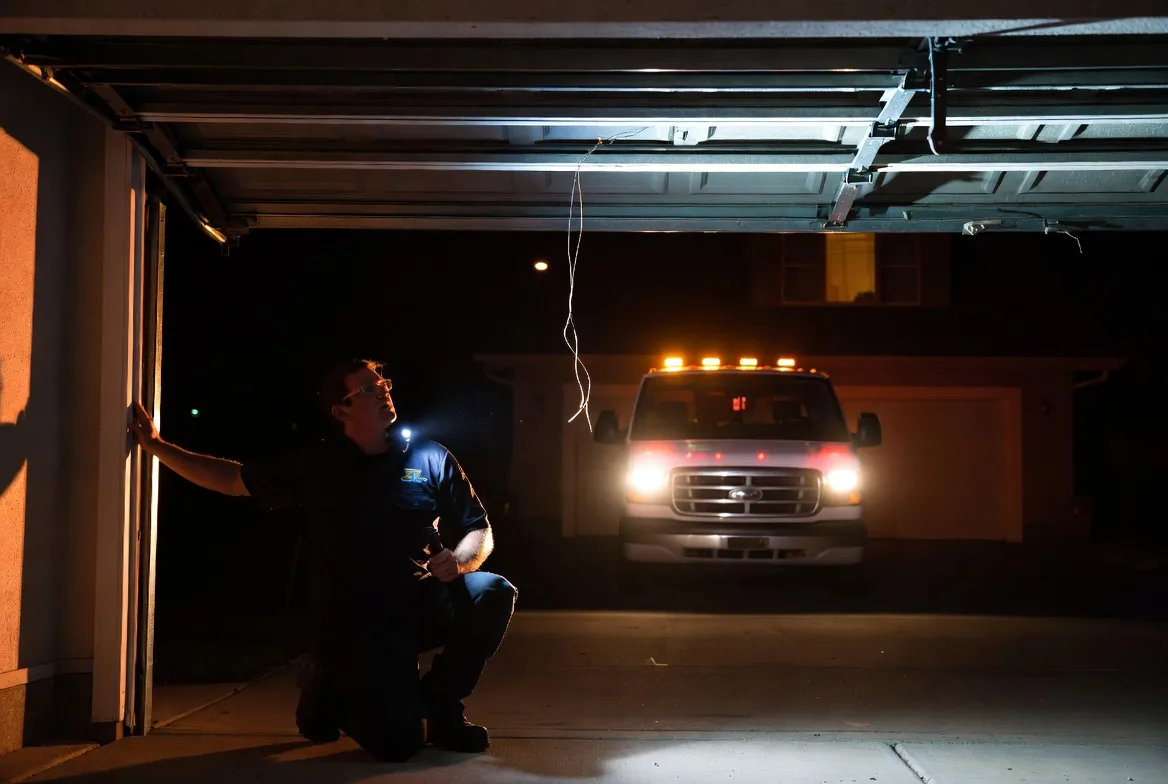
An emergency garage door repair is any garage door failure that leaves your home insecure, a car trapped, or the door itself unstable and dangerous to be near. It's the single most-searched garage door repair term for a reason — when it happens, it usually happens at the worst possible time. Here's how to tell a real emergency from something that can wait, exactly what to do in the first 15 minutes, and what emergency garage door repair actually costs in 2025-2026.
Is it really an emergency garage door repair?
A true garage door emergency threatens your safety, security, or ability to use your car — and it needs same-day attention. Everything else can typically wait for a scheduled next-day visit at standard rates.
True emergencies (call today)
- Door stuck wide openA security risk — it exposes the home to intruders, weather, and pests. If you can't manually close and secure it, call for emergency service.
- Off-track, crooked, or hangingA crush risk. A standard door weighs 200-400 lbs; if rollers have popped out of the track and it falls, it can cause severe injury or property damage.
- Snapped spring or cableOften announced by a loud bang. The torsion spring and lift cables carry the door's full weight — running the opener anyway can burn out the motor or drop the door.
- Car trapped, opener deadIf the door is too heavy to lift by hand (usually a broken spring) and a vehicle is stuck inside, that's an access-failure emergency.
Can wait for next-day service
- Noisy operationSqueaking or grinding usually means worn rollers or dry hinges — not urgent if the door still moves smoothly.
- Sensor misalignmentIf the door won't close but is otherwise stable on its tracks, it's usually a simple photo-eye issue.
- Cosmetic damageSmall dents or scuffs that don't affect the track or rollers.
- Remote or keypad failureIf the wall button still operates the door normally, a dead remote isn't an emergency.
The first 15 minutes: a safety checklist
⚠ Do not walk under the door
A broken torsion spring or snapped cable leaves up to 400 lbs of dead weight completely unsupported and unpredictable.
1. Assess the danger and clear the area
- Do this firstImmediately move children, pets, and vehicles away from the door before doing anything else.
2. Disconnect opener power
- WhyUnplug the automatic opener motor from its ceiling outlet so nobody accidentally triggers it via a wall switch or remote — that can strip the gears or buckle the door.
3. Use the emergency release — only if the door is fully closed
- HowPull the red emergency release cord to detach the door from the carriage so it can be lifted manually if safe.
- Critical warningNever pull this cord if the door is stuck open or halfway up — it could slam shut instantly.
4. Secure the door and call a professional
- What not to doDon't force an off-track or stuck door closed, and don't touch the springs or lift cables under any circumstances.
- What to doLeave the area and call an emergency garage door repair company.
Need emergency service now?
A technician can be dispatched same-day to diagnose and repair the door safely.
Request Service2025-2026 emergency garage door repair costs
Costs vary by part, door weight, and whether it's an after-hours call. National averages from Angi and HomeAdvisor for 2025-2026:
| Service / part | Cost range | Notes |
|---|---|---|
| Average general repair | $155-$379 | Average repair sits around $265 |
| Emergency / after-hours labor call fee | $150-$450 | On top of standard $75-$150/hr labor |
| Spring replacement | $180-$350 | Can reach up to $600 depending on spring weight/cycles |
| Cable repair | $100-$400 | Heavier solid-wood doors need thicker, pricier cables |
| Opener repair / replacement | $100-$800 | Gear/sensor fixes run $100-$500; full motor swap $300-$800 |
| Track & panel repair | $5-$1,000 | Basic brackets from $5; custom panels $250-$1,000 |
| Full door replacement | $800-$2,500+ | National average is $1,223; custom carriage doors can exceed $10,000 |
Standard (non-emergency) service calls run a $50-$75 flat fee plus $75-$150/hr labor. Emergency, weekend, or after-hours calls add the $150-$450 premium on top.
What drives emergency pricing up
- TimingWeekends, holidays, or calls between 8 PM-6 AM guarantee a flat emergency dispatch premium.
- Door weight and materialCustom multi-panel, solid wood, or smart-enabled doors need specialized hardware that costs more and takes longer to calibrate.
- Tension handlingSpring replacement isn't just a parts swap — technicians charge for the physical risk and precise tension calibration needed to balance the door.
- Inventory carrying costsPulling a rare spring size from truck stock instead of ordering from a supplier adds cost that gets passed to the customer.
Safety codes & injury statistics
Garage doors cause roughly 30,000 injuries a year in the US, per Consumer Product Safety Commission (CPSC) estimates — about 7,500 pinching injuries and 2,000 severe crushing injuries. The primary safety standard is UL 325: since January 2016 it has required all entrapment points on automated residential and commercial doors to have two monitored safety entrapment devices, such as photo-eye sensors and a physical sensing edge, and compliance is mandated by the International Building Code. In historical CPSC testing, older safety reversing systems failed to work as intended 40% of the time — a reason to test your own sensors and auto-reverse regularly rather than assume they work.
How to vet a company and avoid scams
⚠ Bait-and-switch is common in emergency repair
The Better Business Bureau reports home-improvement scams cost victims an average of $1,800 — but garage door bait-and-switch scams specifically can run homeowners over $8,000.
Red flags: an unrealistically low advertised price (like a $29 "service call") that balloons once the technician has already dismantled your door; a phone greeting of "Garage Door Service" instead of the specific business name you called, which suggests an offshore lead-generation farm; no verifiable physical address (check it on Street View); and unmarked trucks or demands for full cash payment upfront.
To vet a company: verify state registration and licensing, confirm insurance, get a written itemized estimate before work starts, and look for membership in a recognized trade group like the International Door Association (IDA).
Frequently asked questions
Is a broken garage door spring considered an emergency?
Yes. A broken spring leaves the entire 200-400 lb weight of the door unsupported. Operating the door with a broken spring can burn out the opener motor or cause the door to crash down violently.
Can I manually open my garage door with a broken spring?
It's highly discouraged. Without the spring's counterbalance you're lifting the door's full dead weight, which can cause severe back injury or let the door fall back down on you if you lose your grip.
How much does an emergency after-hours fee usually cost?
Most reputable companies charge their standard service call fee ($50-$75) plus a premium hourly labor rate for after-hours calls, typically $150-$450 depending on the time of night or whether it's a holiday.
Can I replace a snapped garage door cable myself?
No. Garage door cables and springs operate under extreme tension — a slip can cause the hardware to snap back with enough force to cause lacerations, blunt force trauma, or fatal injuries. This is a licensed-professional-only repair.
Why did my garage door randomly get stuck halfway?
Usually a broken torsion spring, a snapped lift cable, or a roller that jumped out of the track. Because the door is bearing weight unevenly, don't stand under it — call a technician.
Will my homeowners insurance cover an emergency garage door repair?
Generally, homeowners insurance doesn't cover wear-and-tear breakdowns like a rusted spring snapping. If the door was damaged by a covered peril — a severe storm, vandalism, or a vehicle crashing into it — the policy may cover repair costs minus the deductible.
How do I know if a garage door repair company is legitimate?
Verify state registration/licensing, insurance, a real physical business address, and membership in a trade group like the International Door Association (IDA). Get a written, itemized estimate before work starts and be wary of unrealistically low advertised prices.
A note on safety
This is general homeowner guidance, not a substitute for a technician's on-site inspection. Cost figures are national-average ranges for 2025-2026 and vary by region, door size, and time of service. Never touch a garage door spring or lift cable yourself — they store enough energy to cause serious injury.