The short version
- Press the rust with your finger. Solid metal = surface rust, fixable. Metal that flexes or is soft = pitting. Metal you can push through, or light through the hole = rust-through, replace the section.
- Surface rust is a $50–$150 DIY job — sand, rust converter, rust-inhibiting primer, exterior paint. A professional spot repair is $200–$400 and a full repaint averages about $350.
- Never paint over rust. It keeps spreading under the paint. That is why touch-ups fail.
- The bottom panel rusts first from road salt, splash, standing water, a failed bottom seal, chipped paint and sprinkler overspray — so that is where prevention pays.
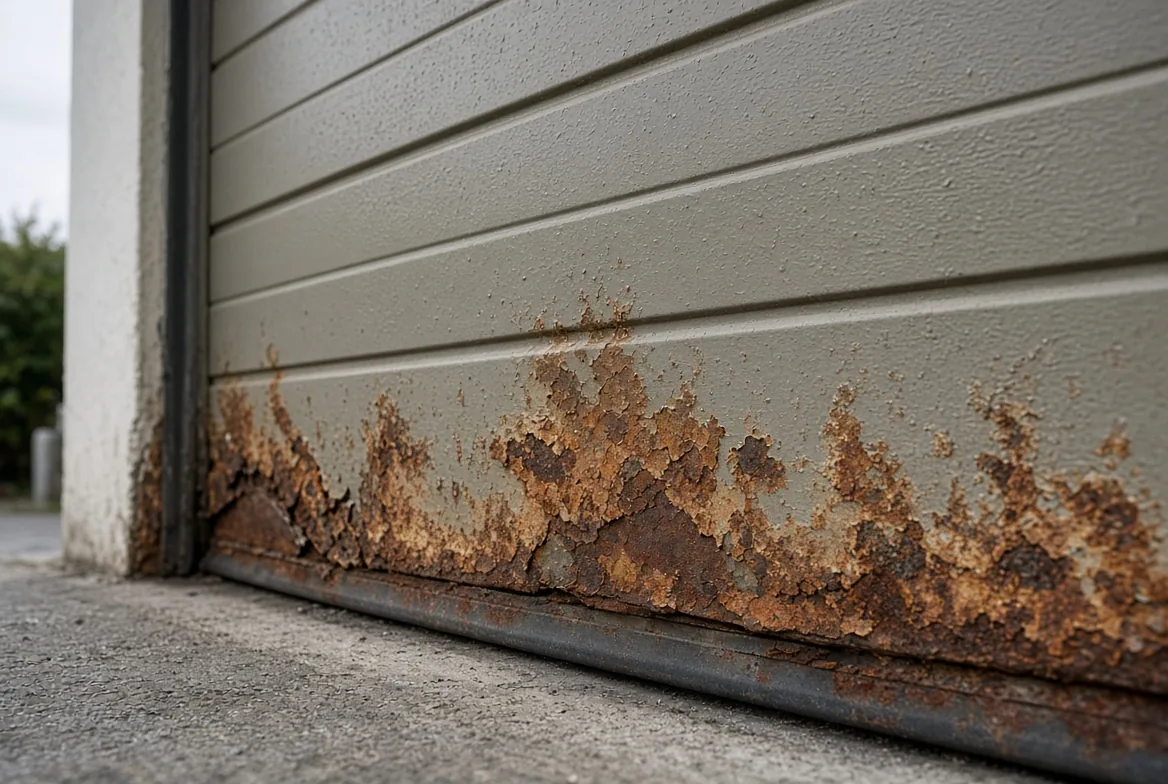
Garage door rust is iron oxide forming wherever moisture and oxygen reach bare steel, and on a painted sectional door it starts under a chip, a scratch or a worn bottom seal and then creeps sideways underneath the surrounding paint rather than stopping at the visible edge. That is what makes it deceptive: the orange spot you can see is usually smaller than the area that has already let go. It also means the fix is never just paint — it is removal, treatment, then paint. This guide covers how to tell surface rust from rust-through, the full removal and repaint process, what a garage door rust repair costs in 2025–2026, and how to stop it coming back.
Why garage doors rust — and why the bottom goes first
Rust needs three things: iron, oxygen and moisture. A garage supplies all three constantly, and the bottom of the door supplies them best.
The lowest panel sits closest to the ground, where driveway splash, standing water, snowmelt and road spray all collect and then linger. It is also the panel most often scratched by grit, bikes and mowers, and the panel most likely to have a bottom seal that has gone hard, cracked or fallen away. Salt makes all of it worse: road salt tracked in on winter tyres reaches the lower panels directly, and in coastal air, salt is hygroscopic — it pulls moisture onto the steel and keeps it there, so coastal doors corrode far faster than inland ones. Industry guidance puts the high-risk zone at the bottom 12–18 inches of the door.
The causes, ranked roughly the way technicians see them:
| Cause | What you see | What fixes it |
|---|---|---|
| Road salt spray | Orange-brown streaks rising from the bottom edge, worst after winter | Rinse the door after storms; treat and repaint; keep the finish intact |
| Salt air (coastal) | Fine orange speckling that spreads fast across the lower panel | Fresh-water rinses, early treatment, or an aluminium / composite door |
| Standing water & splash | Rust along the very bottom edge where the door meets a low spot | Improve drainage so the door closes onto a dry threshold |
| Failed bottom seal (astragal) | Rust just above the bottom edge, with a cracked or flat rubber seal | Replace the bottom seal — it is cheap and it is the best prevention there is |
| Chipped or scratched paint | A rust spot that starts exactly at the chip | Touch up with factory-colour paint within days, not seasons |
| Sprinkler overspray | Rust on one side or one band of the door, not evenly across the bottom | Redirect the head, rinse the minerals off, then treat |
| Condensation & humidity | Even, general surface bloom, often with a damp garage floor | Ventilate; let snow and ice melt off vehicles outside |
| Galvanic corrosion at hardware | Rust clustered around the bottom brackets and their screws | Clean, dry, prime around the bracket; check the bracket itself is sound |
Two spots people forget
The inside face of the bottom section. Rust can start inside the door and penetrate outward, and the interior never gets washed. Wipe the lower inside panel down once a year to clear concrete dust and salt residue.
Under the bottom seal. The aluminium U-channel holding the rubber seal does not rust, but the steel screws and the door edge above it do. With the door closed, gently lift the rubber and look at the metal underneath.
Surface rust vs. rust-through: the 30-second test
Press the rusted spot with a finger. If the metal resists solidly, you have surface rust and it is repairable. If it flexes or feels thin, the steel is pitting. If you can push through it, or see light through the metal, the section has lost its structural integrity and needs replacing.
| Stage | What it looks like | Metal condition | The fix |
|---|---|---|---|
| Surface rust | Orange-brown speckling, slight roughness, paint starting to bubble | Intact and sound | Sand, convert, prime, repaint — DIY |
| Pitting / flaking rust | Rust flakes off when touched, shallow craters in the steel, roughly 10–30% of the door | Thinning; pits hold moisture | Wire-brush, converter, body filler in the pits, primer, paint |
| Rust-through | Holes, soft or flexing metal, light visible through the section, soft under a fingernail | Section has lost structural integrity | Panel replacement or full door replacement |
Two texture checks worth doing by hand while you are down there: run a fingertip across the suspect area — if it feels rough or gritty rather than smooth, the topcoat has already lifted — and check whether the paint around the visible spot is bulging. A bulge means the rust has travelled further than the orange area suggests.
Garage door rust removal, step by step
Surface and lightly pitted rust is a real DIY job. Budget a full day so the weather cooperates: work above 50 °F (10 °C) with no rain forecast for 24 hours, because rust converter and paint will not cure properly in the cold or the wet.
What you need: a wire brush or a wire wheel for a drill, 80- and 120-grit sandpaper, a phosphoric-acid rust converter, rust-inhibiting metal primer, exterior-grade paint matched to the door, and — if the metal is pitted — an automotive body filler. Add gloves and eye protection; rust fragments are sharp.
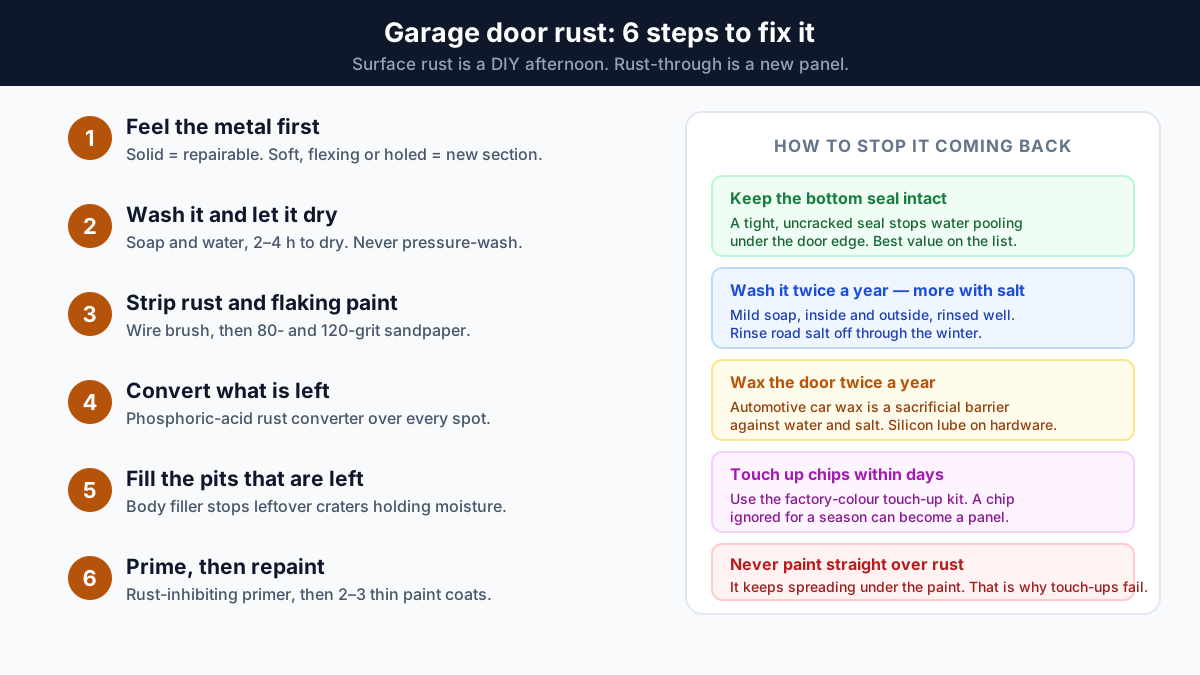
1. Test the stage before you buy anything
Finger pressure, as above. If the metal is soft or perforated, stop here — you are buying a section, not a can of paint. Skip to repair or replace.
2. Wash the whole door and let it dry completely
Mild car-wash or dish soap and water, a soft brush, then a thorough rinse. This removes the salt and grit that would otherwise get sanded into the finish. Let it dry two to four hours in good weather. Do not pressure-wash a garage door to prepare it — manufacturers specifically advise against it because it drives water into seams and seals.
3. Remove the loose rust and flaking paint
Wire brush, or a wire wheel on a drill, worked in small circles over the affected area until you reach solid metal or rust that is tightly bonded. You do not need to reach shiny bare metal across the whole panel — you need every bit of loose, flaking material gone. Finish with 80-grit, then 120-grit, feathering the edges where old paint meets bare metal so the repair does not show as a ridge.
4. Apply a rust converter to what is left
Some rust will always remain in the texture of the steel. A phosphoric-acid-based rust converter (the class that includes Rust-Oleum Rust Reformer) chemically converts that remaining oxide into a stable black compound instead of leaving it to keep spreading. Brush it over every rusted spot, let it cure completely, then sand smooth with 120-grit and finish with 220-grit.
5. Fill pits and pinholes
Rust pits are craters, and craters hold moisture. Left open under paint, they re-rust quickly. Fill them with a metal or automotive body filler, let it harden, and sand flush with the surrounding surface.
6. Prime, then repaint
Two thin coats of rust-inhibiting metal primer over all bare metal, extended slightly onto the sound paint around the repair, drying between coats. Then two to three thin coats of exterior-grade paint. If the door's finish has faded in the sun, paint the whole door rather than the patch — a fresh spot on a faded door reads as a patch from the street.
How to paint a rusted garage door so it stays fixed
The step people get wrong is treating paint as the repair. Paint is the barrier that keeps moisture out — it only works once the rust underneath is gone and converted.
| Product | Typical price | Best for |
|---|---|---|
| Oil-based exterior paint | $30–$60 per gallon | Metal and high-wear surfaces; adheres well and is durable |
| Acrylic latex exterior paint | $25–$55 per gallon | Metal and wood; resists cracking, the usual recommendation for a door |
| Latex exterior paint | $20–$50 per gallon | Wood; the budget option |
| Rust-inhibiting metal primer | ~$10–$30 per quart | All bare metal before topcoat — the step that makes the repair last |
| Automotive car wax (finish protection) | ~$10–$25 | A sacrificial barrier against water and salt; reapply twice a year |
⚠ Stay off the springs and cables
Torsion springs, lift cables and the bottom corner brackets are under extreme tension and can cause serious injury. Rust work is limited to the door skin. If the rust has reached the frame, the bottom brackets, the hinges or the track — or if the door binds, sags, or hangs crooked — stop and call a professional. Read our note on garage door panel replacement before deciding to swap a section yourself.
Two shortcuts that are not shortcuts. Vinegar, and vinegar with baking soda, will dissolve light surface rust, and they are a reasonable way to lift a light bloom before you treat and paint — but they leave the metal wet and they do not replace the converter, primer and paint. And WD-40 is not a rust coating: it displaces moisture short-term, but it is a cleaner, not a protective finish, and it is not the right lubricant for hinges and rollers either.
Garage door rust repair cost in 2025–2026
DIY rust treatment runs $50 to $150 in supplies. A professional spot repair — prep, conversion, priming and painting on moderate rust — runs $200 to $400, and a full professional repaint averages around $350, with a normal range of $200 to $500.
| Job | Typical cost | What it covers |
|---|---|---|
| DIY rust treatment | $50–$150 | Sandpaper, rust converter, primer, paint (materials only) |
| Professional spot rust treatment | $200–$400 | Prep, rust conversion, priming and paint on one area |
| Full professional repaint | $350 average ($200–$500) | Whole-door prep and repaint, $1–$4 per sq ft |
| Repaint by garage size | $100–$250 single · $200–$500 double · $300–$750 triple | Varies with door area and prep |
| Itemised professional rust work | Inspection $75–$250 · removal + primer $150–$650 · coating $100–$700 · labour $150–$1,000 | Typical line items on a detailed quote |
| One replacement section | $250–$900 installed | New panel, colour match and installation once metal has rusted through |
| Full door replacement | $800–$2,500+ | Multiple rusted-through sections; basic insulated steel from ~$1,400 installed |
Labor is $25–$100 per hour for the painting work, and a door takes roughly two to eight hours depending on condition and size. Materials for a repaint run $65–$155. The reason a pro repaint costs what it does is almost entirely prep: rust removal is slow, and it is the part that decides whether the job lasts.
Repair or replace? The 30% and 50% rules
Two simple thresholds decide it. If the rust is surface-level, with no holes, on a door under about 15 years old, and it covers less than 30% of the door, repair it. If the rust has eaten through the metal, several panels are affected, the door sags or binds, or the repair quote exceeds 50% of the price of a new door, replace it.
The cost-ratio rule is the one that surprises people. A worked example from published repair-vs-replace data: a rusted bottom panel on a 22-year-old door — $350 to repair against $1,300 to replace. The verdict there is replace, not because the repair would not work, but because age plus rust means the next panel is not far behind, and a new door resets 20-plus years of finish and hardware.
If you do land on replacing a single section, the practical limits are colour matching and availability — a factory-fresh panel will not match sun-faded neighbours, and manufacturers periodically redesign the interlocking edge profiles, which is why doors over about 8–10 years old get difficult. Our panel replacement cost and process guide covers the 40% rule, finding your model number, and current lead times.
Rust that's reached the brackets, hinges or track?
Once corrosion gets into the hardware it becomes a safety issue, not a cosmetic one. A technician can assess the panel, the counterbalance system and the finish together and tell you honestly whether treatment or replacement is the better spend.
Request ServiceHow to stop garage door rust coming back
Prevention is almost all at the bottom of the door, and it is cheap. In priority order:
- Keep the bottom seal intact. A tight, uncracked bottom seal stops water pooling under the door edge. Replace it at the first sign of cracking or flat spots — before rust starts, not after. It is the single best-value rust measure on the list.
- Wash the door twice a year, more with salt. Mild soap and water, inside and outside, rinsed thoroughly. No harsh or abrasive detergent and no pressure washer. In salt regions, rinse road salt off through winter as needed.
- Touch up chips within days. Many door makers sell factory-colour touch-up kits for their standard finishes; a chip you touch up this month is free, and the same chip ignored for a season can become a panel.
- Wax the door. A thin coat of automotive car wax is a sacrificial barrier against water and salt. Manufacturers recommend applying it when the door is new, and the general advice is to reapply twice a year.
- Lubricate with silicone or Teflon, not oil. Silicone or lithium-based door lubricant on hinges, rollers and tracks, then cycle the door to spread it. Oil-based lubricant and grease attract grit; manufacturers advise against both.
- Fix the water, not just the metal. Get drainage away from the door so it closes onto a dry threshold, and redirect sprinkler heads that hit the door. Gutters and a drip cap above the door divert roof water.
- Ventilate and park dry. Reduce humidity build-up, let snow and ice melt off vehicles outside, and clear standing water off the floor near the door.
A seasonal rhythm makes this easy: wash off winter salt and touch up chips in spring, wax in summer, clear drainage and touch up again in autumn, and keep water off the floor in front of the door through winter. It all folds naturally into an annual garage door tune-up, which is also when a technician will spot corrosion you have not noticed yet.
If you are replacing rather than repairing — or you live somewhere salt fog is a fact of life — the rust-resistant options are aluminium, fibreglass, vinyl and composite, none of which rust. Galvanised steel is the corrosion-resistant steel choice: sections are roll-formed to ASTM A653 from hot-dipped galvanised coil, then finished with a urethane primer and a baked-on polyester topcoat, which is what the rust-through warranties are actually written against.
Does the warranty cover rust?
Usually not for what you have. Steel door makers commonly warrant against rust-through — corrosion that starts at the steel layer and perforates the section — for ten years, or for life on premium collections and specific finishes. What those warranties normally exclude is exactly the thing most homeowners are looking at: surface rust and anything that grew out of it, along with high-salt and coastal exposures.
So the section warranty is not your repair budget. It is worth reading anyway, because it tells you what the manufacturer expects the finish to survive — and if you can see light through a section that is inside its rust-through term, that is a conversation worth having with the dealer before you pay for a panel.
Frequently asked questions
Can a rusty garage door be repaired?
Yes, if the rust is surface-level. Sand it back, treat it with a rust converter, prime and repaint, and the panel is fine. Once rust has pitted through the metal, the panel is structurally compromised and the section has to be replaced — at that point more than 30% of the door being affected makes a new panel or door the cheaper route.
Can I just paint over garage door rust?
No. Paint over active rust traps the rust and it keeps spreading underneath, which is why so many touch-up jobs fail within a season. The rust has to be sanded back to solid metal and treated with a rust converter before primer and paint go on.
How much does it cost to fix a rusty garage door?
DIY rust treatment runs about $50 to $150 in supplies — sandpaper, rust converter, primer and paint. A professional spot repair runs roughly $200 to $400, and a full professional repaint averages around $350, with a normal range of $200 to $500. If the metal has rusted through, a single replacement section runs $250 to $900 installed.
Why is only one side of my garage door rusty?
Almost always a sprinkler head. If irrigation hits the same band of the door every day, that area never dries, and landscape water leaves minerals behind too. Adjust or redirect the head and treat the rust that has already started.
How fast does rust spread on a garage door?
Quickly where salt is involved. Inland, a small spot can sit for a year with little change. Within a couple of miles of the ocean, or in a region that salts its roads, the same spot can spread across a panel in a single season because salt pulls moisture onto the steel and holds it there.
Does WD-40 stop garage door rust?
Not as a coating. WD-40 is a moisture displacer and cleaner, not a protective finish or a proper lubricant, and it does not replace primer and paint. For the moving parts use a silicone or Teflon-based door lubricant, and for the door skin use a coat of automotive car wax.
Does the garage door warranty cover rust?
Read the wording first. Section warranties commonly cover rust-through at the steel layer for ten years, or for life on premium collections, but they normally exclude surface rust and rust that grew out of it, and they exclude high-salt and coastal environments. Surface rust is almost never a warranty claim.
What kind of garage door does not rust?
Aluminium, fibreglass, vinyl and composite doors do not rust at all. Steel is still the most common material, but galvanised steel sections — roll-formed to ASTM A653 with a factory primer and baked-on topcoat — resist corrosion well as long as the finish stays intact.
A note on scope
This is general homeowner guidance, not a substitute for a technician's on-site assessment. Costs are national-average ranges for 2025–2026 and vary by region, door size and material. Rust work is limited to the door skin: never work near torsion springs, lift cables or bottom brackets, which are under extreme tension. If the rust has reached the frame, brackets, hinges or track — or the door binds, sags or hangs crooked — stop and call a professional.