The short version
- Garage door panel replacement costs $250-$900 per section installed, depending on material and whether the door is single- or double-wide.
- One or two damaged panels lean toward a partial repair. Three or more means replace the door. Pros use the 40% rule: if the repair exceeds 40-50% of a new installed door, buy the door.
- Shallow dents and surface rust are DIY-friendly. The panel swap itself is not — it means unwinding torsion springs, which is a professional job.
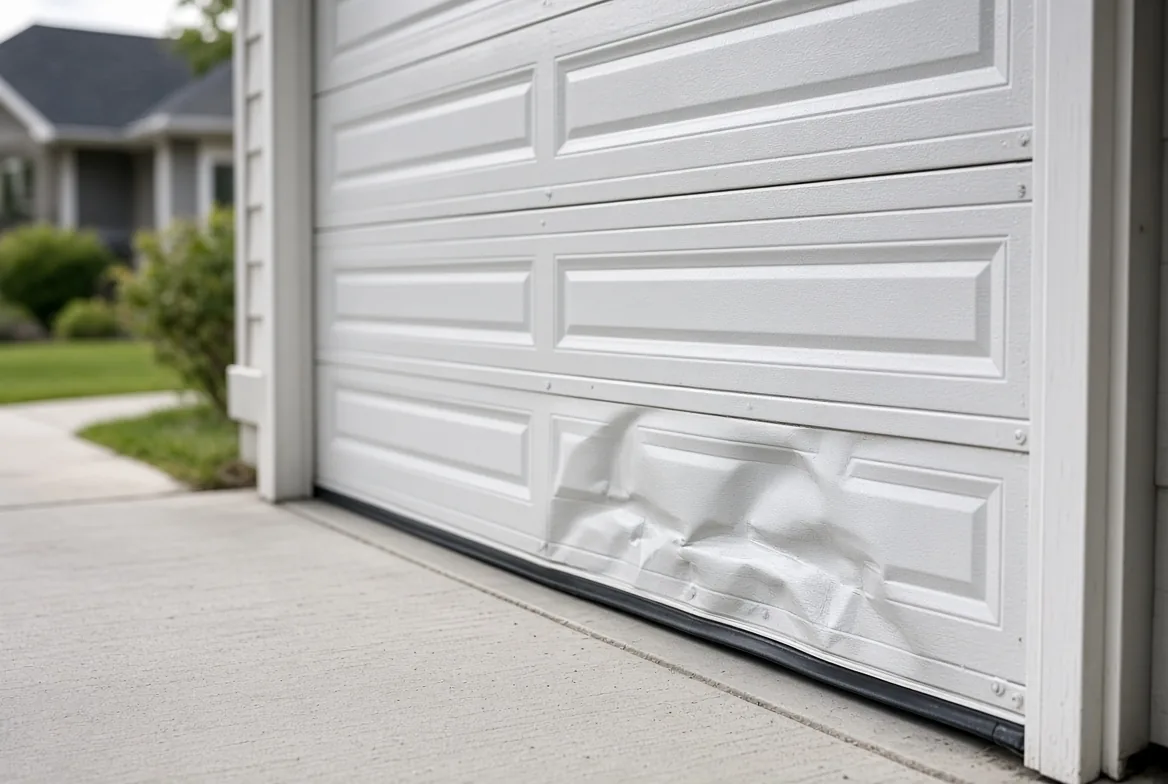
A single crumpled section is one of the most common calls a garage door company gets — a bumper, a basketball, road salt at the bottom edge. The good news is that a sectional door is designed to come apart, so garage door panel replacement is a real option instead of buying a whole new door. The bad news is that it isn't always the cheaper option, and the panel swap itself is not a DIY job. Here's how to work out which repair you actually need, what it costs in 2025-2026, and where the safe line is between what you can do and what a technician has to.
Garage door panel replacement cost in 2025-2026
Expect $250 to $900 to replace a single garage door panel installed, with custom wood or architectural glass sections running $1,200 to $3,000. Material and door width do most of the work in that range: a standard door has four or five horizontal sections, and a 16-foot double-car section needs heavier strutting and higher-gauge steel than an 8- or 9-foot single, which pushes material cost up 20% to 60%.
| Panel material | Single door, parts only | Double door, parts only | Single door installed | Double door installed |
|---|---|---|---|---|
| Uninsulated steel | $150-$300 | $250-$500 | $250-$600 | $450-$850 |
| Insulated steel (EPS/polyurethane) | $250-$500 | $400-$800 | $400-$850 | $650-$1,250 |
| Aluminum | $100-$300 | $200-$500 | $250-$600 | $400-$900 |
| Wood (standard to custom) | $300-$800 | $600-$1,800 | $500-$1,200 | $900-$2,500+ |
| Fiberglass / composite | $250-$600 | $450-$1,100 | $400-$950 | $700-$1,600 |
Labor doesn't scale linearly. The first panel absorbs the mobilization and setup cost — securing the door leaf and releasing spring tension — so a second or third section adds material at full price but labor at a discount. That's why the total for three panels lands so close to a whole new door.
| Scope | Typical installed cost | What it includes |
|---|---|---|
| Single panel | $250-$900 | 1 section, hardware transfer, hinge alignment, basic rebalancing |
| Two panels | $600-$1,600 | 2 sections, hinge and roller overhaul on the replaced sections |
| Three panels | $1,200-$2,600 | 3 sections, hardware rebuild, track recalibration, spring adjustment |
| Full door, single car | $700-$2,700 | Complete 4-5 section leaf, new tracks, springs, cables, full warranty |
| Full door, double car | $1,000-$3,500+ | Double-wide leaf, heavy-duty track, high-cycle springs, weather seals |
Labor is usually billed as a flat project rate or $75-$150 per hour, with This Old House reporting a national trade average of $63-$95 per hour for basic panel swaps. A single-panel swap takes one to two hours; multi-panel or custom wood work takes three to five.
| Fee | Typical cost | When it applies |
|---|---|---|
| Base installation labor (per job) | $150-$500 | Site prep, unstacking sections, the swap, basic track alignment |
| Emergency / same-day call | $100-$250 | After-hours dispatch, or a vehicle trapped inside |
| Spring rebalancing | $100-$200 | New panel weighs differently than the original, changing lift equilibrium |
| Track realignment / roller swap | $125-$300 | Impact bent track beyond operational tolerance |
| Old panel disposal | $50-$370 | Haul-away plus environmental and recycling fees |
| Paint / finish matching | $100-$300 | Field-painting to match a UV-faded existing finish |
One panel or a whole new door?
The single most useful number here is the 40% rule: if the cost to repair or replace the damaged sections exceeds 40% to 50% of a brand-new installed door, replace the door. Spending $1,400 to fix two panels when a new double steel door is $2,000 installed saves you $600 and leaves you with aging springs, worn rollers, and old side tracks.
Three other things quietly decide this for you:
- Door age and spring cyclesResidential doors last 15-20 years and standard torsion springs are rated for about 10,000 lift cycles. Bolting a pristine new section onto a 12-15 year old leaf creates a mismatch: the older, fatigue-stressed sections keep flexing unevenly and put shear on the new panel's hinges.
- Joint profile discontinuationManufacturers redesign the interlocking edge profiles every few years for better weather sealing and anti-pinch safety — Amarr's Safe-Guard system and Clopay's Safe-T-Bracket profile are examples. A modern section will not interlock tightly with a 15-year-old top or bottom section, and forcing it causes air leakage and binding at the track radius.
- Color matchEven an exact model match won't look right. UV, pollution, and rain fade baked-on polyester finishes, so a factory-fresh section reads as a patch. Fixing that means repainting the whole leaf in exterior acrylic latex — another $100 to $500.
| Factor | Replace the panel | Replace the door |
|---|---|---|
| Damaged sections | 1 panel (sometimes 2 on a newer door) | 3 or more |
| Door age | Under 8 years | Over 10-12 years |
| Joint profile | Current production geometry | Discontinued shiplap or obsolete joint |
| Repair-to-new cost ratio | Under 40% of a new door | Over 40-50% of a new door |
| Tracks and springs | Plumb, square tracks; springs within cycle life | Bent tracks, corroded cables, fatigued springs |
| Finish | Minimal fading, easy touch-up | Severe chalking, peeling, widespread discoloration |
Five checks before you order a section
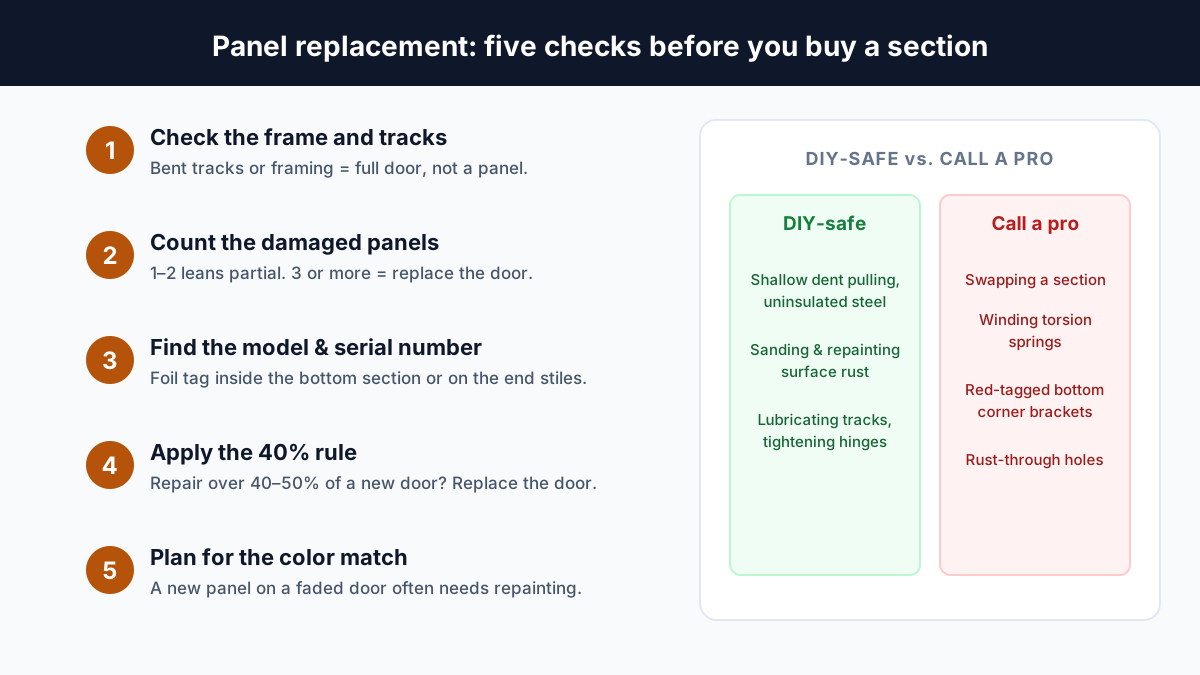
1. Check the frame and tracks first
- What to look forLook at the vertical and horizontal tracks and the door framing. If the tracks or framing are bent, the job is a full door replacement, not a panel swap.
2. Count the damaged panels
- How to decideOne or two damaged sections lean toward panel replacement. Three or more usually costs as much as a complete new door, so replace the door instead.
3. Find the model and serial number
- Where to lookLook for a white or yellow foil tag on the interior face of the bottom or second section, on the vertical end stiles, or on the vertical track near the floor. Dealers need that data string to source a matching section.
4. Apply the 40% rule
- The mathCompare the repair quote to the installed price of a brand-new door. If the repair exceeds 40% to 50% of a new door, replace the whole door and get new tracks, springs, and a full warranty.
5. Plan for the color match
- What to budgetA factory-fresh panel will not match sun-faded neighbors. Budget $100 to $500 to repaint the whole door leaf with exterior acrylic latex if the existing finish has faded.
Not sure if one panel will do it?
A technician can check the frame, tracks, and joint profile on-site and quote the panel swap against a new door.
Request ServiceHow a pro replaces a panel
⚠ This is not a DIY job
A sectional door weighs 130 to 350+ pounds and is counterbalanced by springs storing hundreds of foot-pounds of energy. Swapping a section means unwinding those springs and removing the bottom corner brackets — the ones with the red-headed fasteners, which are bolted straight to the high-tension lift cables. CPSC and DASMA both warn untrained people away from spring work; a slipped winding bar can break bones or worse.
- Disconnect and lock out the opener. The J-arm comes off the top-section trolley so the motor can't run.
- Release the counterbalance energy. Torsion springs are unwound turn by turn with solid steel winding bars. Extension springs are relieved by raising the door fully, clamping beneath the bottom rollers, and detaching the safety cables.
- Unstack from the top down. Intermediate hinges, side roller brackets, and end stiles come off; track brackets loosen if extra side clearance is needed.
- Swap the panel and transfer hardware. Struts, hinges, top fixtures, and bottom brackets move to the new section, with screws engaging the structural stiles rather than stripping thin skin.
- Re-stack and align the joint. The new section seats onto the one below, the tongue-and-groove joint has to seal across the full width, rollers go back in the track, and level gets checked.
- Re-tension and rebalance. Springs are rewound to the manufacturer's turn count for the door's weight and drum diameter. A balanced door stays put when stopped 3 feet off the floor.
- Recalibrate safety. The J-arm goes back on, the photo-eye sensors get tested, and the UL 325 reverse test runs with a 2x4 laid flat in the closing path.
A few standards shape what a technician can legally and safely install. UL 325, codified federally under 16 CFR Part 1211, requires photo-eye entrapment protection and an automatic reverse within 2 seconds of contact — a panel swap must not change door weight or geometry enough to overload the opener's force settings. DASMA TDS #154 covers steel gauge: sections run 24-gauge (0.022 in) down to 25/26-gauge (0.017-0.014 in), and dropping a 26-gauge section into a 24-gauge door causes buckling. TDS #163 requires a replacement section on an insulated door to match its neighbors' R-value, or you get thermal leaks and condensation. And TDS #185 covers thermal bowing: a dark polyurethane-insulated door in direct sun can hit 180°F on the outside skin against 70°F inside, flexing the section enough to bind in the tracks unless vertical struts are added.
Garage door dent repair you can do yourself
Whether a dent can be popped out comes down to one question: did the impact stay within the steel's elastic limit, or did it crease? Shallow, wide "pop-in" dents on single-layer uninsulated steel are often recoverable. A sharp crease is not — the metal grain has stretched permanently, and pulling it produces oil-canning, a loose wavy bulge that flexes back and forth every time the door moves.
- Thermal shock (foil + compressed air)Clean the dent, heat it evenly with a heat gun or high-wattage hair dryer held about 6 inches away for 60-90 seconds, lay flat aluminum foil over the hot metal, then spray an inverted can of compressed air across the foil for 20-30 seconds. The propellant discharges at roughly -50°F and the rapid contraction pulls shallow dents back. Best on uninsulated 25/26-gauge steel with uncracked paint.
- Suction puller or plungerMoisten the rubber lip, press the cup over the center of the dent to make an airtight seal, and pull straight out perpendicular to the panel in one swift motion. Works on medium-radius concave depressions with no crease line.
- Block and malletNeeds access to the uninsulated back skin. Hold a contoured wooden block against the exterior dent ridge and tap the deep center from inside with a dead-blow rubber mallet, working from the outer perimeter inward.
- Heat gun and wood formingWarm the area to roughly 120°F so the factory polyester paint turns pliable and doesn't micro-crack, then massage the back of the crease outward with a smooth rounded block while damping exterior flex with your hand. Best for minor ridges near the stiles.
Two hard limits
Stretched steel fractures the roughly 1.0-mil factory-baked topcoat and the zinc galvanizing beneath it, so even a mechanically flat repair exposes bare iron and starts rusting — prime and paint any dent you pull. And sandwich-construction insulated panels (steel skin, bonded polyurethane core, steel skin) can't be worked from behind at all. Those need replacement.
Garage door rust: surface vs. rust-through
Garage door rust starts where the factory zinc galvanizing, epoxy primer, and baked polyester topcoat get compromised — usually at the bottom section. In coastal air, hygroscopic salt ions accelerate oxidation enough to degrade standard galvanized steel in three to five years if the door is never washed. In winter climates, tires splash calcium and magnesium chloride de-icers into the bottom weather-seal retainer channel, where they sit against the metal.
Surface rust is fixable in an afternoon. Rust-through is not.
- Degrease and salt-wash. Warm water with TSP or concentrated dish soap to strip grime, wax, and salt residue. Rinse and dry completely.
- Sand to bare metal. 80-grit aluminum oxide paper or a wire wheel on a drill, then feather about 2 inches into the surrounding sound paint with 220-grit for a smooth transition.
- Convert the residual rust. A phosphoric/tannic acid rust converter turns leftover iron oxide into iron phosphate, a stable black protective layer. Let it cure 24 hours.
- Prime within 2 hours of sanding. A zinc-rich or red-oxide oil-based exterior metal primer over all bare and converted metal, before flash rusting starts.
- Topcoat. Two thin coats of premium exterior acrylic latex or rust-inhibitive enamel, color-matched to the factory finish.
Once rust has perforated the full thickness of the sheet, the section has lost structural integrity. Patching holes with body filler or fiberglass mesh only buys time — the oxidation cell keeps expanding underneath and the patch cracks off as the door flexes. Perforated sections get replaced.
Brands, lead times & finding your model number
Sourcing is the step that most often stalls a panel job, because availability and lead time vary a lot by manufacturer.
| Manufacturer | Sourcing | Lead time | Where the ID tag is |
|---|---|---|---|
| Clopay | Nationwide independent dealers and major home centers | 1-3 weeks standard; 4-6 custom | Large yellow/white foil sticker, interior lower-left or lower-right panel face |
| Wayne Dalton | High national coverage; common builder-grade default | 2-4 weeks standard; 5-8 custom | Yellow warning label on interior face, end stiles, or TorqueMaster tube |
| Amarr (Entrematic) | Broad regional distribution | 2-3 weeks standard; 4-7 custom | Foil tag on vertical end stiles or interior face near the bottom corner |
| Overhead Door | Authorized Ribbon Distributors only | 2-4 weeks standard; 5-8 custom | Red/white Ribbon logo tag on interior end stiles or track brackets |
| C.H.I. | Extensive independent dealer network | 1-3 weeks standard; 3-5 custom | White data sticker on vertical interior end stiles |
| Raynor | Factory-direct network | 3-5 weeks standard; 6-8 custom | Stamped metal plate or vinyl sticker on the inside edge of the end stiles |
A dealer needs the full data string from the manufacturer label — Product ID (PID), model number, and serial number. If the tag is gone or unreadable, measure the section height (usually 18, 21, or 24 inches), the section length, the panel thickness (2 inches is standard), the exterior embossment pattern (short panel, long panel, or flush), and the gauge, then photograph the panel face and the interlocking male/female edge joint at high resolution to send to the distributor.
Insurance after a car hits the door
Who pays depends entirely on who was driving. If you or someone in your household backs into your own door, your auto policy won't cover it — auto liability explicitly excludes property you own, rent, or occupy. It falls to homeowners insurance under Coverage A (Dwelling) for an attached garage or Coverage B (Other Structures) for a detached one, subject to your deductible. If a neighbor, a delivery driver, or a visitor hits it, their auto property damage liability pays the full repair with no deductible for you.
| Scenario | Repair cost | Net payout | What to do |
|---|---|---|---|
| Minor single-panel damage | $600 | $0 | Pay out of pocket — below the deductible |
| Two-panel moderate impact | $1,100 | $100 | Pay out of pocket — a $100 payout isn't worth the premium risk |
| Severe impact, door + frame | $3,200 | $2,200 | File the claim — the payout clearly outweighs the policy impact |
The rule of thumb: only file if the estimate exceeds your deductible by at least $1,000-$1,500. Small claims risk premium increases and the loss of claims-free discounts over a three-to-five-year window.
If the impact also knocked the door out of its channel, start with our guide to a garage door off track before ordering panels — bent track changes the whole calculation.
Frequently asked questions
Can you replace just one panel on a garage door?
Yes, as long as the manufacturer still makes a section with a compatible joint profile and the rest of the door, the tracks, and the springs are structurally sound. Doors older than about 8-10 years are where this gets difficult, because manufacturers periodically redesign the interlocking edge profiles.
How much does it cost to replace a single garage door panel?
The national average installed is $250-$900 per section. Basic uninsulated steel runs about $250-$600 installed on a single-car door, while insulated, custom wood, or architectural glass sections run $600-$1,200 and up. Double-wide sections cost 20%-60% more than single-car sections.
Is it cheaper to replace a garage door panel or the whole door?
One panel is almost always cheaper. Two panels start to close the gap, and three or more usually costs as much as a full door. Pros use the 40% rule: if the repair quote exceeds 40%-50% of a new installed door, replace the door, because that buys new tracks, springs, cables, and a full warranty.
How do I find the model number of my garage door?
Check the interior face of the bottom or second section for a white or yellow foil sticker with the manufacturer name, Product ID (PID), and serial number. If it isn't there, check the vertical metal end stiles on the side edges of each section, or the vertical track near the floor.
How long does it take to get a replacement garage door panel?
Standard steel sections from Clopay, Amarr, or Wayne Dalton typically arrive in 1-3 weeks. Custom carriage-house sections, custom paint finishes, and specialty insulated wood panels run 4-8 weeks. Raynor sections are factory-direct and tend toward 3-5 weeks standard.
Can I fix a dented steel garage door panel myself?
Shallow dents with no sharp crease on single-layer uninsulated steel can often be popped out with thermal shock (heat gun plus inverted compressed air) or a suction puller. Creased dents have stretched the metal permanently, and double-wall insulated panels can't be worked from behind, so both need replacement.
Does homeowners insurance cover a car backing into a garage door?
If a resident drives into their own garage door, homeowners insurance covers it under Dwelling Coverage (Coverage A) for an attached garage, subject to your deductible. Auto liability won't pay, because it excludes property you own. If a third party hits your door, their auto property damage liability pays with no deductible for you.
Is replacing a garage door panel a safe DIY project?
No. A full section swap requires unwinding high-tension torsion springs and removing the red-tagged bottom corner brackets that are attached to the lift cables. CPSC and DASMA both warn untrained people away from spring work. Surface painting, dent pulling, and hinge tightening are fine to do yourself.
A note on safety
This is general homeowner guidance, not a substitute for a technician's on-site inspection. Cost figures are national-average ranges for 2025-2026 and vary by region, brand, and door type. Torsion spring work is a professional job in every case.