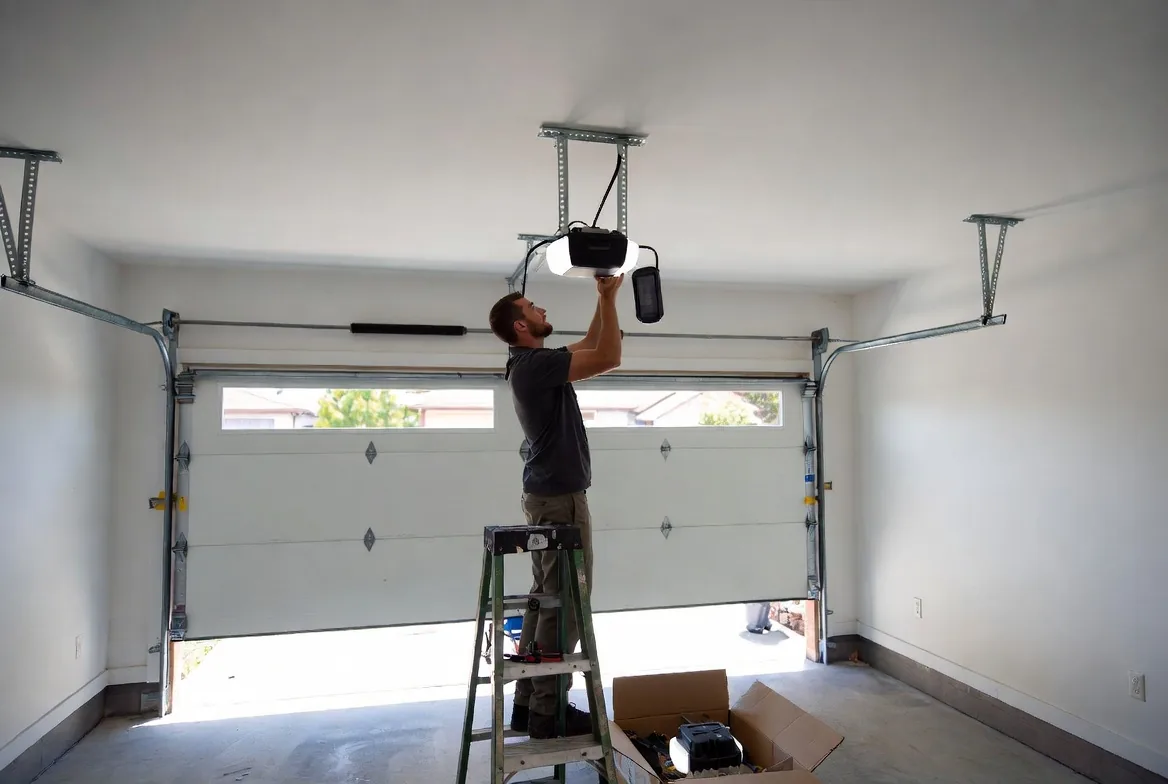
The short version
- Replace garage door opener once repairs pile up. If a repair quote tops roughly 50% of a new installed unit's cost, or the opener is already 10-15+ years old, replacement beats another patch job.
- Expect $300-$900 installed for a standard unit, with $500-$800 covering a solid mid-range opener and professional labor. Premium smart models run $1,200-$1,500+.
- Professional installation takes 1-3 hours; DIY typically takes 4-8 hours the first time, mostly due to sensor alignment and learning curve.
At some point every garage door opener stops being worth repairing, and the decision to replace garage door opener hardware instead of fixing it again comes down to two numbers: the opener's age and the repair quote compared to a new unit's cost. Here's what it actually costs to install a garage door opener in 2025-2026, how chain, belt, and screw drives compare, how long the install takes DIY versus professional, and the simple threshold pros use to make the call.
How long do garage door openers actually last?
Most garage door openers last 10-15 years under normal residential use. Some older, heavy-duty chain-drive units keep running for 20 or even 30 years — but that extra life usually comes without the safety and security features modern buyers expect, like rolling-code remotes and self-diagnostic auto-reverse sensors. An opener already inside that 10-15 year window is a strong candidate for replacement rather than another round of repairs.
Should you replace garage door opener or repair it?
Two simple checks cover most of the decision:
- The 50% ruleIf a repair quote comes in above roughly half the cost of a new installed opener, replacement is the better value.
- The second-repair ruleA second significant repair on the same aging unit is usually the signal that further repairs are buying months, not years.
- Age aloneA unit 10-15+ years old is already near or past its expected service life, even if it's currently working.
Repair still makes sense when the opener is relatively new and the failure is an isolated, inexpensive part — a remote, a sensor, a capacitor. Replacement makes more sense once the motor, logic board, or drive gear itself has failed on an older unit.
2025-2026 garage door opener installation costs
| Tier | Typical total (unit + install) |
|---|---|
| Standard installed opener (most common) | $300-$900 |
| Quality mid-range unit + professional install | $500-$800 |
| Opener unit only | $150-$500 |
| Labor only | $150-$400 |
| Premium smart / Wi-Fi opener | $1,200-$1,500+ |
LiftMaster installations follow the same pattern by tier: a basic 1/2 HP belt-drive unit with standard sensors runs around $450 total (roughly $180 opener, $230 install, $40 accessories); a mid-range 3/4 HP belt-drive with remote connectivity and battery backup runs around $680; and a premium 1 HP chain-drive with smart features runs $1,020+ once permits and taxes are included. Horsepower, drive type, and smart-home features are the main cost drivers across every brand.
Ready for a quote?
A technician can size the right opener for your door's weight and give you an installed price on the spot.
Request ServiceChain vs. belt vs. screw drive
| Type | Noise | Price | Best for |
|---|---|---|---|
| Chain drive | Loudest (modern units add vibration-dampening mounts) | Lowest upfront cost | Detached garages, heavier doors, budget installs |
| Belt drive | Quietest — smooth, low vibration | ~$50-$100 more than chain | Attached garages, rooms above/next to the garage |
| Screw drive | Moderate; fewer moving parts | Between chain and belt | Heavier doors, fast operation; more sensitive to temperature extremes |
Horsepower & lifting power
AC-motor openers are rated in horsepower, typically 1/2 HP to 1 1/4 HP. A 1/2 HP unit is enough for most single lightweight doors; heavier or insulated doors usually need 3/4 HP or more. DC-motor openers are instead rated by lifting power, usually 400-800 lbs, rather than horsepower — check your door's weight rating against either spec before buying.
DIY vs. professional install time
- Professional installationTypically 1-3 hours for a straightforward swap of an existing opener; some technicians finish in as little as 1-2 hours thanks to daily familiarity with different models.
- First-time DIY installationTypically 4-8 hours, including learning curve, mounting, wiring, and troubleshooting.
- Sensor alignmentTakes a professional roughly 15-20 minutes; DIYers often spend meaningfully longer getting a clean, solid photo-eye signal.
- Smart/Wi-Fi featuresBattery backup and app connectivity add setup time over a basic chain-drive unit for both DIY and professional installs.
Replacing an existing opener — reusing the same rail, mounting points, and wiring — is significantly faster than a first-time install that requires new bracing or a new dedicated outlet.
How to decide: step by step
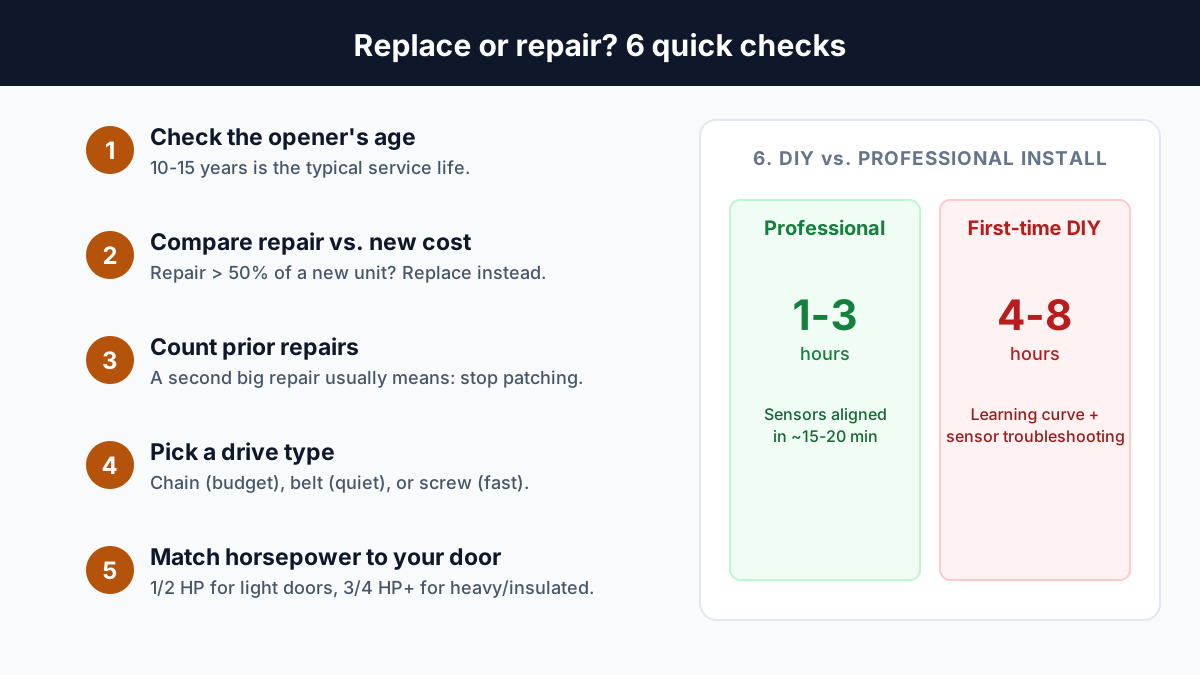
1. Check the age of your opener
- WhyGarage door openers typically last 10-15 years. A unit already in that range is a candidate for replacement rather than another repair.
2. Compare the repair quote to a new-unit cost
- WhyIf a repair quote comes in above roughly 50% of what a new opener would cost installed, replacement is the better value.
3. Count how many times you've already repaired it
- WhyA second significant repair on the same aging opener is usually the signal to stop repairing and replace instead.
4. Pick a drive type for your situation
- WhyChain drive suits a detached garage or the lowest upfront cost, belt drive suits a quiet attached garage, and screw drive suits speed with fewer moving parts.
5. Match horsepower or lifting power to your door
- WhyA 1/2 HP unit suits most light single doors; heavier or insulated doors need 3/4 HP or more, or a DC unit rated 400-800 lbs of lifting power.
6. Decide DIY vs. professional installation
- WhyA professional typically installs a replacement opener in 1-3 hours; a first-time DIY install commonly takes 4-8 hours including learning and sensor alignment.
Frequently asked questions
How long do garage door openers last?
Most garage door openers last 10-15 years. Some older, heavy-duty chain-drive units keep running 20-30 years, but that longevity usually comes without modern safety features like rolling-code security and auto-reverse sensor self-diagnostics.
How much does it cost to install a garage door opener in 2026?
Most homeowners pay $300-$900 all-in for a standard opener plus professional installation, with a common middle range of $500-$800 for a quality mid-range unit. The unit itself typically runs $150-$500 (up to $1,200-$1,500+ for premium smart models), and labor runs $150-$400.
Should I repair my garage door opener or replace it?
If a repair quote is more than about 50% of the cost of a new installed opener, replacement is the better value. Age matters too: a unit that's 10-15+ years old, or one facing a second significant repair, is usually past the point where repairs are worth it.
Which is better: chain, belt, or screw drive opener?
Chain drive is the most affordable and handles heavy doors well, but is the loudest, making it a good fit for detached garages. Belt drive costs about $50-$100 more but runs the quietest, which suits attached garages or rooms above the garage. Screw drive sits in between on price, has fewer moving parts, and is fast and strong, though it's more sensitive to extreme temperature swings.
What horsepower do I need for a garage door opener?
A 1/2 HP AC motor is enough for most single lightweight doors. Heavier or insulated doors typically need 3/4 HP or more. DC-motor openers are instead rated by lifting power, usually 400-800 lbs, rather than horsepower.
How long does it take to install a garage door opener?
A professional typically completes a straightforward replacement in 1-3 hours, sometimes as little as 1-2 hours. A first-time DIY installation commonly takes 4-8 hours once you account for learning the process, mounting, wiring, and properly aligning the safety sensors.
Is a LiftMaster opener installation worth the cost?
LiftMaster projects typically range from about $450 for a basic 1/2 HP belt-drive unit up to $1,020+ for a premium 1 HP chain-drive model with smart features, including installation. The right tier depends on your door's weight, how much noise matters, and whether you want smart-home connectivity and battery backup.
A note on accuracy
This is general homeowner guidance, not a substitute for an on-site quote. Cost, lifespan, and install-time figures are national-average ranges for 2025-2026 and vary by region, door weight, and opener brand.