The short version
- Four different batteries run a garage door system: the rechargeable 12V backup pack in the motor head, a coin cell in each remote, a 9V or AAA cell in the keypad, and a CR2450 in the myQ door sensor.
- Only the backup pack is expensive — roughly $20-$61 depending on OEM vs aftermarket, and it lasts about 1-2 years. Remote and sensor cells cost $1-$8.
- Beeping tells you which one died: every 30 seconds with a flashing orange battery LED means the 12V pack is low; a solid red LED means it is dead and will not recharge.
When a garage door stops responding, the garage door opener battery is the first thing to blame — but "the battery" is really four separate batteries, and mixing them up is why people buy the wrong part. A dead CR2032 in a visor remote and a dead 12V backup pack in the motor head produce almost the same complaint, yet one is a $3 fix and the other is a $50 one. This guide covers which battery your opener, remote, keypad and myQ sensor each take by brand, the exact beep and LED signals that identify the dead cell, how to change each one safely, and what replacement costs in 2025-2026.
Which garage door opener battery does your opener take?
Your garage door system uses four different batteries, and the rechargeable 12V backup pack in the motor head is the only one that matters for power-outage operation. The other three are primary cells in the remote, the outdoor keypad and the myQ door sensor. Before ordering anything, work out which one has failed — the symptoms and the price are completely different.
| Battery | Where it lives | What it takes | Life |
|---|---|---|---|
| Backup battery | In a tray inside the motor head | 12V sealed rechargeable, 4.5-5 Ah | 1-2 years |
| Remote control battery | Inside the visor or keychain transmitter | CR2032 coin cell (most), A23, CR2025/CR2016, or AAA | 1-2 years |
| Wireless keypad battery | Behind the outdoor keypad faceplate | 9V or 2× AAA | 1-2 years |
| myQ door sensor battery | Inside the sensor pod mounted on the door | CR2450 3V lithium, positive side up | ~2 years |
If the door still opens from the wall button but not the remote, skip straight to the remote battery section. If the door won't run during an outage, or the opener is beeping, the 12V backup pack is the suspect.
Battery replaced, door still stuck?
Get a licensed technician to test the charging circuit, travel limits and photo eyes before a small fault becomes a full opener replacement.
Request ServiceBackup battery part numbers by brand
Match the part number printed on the old battery, not the shape of the case. Battery-backup openers from the same brand family use the same 12V cell under several different numbers, and the numbers are not interchangeable across every brand.
| Brand | OEM part number | Voltage / capacity | Typical price |
|---|---|---|---|
| LiftMaster | 485LM (also 485LMC, 041A6357-1, 41A6357-1, 012381742288) | 12V, 4.5 Ah, F1 terminals, ~3.5 lb, 90×70×101 mm | ~$50-$61 |
| Chamberlain | 4228 / 41A6357-1 (same cell as the 485LM) | 12V, 4.5 Ah sealed rechargeable | ~$50-$61 |
| Genie | 111658.0002.S (SLA1055) | 12V, 5 Ah SLA | $49.99 |
| Aftermarket equivalents | Generic 12V 4.5-5 Ah AGM/SLA | 12V, 4.5-5 Ah, may need an F2-to-F1 negative adapter | ~$20-$35 |
LiftMaster and Chamberlain share the 485LM/4228 family across the battery-backup lineup, including the 3850, 8360, 8550, 8500 and 8550W wall-mount and belt-drive families. The Genie pack fits backup-equipped models 7035, 7055, 7155, 6170, 6172, 3020H and 3020H-B; Genie sells the mounting hardware separately (39577R.S for the 7035/7055, 39367A.S for the 3020H). Craftsman, AccessMaster and Raynor units built by Chamberlain usually take the same 4228 cell — but confirm against the old battery's label before ordering.
- CapacityChamberlain publishes the backup cell as 12V, 4.5 Ah, and a fully charged pack gives about 24 hours of standby time and up to 20 full open/close cycles at room temperature.
- Run timeReal outage performance depends on door balance, battery age, temperature and how often the door is cycled while on backup — a heavy or out-of-balance door can halve the number of cycles.
- Don't substituteNever fit a 24V two-battery kit into a 12V tray, never mix SLA and lithium packs, and never leave the harness disconnected inside the housing.
Remote, keypad and myQ sensor batteries
Chamberlain and LiftMaster remotes almost always take a CR2032 coin cell, while Genie splits between CR2032, AAA and the older 12V A23 depending on the model. Pull the back off the remote and read the code engraved on the old battery — that removes all guesswork.
| Device | Battery | Notes |
|---|---|---|
| Chamberlain / LiftMaster multi-button visor remotes | CR2032 3V coin | The industry standard for years, including Security+ 2.0 remotes |
| Very slim or older Chamberlain / LiftMaster remotes | CR2025 or CR2016 3V coin | 2.5 mm thick vs the CR2032's 3.2 mm — a loose fit causes intermittent operation |
| Older LiftMaster / Chamberlain 3-button remotes, Linear, Marantec, Genie bullet remotes | A23 12V alkaline | Looks like a miniature AAA; leaks if left in a hot car for years |
| Genie Intellicode remotes | CR2032 coin or a single AAA | Genie's coin cell part is 34472B; the A23 for the GITR-3BX is 24030A.S |
| Genie wireless keypads (GK-R and newer) | 2× AAA | Compartment slides open at the bottom of the keypad |
| Genie 912 transmitters and universal / Raynor keypads | 9V | Standard 9V behind the faceplate |
| myQ Smart Garage Control door sensor | CR2450 3V lithium | Positive terminal up; the myQ app warns you before it fails |
| Craftsman remotes | CR2032 | Chamberlain-built hardware, same cell |
Expected life for all of these is roughly one to two years. Alkaline cells (A23, AAA, 9V) are the ones that leak: check them once a year for white powdery residue, because leaked electrolyte destroys the remote's contacts. Coin cells hold their charge far longer on the shelf, but a CR2032 in a hot car still gives up faster than the two-year average.
Symptoms and beep codes of a dying battery
On a battery-backup opener, beeping every 30 seconds with a flashing orange battery LED means the backup battery is low, while beeping every 2 seconds with a solid orange LED means the opener is running on battery power right now. The number and rhythm of the beeps is the fastest diagnosis you can get.
| Signal | What it means | What to do |
|---|---|---|
| Beep every 2 seconds, battery LED solid orange | Running on battery power | Check whether the power is out; if it's back, test the outlet with another device |
| Beep every 30 seconds, battery LED flashing orange | Backup battery is low | Test the outlet, then replace the 12V pack if the LED never goes to flashing green |
| Battery LED solid red | Battery is dead and will not recharge | Replace the pack |
| Beeping that won't stop while you wait for the part | Low-battery alert | Unplug the opener, disconnect the battery, plug it back in — beeping stops |
Battery problems in remotes and keypads look different: the door only responds from a few feet away, needs two or three presses, or the remote's LED goes dim or dead. The myQ app reports a low door-sensor battery before the sensor drops out. And remember that if the door opens but refuses to close, that is usually the photo-eye safety sensors rather than a battery at all.
How to replace a garage door opener battery
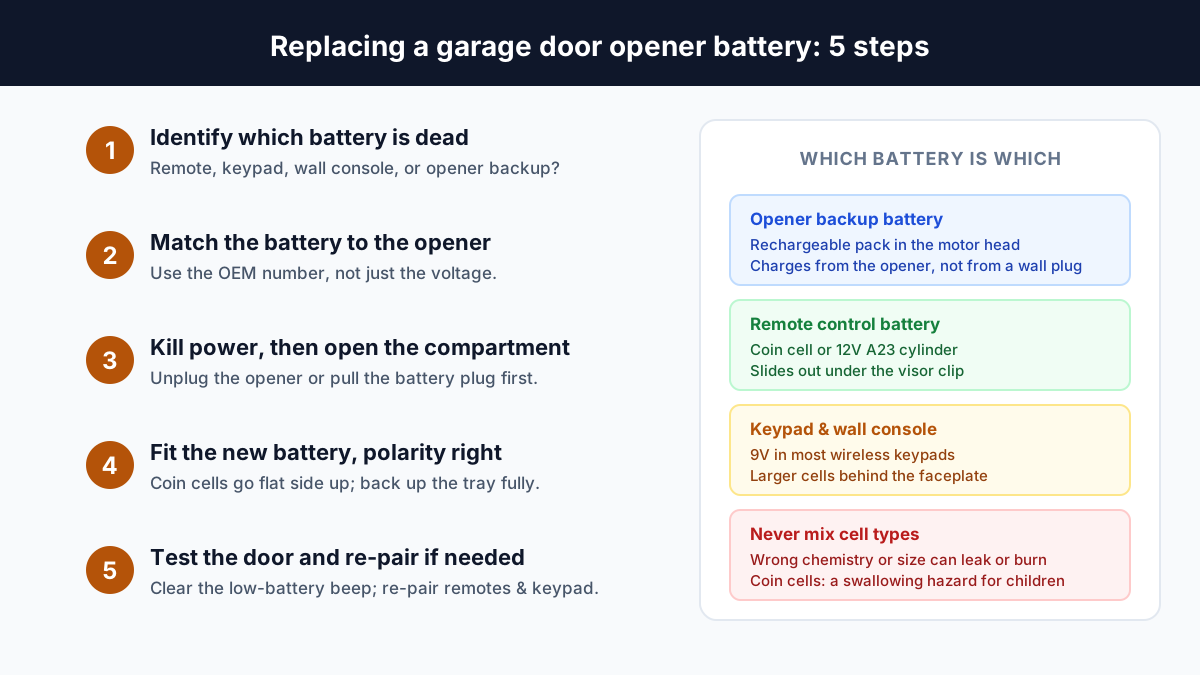
The replacement procedure differs for each battery, but the order of operations is the same: identify, match, power down, swap, test.
1. Identify which battery is dead
- What to checkWall button works but the remote doesn't? Remote battery. Door won't run on backup or the opener beeps? 12V pack. Keypad dark? Keypad battery. App shows a sensor warning? CR2450. Note that the wall button runs on household power, so it will keep working with a completely dead backup pack.
2. Match the replacement to the opener
- What to checkRead the number on the old battery: 485LM / 4228 / 41A6357-1 for LiftMaster and Chamberlain, 111658.0002.S for Genie, or the engraved coin-cell code (CR2032, CR2025, CR2016, CR2450, A23). Buy the OEM pack when the opener is under warranty, and a 12V 4.5-5 Ah AGM equivalent when it isn't — just check whether the negative terminal needs an F2-to-F1 adapter.
3. Power down and open the compartment
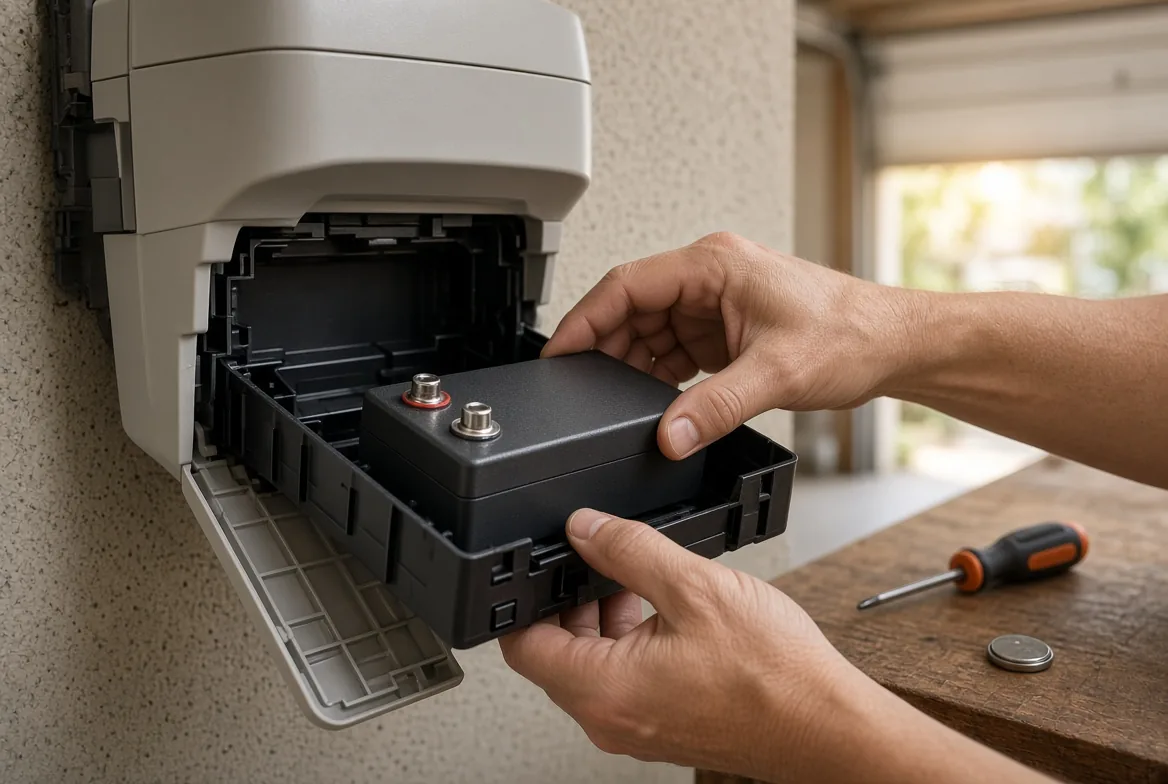
- What to doUnplug the opener from the wall outlet or switch the breaker, then disconnect the battery leads and note which wire sits on the positive post (red) and which on the negative (black). Remove the compartment cover or slide the battery tray out — on wall-mount and jackshaft openers the tray is on the side of the head. Wear gloves and eye protection: the pack contains lead and electrolyte.
4. Fit the new battery with correct polarity
- What to doLift the old pack out, set the new one in with the terminals facing the original orientation, reconnect red to positive and black to negative, secure the wires so they can't touch the terminals, and close the cover. For a remote or keypad, pry the shell open along the seam with a small flat screwdriver, push the old cell out, drop the new cell in with the positive side up, and snap the case back together. For the myQ sensor, fit the CR2450 positive side up and close the pod.
5. Test the door and re-pair if needed
- What to checkRestore power, let the opener charge the pack, then unplug the opener and run the door on the wall button to prove the backup actually works. If the remote stopped responding after the cell swap, press the Learn button on the opener and press the remote button inside the window; Genie remotes in particular often need re-programming after a battery change.
2025-2026 replacement costs
A do-it-yourself battery replacement costs $20-$61 in parts, while a technician visit typically totals $75-$150 including the service-call fee. Most of that spread is labor, not the battery — which is why a backup pack swap is one of the few opener repairs worth doing yourself.
| Item | Typical cost |
|---|---|
| OEM LiftMaster 485LM / Chamberlain 4228 backup battery | $50-$61 |
| OEM Genie 111658.0002.S backup battery | $49.99 |
| Aftermarket 12V 4.5-5 Ah AGM/SLA equivalent | $20-$35 |
| Remote coin cell (CR2032 / A23) | $1-$5 |
| myQ CR2450 sensor battery | $2-$8 |
| Service-call fee | $50-$100 |
| Opener repair (if the fault isn't the battery) | $100-$200 typical, up to $500 |
| New opener installed | $300-$900 |
If the technician's diagnosis is anything more than the battery, get the numbers before authorizing work: opener repair sits at $100-$200 on average, while a full replacement runs $300-$900 installed. Our opener replacement guide covers when replacing beats repairing.
When a new battery doesn't fix it
A backup pack that dies in days instead of years means something is draining it, not that you bought a bad battery. Chamberlain and LiftMaster openers publish flash-pattern diagnostic codes for exactly this, and several of them point at the logic board rather than the battery.
| Code (up / down flashes) | Meaning |
|---|---|
| 2 up 1 down, 2 up 2 down, 2 up 3 down | Logic board component failure — disconnect the backup battery, power-cycle, replace the board if the code persists |
| 2 up 4 down / 3 up 2 down | The opener lost power and must re-locate its travel limits — check the outlet, then run the door to clear it |
| 3 up 3 down | Battery over-voltage detected (indicator flashes green constantly) — replace the logic board |
| 4 up 3 down | Loss of RPM on the down travel — door balance or the RPM sensor, not the battery |
Other non-battery causes of the same complaint: a damaged battery harness, an outlet that reads live but sags under load, travel limits set wrong so the opener strains on every cycle, and a door that is out of balance or too heavy. LiftMaster's own parts guidance is blunt about it — a new battery will not fix a failed charging circuit, a damaged harness, poor outlet power, or a door the opener can't move efficiently. Our brand-by-brand opener troubleshooting guide walks through those next, and a tune-up is a cheaper first test than a parts swap.
Safety, codes and disposal
Battery work on an opener touches two safety systems: UL 325 entrapment protection and, in California, the SB 969 battery-backup mandate. Handle the cells properly and don't disable anything while you're in there.
- UL 325Has governed residential openers since 1993: auto-reverse on contact, non-contact reversal from photo-eye sensors mounted no more than 6 inches above the floor. Never tape, bypass, or relocate a sensor to "fix" a door that won't close — that is the entrapment protection working.
- California SB 969Effective July 1, 2019 (Health & Safety Code §19891), every automatic garage door opener manufactured for sale, sold or installed in a California residence must include a battery-backup function, with a civil penalty up to $1,000 per non-compliant opener. It applies to new openers and replacements, not to units already on the wall.
- Coin cell hazardCR2032, CR2025, CR2016 and CR2450 cells are a serious swallowing hazard for children — a swallowed coin cell can cause severe internal burns within hours. Keep new cells and old remotes out of reach and treat a suspected swallow as an emergency.
- Lead and electrolyte12V SLA/AGM packs are sealed but still contain lead and electrolyte. Gloves and eye protection, no puncturing or shorting the terminals, and recycle at a battery retailer or municipal household-hazardous-waste site — never in household trash.
- Alkaline leakageRemove dead A23, AAA and 9V cells instead of leaving them in; leaked residue corrodes remote contacts and ruins the transmitter.
Frequently asked questions
How long does a garage door opener battery last?
The rechargeable backup battery in the motor head lasts about one to two years with normal use, which is the figure both Chamberlain and LiftMaster publish; owners in mild climates often get three to four years. Remote, keypad and myQ sensor cells also run roughly one to two years. Garage heat, frequent outage cycling, and a door that is out of balance all shorten that life.
What battery does a LiftMaster or Chamberlain opener take?
The backup pack in battery-backup LiftMaster and Chamberlain openers is a 12V sealed rechargeable cell, 4.5 Ah, sold as part 485LM, 485LMC, 4228, 41A6357-1 or 041A6357-1, with F1 terminals. It typically runs $50-$61 from a dealer or OEM retailer, and aftermarket 12V 4.5-5 Ah AGM equivalents cost closer to $20-$35 but often need an F2-to-F1 terminal adapter.
What battery goes in a garage door remote?
Most Chamberlain and LiftMaster remotes take a CR2032 3V coin cell, and very slim or older models sometimes take a CR2025 instead — they look identical but differ in thickness, so a 2025 in a 2032 slot sits loose and works intermittently. Older three-button remotes and Genie bullet remotes often take a 12V A23 cylinder, newer Genie Intellicode remotes take a CR2032 or a single AAA, and keypads usually take a 9V or two AAA cells. Always match the code engraved on the old battery.
Why is my garage door opener beeping?
On a battery-backup opener, beeping every 30 seconds with the battery LED flashing orange means the backup battery is low — test the outlet first, then replace the pack. Beeping every 2 seconds with a solid orange LED means the opener is running on battery power, because the power is out or the outlet is dead. A solid red battery LED means the pack is dead and will not recharge. To silence it while you wait for a replacement: unplug the unit, disconnect the battery, then plug it back in.
Can I replace the garage door opener battery myself?
Yes. The 12V backup pack sits in a tray behind a cover on the motor head and takes about 15-30 minutes with a screwdriver, and remote, keypad and sensor cells are simple swaps. Call a professional if the tray or harness is corroded, if a brand-new pack still will not charge, if the opener shows a logic-board diagnostic code, or if the door is heavy or out of balance — a new battery will not fix any of those.
How much does garage door opener battery replacement cost?
DIY replacement runs about $20-$61 in parts: roughly $20-$35 for an aftermarket 12V pack, $50-$61 for the OEM LiftMaster 485LM or $49.99 for the Genie 111658.0002.S, and $1-$8 for a remote, keypad or sensor cell. Having a technician do it lands near the low end of a service visit — most companies charge a $50-$100 service-call fee, so a battery-only visit typically totals about $75-$150.
My garage door opener battery keeps dying — what's wrong?
A pack that dies within days or weeks instead of years points to a drain rather than a bad battery. The usual causes are mis-set travel limits, a failing logic board or diode, a damaged battery harness, a dead outlet, or a door that is so heavy or out of balance that the opener works overtime. LiftMaster and Chamberlain diagnostic codes 2-up-1-down, 2-up-2-down and 2-up-3-down all indicate logic-board failure, and code 3-up-3-down indicates battery over-voltage.
Before you power anything up
Work with the opener unplugged, reconnect polarity exactly as you found it, and test the auto-reverse and photo eyes before you leave the door in daily service. If the opener is under warranty, use the OEM part number — aftermarket packs can void coverage.