The short version
- Fix garage door track problems in this order: is the track straight, is it plumb, are its bolts tight, and is the gap at the roller even? Three of those four are tighten-and-adjust jobs.
- Straight is repairable; cracked, twisted or pitted is not. Tap a mild dent out with a rubber mallet and a block of wood behind the track. If the metal springs back into the dent, cracks, or the bracket holes have stretched out of round, that section gets replaced.
- The numbers to work to: vertical track plumb, horizontal track level and slightly downhill toward the opening, about a 1/4 in gap at the roller (1/8 in is ideal, 1/4 in is the maximum), and the track roughly 3–4 in off the jamb.
- Cost: $75–$150 to realign, $150–$300 to replace one track section installed, $200–$600 for both sides. Parts alone are $30–$80 per section.
- Never take a track loose while the door's weight is on it. The tracks steady a door that can weigh up to two tons. Springs, cables and bottom brackets are off-limits entirely.
Most guides treat a bent or shifted track as an emergency, and for a door that has already come off its tracks it is — but that is the off-track rescue, not this job. This guide is about the slower, far more common problem: a track that has been knocked, loosened or rusted just enough to start dragging the door. Learning how to fix garage door track damage starts with deciding which of those two problems you actually have, because a realignment costs an afternoon or about $100, while a bent, cracked or pitted section has to be replaced — and a door run for months on a bad track takes rollers, hinges and panels down with it.
How a garage door track system works
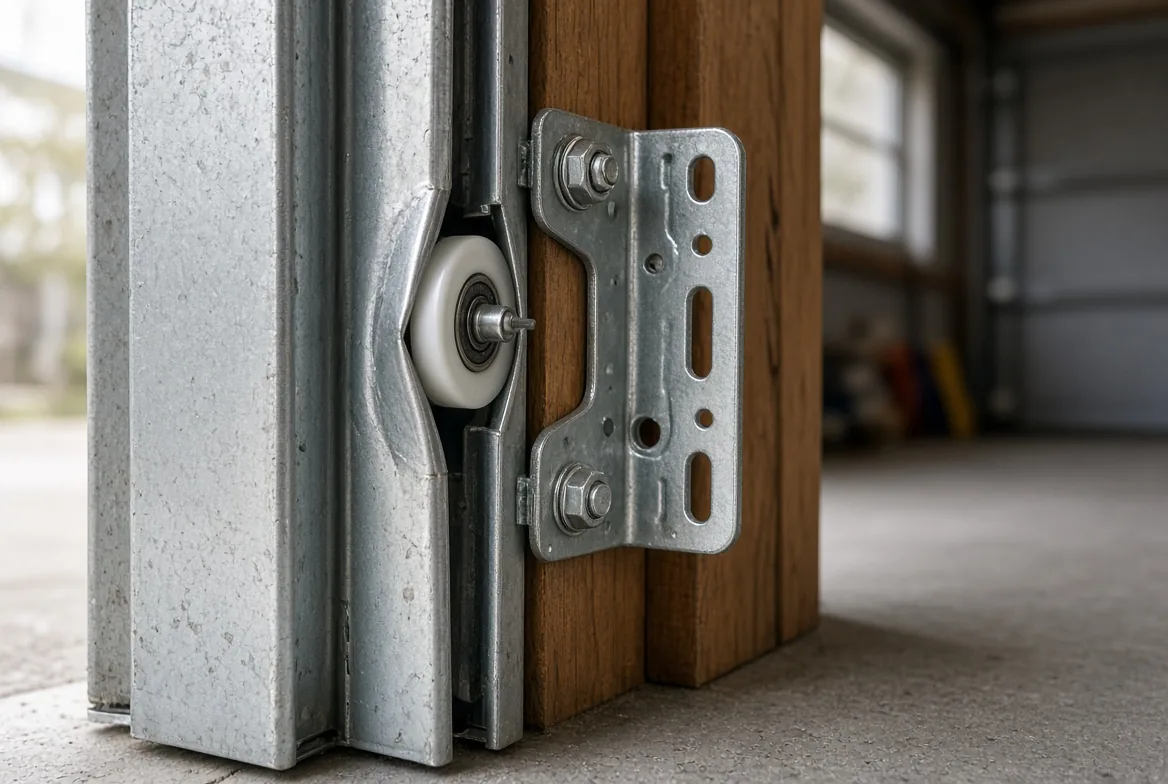
A sectional door rides on four track sections — two vertical, two horizontal — plus the curve where each pair meets. The tracks carry the full weight of the door and set its path, which is why they have to be square to each other and to the framing: the door is a rigid assembly riding in a channel that is only a little wider than the rollers inside it.
| Part | Where it is | Job |
|---|---|---|
| Vertical track | Down each side of the opening, floor to just above the top panel | Guides the door on its first travel; must be plumb to within roughly 1/8 in over its full height |
| Track brackets (jamb brackets) | Bolted to the wall framing, roughly every 24 in up each vertical track | Hold the vertical track to the structure and set the gap between the door and the jamb |
| Radius (curve) section | Where vertical turns into horizontal | Turns the door from vertical to horizontal travel; takes load at every cycle, so it is the section most often replaced |
| Flag bracket | At the front, joining vertical track, horizontal track and header | The single connection that ties the front of the overhead run together |
| Horizontal track | Runs back along the ceiling above the door | Carries the open door flat overhead, level and slightly downhill toward the opening |
| Rear hangers (angle iron) | From the back end of each horizontal track to the ceiling framing | Holds the rear of the track up; needs a sway brace so the tracks cannot spread sideways |
| Stop bolts | At the rear end of each horizontal track | Stop the rollers and keep the door from rolling off the back of the track |
| Rollers | In the roller brackets on the door edges | Ride the channel; a stiff or seized roller is what bends track in the first place |
The supports are structural, not cosmetic. DASMA's code-inspection checklist for sectional doors lists two of its fifteen items as horizontal tracks securely connected to structurally sound, load-bearing members and vertical tracks securely connected to structurally sound material, and Clopay's installation manual is blunter about why: rear track hangers must carry sway braces, because "if the tracks are not firmly stabilized they might spread, allowing the door to fall and cause severe injury and damage." That is the whole safety argument for this article in one sentence.
Symptoms: what a failing track feels like from the driver's seat
The door is the diagnostic tool. A track problem shows up as something that happens at one consistent point in the travel, or on one side of the door — an opener or spring problem tends to affect the whole cycle or the whole door.
| What you see, hear or feel | Most likely track fault |
|---|---|
| Scrape or grind at the same point every time | A local dent or bend in the vertical track, or a lock striker rubbing the channel |
| Door jerks, stutters or reverses at one spot | Roller hitting a deformed section; the opener reads it as an obstruction |
| Door rubs the seal or stop moulding on one side | That track has shifted in or out — the door-to-jamb gap is no longer even |
| Uneven gap between the door edge and the track, top to bottom | Vertical track out of plumb, usually leaning in at the top |
| Rattle or slap during travel; door wobbles side to side | Loose track bracket, loose rear hanger, or a missing sway brace |
| Door drags or hangs when it starts to open | Rear hanger bolt loose, or the horizontal track and radius bent downward |
| Rollers jump or climb out of the channel | Track has moved outward — gap at the roller is over about 1/4 in |
| Rust pitting or flaking on the inside of the rail | Corroded track grinding the rollers (light surface rust is cosmetic; pitting is not) |
The 30-second test
Stand inside, close the door, and run it through one full open-and-close cycle while you watch the tracks, not the door. A door that moves smoothly and at a constant speed through the whole travel is fine. Any hesitation, jerk, scrape or wobble at a specific point means something in the track system has moved — and the point in the cycle tells you roughly how high up the run to look.
How to fix garage door track problems: 6 steps
Everything below is deliberately limited to the track, the brackets and the rollers. If a cable is slack or coiled, a spring has a visible gap, or a bottom bracket looks off, stop — those parts are under extreme tension and are a professional's work, not a homeowner's. Our off-track guide covers that diagnosis in detail, and cable repair covers the most common culprit.
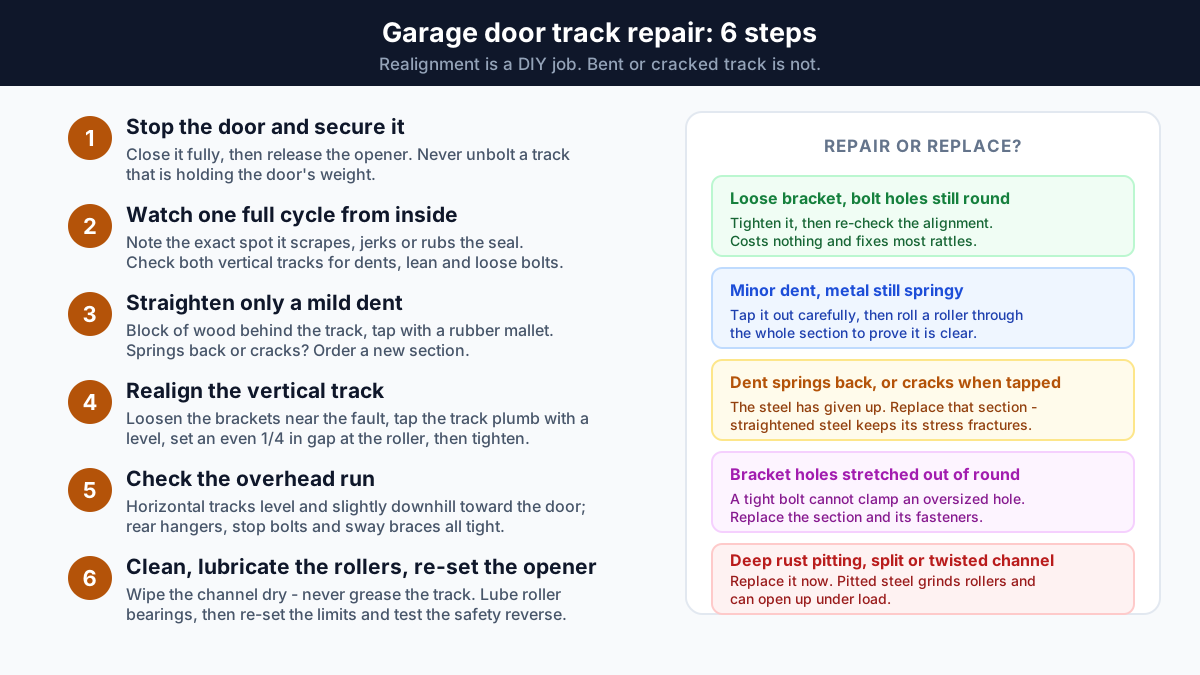
1. Stop the door and secure it
Put the door in the fully closed position before you touch a bracket — closed is where the spring load on the tracks is lowest and where a slip cannot drop the door on you. Disconnect the opener (pull the red release, or switch the opener off at the wall) so nobody can cycle the door while your hands are in the track, and check that every roller is still seated in its channel. Do not unbolt any track section that is carrying the door's weight, and never use the tracks as a ladder or a handhold.
2. Watch one full cycle from inside, then inspect both tracks
Run the door once with the lights on and watch the rollers travel. Then check both vertical tracks, floor to curve, for these four things:
- Dents and bends — run your hand or a straight edge along the inside face. Even a half-inch deflection is enough to pinch a roller.
- Plumb — hold a level against the track, or drop a plumb line. A track leaning in at the top narrows the roller path and binds the door as it rises; this is the fault most often mistaken for a spring or roller problem.
- Loose fasteners — try each bracket with a socket wrench. A bracket that rocks means the track can shift every cycle.
- Rust — light surface bloom is cosmetic, but pitting or flaking on the inside of the rail is grinding the rollers.
Check the gap between the door edge and each track at three heights: it should be consistent, and the same on both sides. That single measurement tells you which track has moved.
3. Straighten a mild dent — or stop and order a section
For a small kink in a section that is otherwise sound: put a block of wood against the outside of the track as a backing, and tap the dent out from the inside with a rubber mallet — not a hammer, which stretches and work-hardens the steel. A short rod or a large screwdriver behind the bend works for a dent you cannot reach squarely. Then run a roller through the full length of that section by hand, or cycle the door once, to prove the path is clear.
Replace the section instead if any of these are true: the dent springs back into shape when you push on it, the metal cracks or the paint splits at the bend, the area is visibly thinner than the rest of the track, the inner rail is pitted, or the bracket holes have stretched. Straightened steel keeps the stress fractures it picked up, and a section that has lost its cross-section will not hold the door's weight the way it used to.
4. Realign the vertical track and reset the gap
- Loosen only the brackets around the problem area — backing off every bolt lets the whole run move at once.
- Tap the track into position with a rubber mallet and a wood block: leaning in (roller binding) means it moves out, away from the door; leaning out (roller loose) means it moves in, toward the door.
- Set the track plumb with a level and hold the gap even from the floor to the curve — about 1/4 in between the inside face of the track and the roller, with the track 3–4 in off the jamb.
- Tighten the brackets firmly but not brutally: over-tightening strips a lag screw or cracks a bracket, and a stripped fastener in soft framing is a job for a technician. If a bolt will not hold, the section or the bracket is finished.
- Check both sides are parallel and the same distance apart at the bottom, the middle and the top before you call it done.
5. Check the overhead run
The most common track fault after a vehicle strike is a horizontal track that has dropped or spread. Confirm:
- Level side to side, and very slightly downhill toward the door (about 1/4 in over the run) so gravity holds the door closed when the opener is idle.
- Rear hangers tight, with sway braces fitted — a hanger that has loosened lets the track sag, and the door's weight then pulls the radius section out of shape.
- Stop bolts present at the rear end of both horizontal tracks, so the door cannot roll off the back.
- Flag bracket and the front of the overhead run tight, with no daylight between the vertical track, the curve and the header connection.
6. Clean, lubricate the rollers, then re-set and test the opener
Wipe the inside of the channel out with a dry cloth. Do not grease the track: lubricant in the channel makes the rollers slide instead of roll, which accelerates wear on both the rollers and the track. Grease belongs on the roller bearings, hinges and springs — a silicone or white-lithium garage-door lubricant.
Run the door by hand first, then with the opener, and re-set the travel limits and force. Finally, re-test the safety reverse: the door must reverse on contact with a 1-1/2 in high object (a 2×4 laid flat works) and the photo eyes must stop a closing door when the beam is broken. If the opener complains, the door is binding somewhere — find it rather than dialling the force up. Our annual tune-up checklist walks through the full sequence.
⚠ Do not go near the springs, cables or bottom brackets
Torsion and extension springs, the lift cables and the bottom corner brackets are under extreme tension, and they are what actually hold the door up. Never loosen, remove or adjust them to make a track line up. If the door only moves thanks to a spring system in poor condition, the track is a symptom, not the problem — that is a technician's visit.
Bent, loose or misaligned: repair or replace?
Every track job comes down to one question, and it has a short, testable answer. A track that is straight but in the wrong place gets adjusted. A track that is no longer straight, or no longer strong, gets replaced.
| Track condition | Action | Why |
|---|---|---|
| Loose bracket, bolt holes still round | Tighten and re-check alignment | Costs nothing and fixes most rattles and one-sided rubbing |
| Minor dent, metal still springy | Tap out carefully, then re-run a roller through it | Still repairable if the cross-section is intact |
| Dent springs back, or cracks when tapped | Replace that section | Straightened steel keeps its stress fractures and can fail under load later |
| Bracket mounting holes stretched out of round | Replace the section | A tight bolt cannot clamp an oversized hole, so the track will shift again |
| Visibly thinner metal at the damaged spot | Replace the section | Straightening makes a thin spot thinner still |
| Deep rust pitting or flaking on the inner rail | Replace the section | Rough steel grinds rollers and the section has lost strength |
| Crack, split or twist in the channel | Replace immediately | The track is the door's support; a split channel can open up under load |
| Vertical and horizontal damaged on one side | Replace that whole side as an assembly | Cheaper and squarer than piecing sections together at the curve |
Partial replacement is normal and expected. Vertical tracks come in standard lengths for 7 ft and 8 ft doors, so a single section can be swapped without touching the rest; the radius section is the one most often replaced, because it takes load every time the door transitions from vertical to horizontal. When both sections on one side are damaged, doing the full side is usually the better value.
Track types, sizes and gauges: what to buy
If you are ordering a replacement, match width, thickness, radius and lift type to what is on the door. Two-inch track is the residential standard; the width number is the inside measurement of the channel, and it has to match your rollers.
| Option | Used for | Notes |
|---|---|---|
| 2 in track | Almost every residential door | Steel commonly 0.055–0.075 in thick; 0.062 in suits small doors, 0.075 in suits wide or heavy ones |
| 3 in track | Heavy residential and industrial doors | Around 0.109 in steel; stronger, takes more room, more expensive |
| 1 in track | Truck and trailer doors | Not for garages |
| 12 in radius | Standard lift, low ceilings | Needs about 12 in of headroom |
| 15 in radius | Standard lift, common residential | Needs about 14.25 in of headroom |
| Low headroom | Tight ceilings; door turns almost immediately | About 9 in of headroom front-mount, 4.5 in rear-mount; a conversion kit is roughly $100 |
| High lift | Tall garages, car lifts, storage under the door | Extended vertical section; needs the high-lift distance plus about 9.5 in |
| Vertical lift | Commercial, very tall openings | The door goes straight up and stays flat against the wall |
Sideroom matters as much as headroom when you order: plan on at least 4.5 in each side of the opening for a standard residential track, springs and brackets, and door height plus about 16 in of backroom for the door to lie flat overhead. Track and hardware are almost always hot-dip galvanised now, and most track sold in the US is rolled by a handful of suppliers rather than by the door brand — but the section still has to match width, thickness and radius, so measure before you order.
Track repair and replacement cost in 2025–2026
Track hardware is cheap; getting it installed square and safe is what you are paying for. Realignment is a sub-hour job with no parts. Replacing a section is a two-to-three-hour job with a parts bill of $30–$80.
| Job | Typical cost | What it covers |
|---|---|---|
| Realignment only (no parts) | $75–$150 | Loosening brackets, resetting plumb and gap, tightening; 30–60 minutes |
| Bracket repair or reinforcement | $100–$200 | New bracket $25–$50 each plus labour |
| One track section replaced | $150–$300 | Vertical or radius section, fitted; 2–3 hours |
| Bent track straightened instead of replaced | $125–$275 per track | Only when the metal is still sound |
| Both tracks, single-car door | $200–$400 | Both sides of a 9 ft opening |
| Both tracks, double-car door | $350–$600 | 16 ft opening |
| National-chain full replacement | $250–$600 | Vertical $250–$350, horizontal $450–$550 |
| Track replacement, guide average | $125–$300 | Typical consumer cost guides |
| Per-track repair, calculator range | $232–$420 | Labour, supplies, disposal |
| Rollers replaced at the same time | $10–$15 each | A standard door has 10–12 rollers |
| Off-track realignment and repair | $200–$350 | When the door has already left the tracks |
| Opener re-programming, if billed separately | $50–$100 | Usually included in the visit |
| Emergency or after-hours call-out | +$75–$150 | Weekend and holiday rates run 1.5–2× |
| Permit, where a jurisdiction requires one | $50–$200 | Major track work only; most repairs need none |
DIY parts, for comparison:
| Part | Price |
|---|---|
| Standard vertical track section | $30–$80 |
| Galvanised track section, retail | $40–$80 basic; $80–$150 heavy-duty |
| Universal 2 in vertical track pair (7 ft / 76 in) | About $79–$135 |
| Full track assembly, one side of a double door | $100–$200 in parts |
| 2 in horizontal track plus angle, pair | About $165 |
| 2 in low-headroom track set, 7 ft, 12 in radius | About $488 a pair; retail conversion kit about $100 |
| Track hanging kit (2 in, 12-gauge angle) | About $78 |
| DIY total, done carefully | $50–$100 in parts, 3–6 hours |
Two pricing notes worth having in hand when a technician quotes. First, insurance usually covers track damage from a covered event — a storm, a fallen limb, a vehicle impact — but never wear and tear or a problem that was left to develop, so keep the date and cause straight. Second, professional track work normally carries a warranty of about 90 days to a year on labour and one to five years on the track material; ask for it in writing, because a realignment that drifts out again within the warranty period is their return visit, not a new bill.
Why tracks bend, loosen and rust
- A vehicle strike. The single most common cause: a bumper, side mirror, bike handlebar, bin or a load sticking out of a truck bed catches the vertical track. It does not have to look dramatic — a half-inch deflection is enough to pinch a roller.
- Loose brackets and bolts. Every cycle vibrates the bracket bolts and lag screws a little. Over years, the track drifts out of plumb — usually leaning in at the top, which narrows the roller path and binds the door. This is the fault most often blamed on springs or rollers.
- Rust and road salt. Snowmelt off a car, salt tracked in, and a poorly ventilated garage take the galvanising off a track. Light surface rust wipes off; pitting and flaking grip the rollers and eventually weaken the section.
- Structural movement. Frost heave in the slab, settled or rotted jamb framing, or a footing that has gone soft. In bad cases the vertical track and flag bracket are effectively holding the header up, and no amount of track adjustment fixes that — it is a framing repair first.
- Another part failing first. A broken cable or drum connection lets the door sag sideways and bends the track the first time someone presses the button; a stiff or seized roller deforms the lower horizontal run; a lock striker can scrape and eventually split a vertical track.
- Metal fatigue and re-used hardware. The radius and horizontal sections carry the door's weight on every cycle. Re-using old, pre-stressed track on a new door — which manufacturers specifically warn against — moves that fatigue straight into the new installation.
Two of these are worth catching early for the same reason: a stiff roller and a rusted rail both damage the parts next to them, so a $10 roller or a wiped-down track prevents a $300 track job. If your door has started to grind or squeal rather than rub, work through the 12 common causes before assuming the track is at fault.
Prevention: the five-minute track check
- Once a month: stand inside and watch one full cycle. Thirty seconds, and it catches nearly every developing track problem.
- Twice a year (spring and fall): wipe the inside of both channels with a dry cloth, and check every visible bracket bolt with a socket wrench. Snug, never gorilla-tight.
- Never grease the track. Lubricate the roller bearings, hinges and springs once a year — a clean, dry channel and freely rolling rollers is what keeps the door off the track walls.
- After any storm or vehicle contact: look at the track and brackets. Hail and glancing impacts loosen brackets that were already marginal, and a mirror strike you did not notice will show up as a rub a month later.
- Once a year: have the whole system inspected — not just the part that made the noise. DASMA's guidance is explicit that a door that does not move smoothly and evenly should be treated as a potential unsafe condition, and the annual tune-up is where a loose bracket gets caught before it becomes a bent track.
Track that keeps shifting, or a bolt that will not hold?
A track that will not stay plumb is usually telling you about the framing behind it — rotted or split jamb wood, a stripped lag screw, or a slab that has moved. A technician can read that in one visit, replace the section if it is done, and reset the door and the opener in the same trip.
Request ServiceWhen to call a professional
Realigning a track and tapping out a small dent are genuinely homeowner-level jobs. The safety line runs along one question: is the door's weight resting on the part I am about to touch, or is the part under spring tension? Call a technician when:
- The door has left the tracks, or is crooked when closed. An off-track door is under spring tension and has to be brought down and reset with the load controlled — see off-track repair.
- A cable is slack, kinked or wound off the drum. That is the cable and it has to be dealt with before any track alignment will hold.
- A spring is broken (a visible gap in the coil) or the door is heavy on one side. Springs and cables are under extreme tension and are never a DIY part.
- The track is cracked, twisted, pitted through, or the section is not straight in the first place. Replacement has to be done with the door's load supported, with the correct width, thickness and radius — and often with new rollers at the same time.
- A bolt will not hold. A stripped lag screw in soft jamb wood, or a bracket hole stretched out of round, means the fault is in the mounting, not the track.
- The garage structure has moved. Cracks in the slab or jambs, a door opening out of square, or water at the bottom of the vertical track point to a foundation or framing problem that track work will not solve.
Frequently asked questions
Can I fix a bent garage door track myself?
A mild dent in a section of track that is still springy can be tapped back with a rubber mallet and a block of wood behind the track, and a track that has simply shifted out of alignment can be realigned by loosening its brackets and resetting it plumb. Anything cracked, twisted, heavily rust-pitted, or bent enough that the metal springs back into the dent needs a new section — straightened steel keeps the stress fractures it picked up. Track work also never involves the springs, cables or bottom brackets, which are under extreme tension and are strictly a technician's job.
How much does it cost to fix a garage door track?
A straight realignment is $75–$150 (usually under an hour, no parts). A single track section replaced runs $150–$300 installed, bent-track straightening $125–$275 per track, and both tracks $200–$400 on a single-car door or $350–$600 on a double-car door. National chains quote $250–$600 for full track replacement; general cost guides put track replacement at $125–$300, and homewyse's calculator range for a track repair is $232–$420 per track. Rollers replaced at the same time add $10–$15 each.
What causes a garage door track to bend or shift?
The most common cause is a vehicle strike — a bumper, side mirror, bike handlebar or a load in a truck bed. After that: bracket bolts and lag screws loosening from years of vibration (the track drifts out of plumb, usually leaning in at the top), rust and road salt degrading the galvanised surface, foundation or jamb movement, and a failed cable, drum or stiff un-lubricated roller that lets the door sag sideways and bend the track it rides in.
How do I know whether my track needs replacing or just realigning?
Four tests. Run a straight edge along the inside of the vertical track: a track that is straight but shifted is a realignment job. Tap a small dent with a rubber mallet — if the metal springs back or cracks, replace it. Look at the bracket mounting holes: if they have stretched out of round, no tightened bolt will clamp the track, so replace the section. And look for pitting rust, twists or splits in the channel — any of those means replacement, not straightening.
How much gap should there be between the roller and the track?
About 1/8 in between the inside face of the track and the roller is normal, and 1/4 in is the practical maximum — past that the roller can pop out of the channel if the door is jarred or a spring changes tension. The track also sits roughly 3–4 in from the door jamb, and the gap should be the same at the bottom, the middle and the top of the run.
Can I keep using the door with one bent garage door track?
For a short time if the door still runs, but not for long. A bent or shifted track pinches the rollers, which wears them, overloads the opener and twists the door panels — and every cycle works the bend further in. Catching it while it is still a realignment or a single section usually costs a fraction of waiting until the door comes off the track, which is an off-track repair plus whatever the door damaged on the way down.
Do I have to reset the opener after track work?
Yes. Moving a track changes where the rollers sit and how much force the door needs, so the opener's travel limits and force settings have to be re-learned, and the safety reverse must be re-tested: the door has to reverse on contact with a 1-1/2 in high object (or a 2x4 laid flat). Most technicians include this in the visit; if it is billed separately it is usually $50–$100.
Why does my garage door rub on one side only?
Because only one track has moved. A bracket that has loosened on one side lets that track lean in at the top, which narrows the roller path on that side and drags the door against the stop moulding or weather seal. Check the gap between the door edge and each track from the floor to the curve — the side with the uneven, smaller or larger gap is the side that needs realigning.
A note on scope
This is general homeowner guidance, not a substitute for a technician's on-site assessment. Costs are national-average ranges for 2025–2026 and vary with region, door size, track gauge and access. Track work is limited to the tracks, brackets, rollers and fasteners that attach them: never work near torsion or extension springs, lift cables or bottom brackets, which are under extreme tension. UL 325 and 16 CFR part 1211 require entrapment protection on every residential opener, and ANSI/DASMA 102 governs the door hardware those tracks are part of — after any adjustment to the door, re-test the safety reverse and the photo eyes before you use it normally.