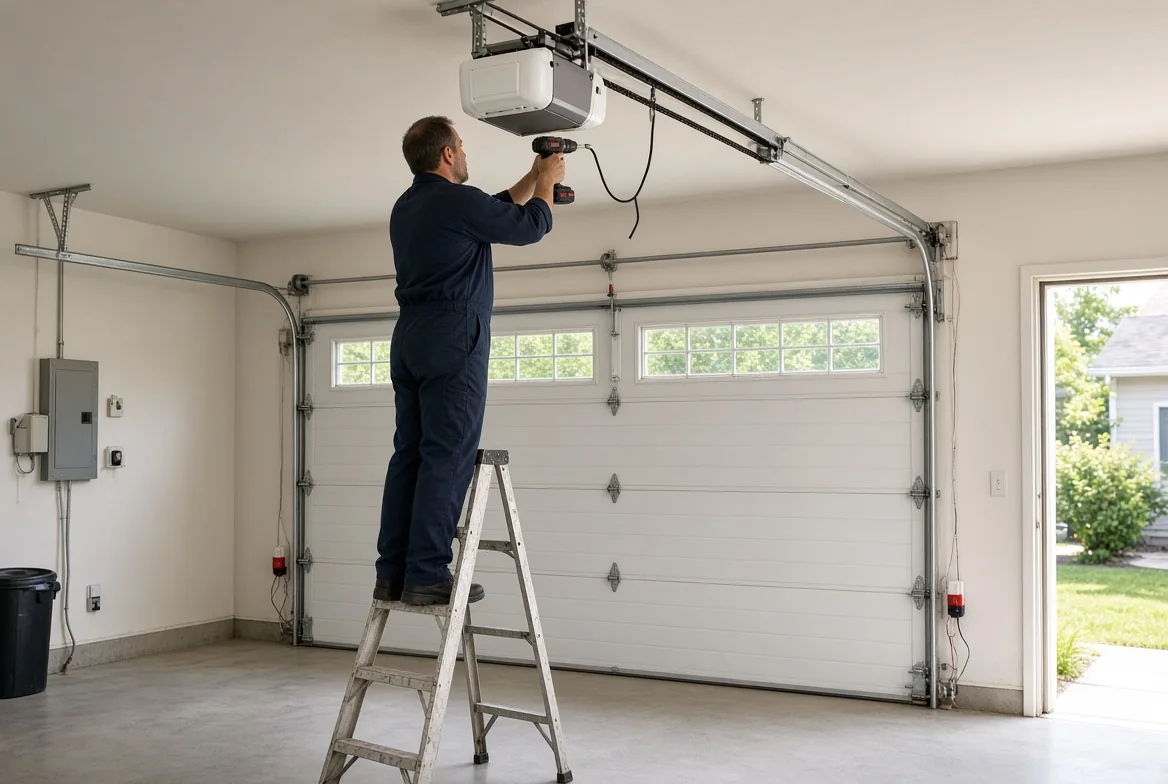
The short version
- Installation of garage door opener runs $300-$900 installed for most homes, with $500-$800 covering a quality mid-range belt-drive unit and professional labor. Dealer medians with premium equipment reach ~$1,000.
- The labor line is $150-$400 - $65-$85 an hour for a two-to-six-hour job, or about 3.6 hours at $190-$404 on a like-for-like replacement.
- Replacement is cheaper than a first install. Carrying over the rail, brackets and wiring is included in the labor; a door that never had an opener usually needs a GFCI outlet run, adding $150-$300.
- Installed by drive type: chain $220-$450, screw $240-$500, belt $270-$550, direct drive $320-$600, jackshaft $370-$700.
- DIY saves the labor, and nothing else - the unit, sensors and brackets cost the same. You trade $150-$400 for four to eight hours, and you own the travel-limit and force calibration that the safety reversal test depends on.
- UL 325 is not optional: openers must be listed and labelled to it under IRC R317 and the CPSC rule at 16 CFR part 1211, installed to the manufacturer's instructions, and proved with a safety reversal test before you pay.
Installation of garage door opener work is really two purchases: a box with a motor, rail and two remotes, and the two-to-six hours of measured work that puts it on your ceiling and makes it safe. Because those two purchases are quoted differently by different sellers, the same job shows up as $220 from one source and $996 from another - and both are honest numbers for different things.
This guide separates them for 2026: what the unit costs by drive type, what labor costs by the hour and by the job, the extras that quietly add $50-$300 to a quote, the permit and code requirements a compliant install has to meet, and the honest arithmetic on professional installation versus doing it yourself.
Installation of garage door opener: what it costs in 2026
The answer depends on whether the quoted figure includes the opener itself, which is why published ranges look so far apart. Pulled onto one table with the unit included, the numbers line up:
| What the number measures | 2026 figure | Source |
|---|---|---|
| Unit + professional labor installed, national range | $300-$900 (average $600; min $220, max $1,100) | HomeGuide |
| Straightforward chain or belt install, all in | $220-$700; mid-range belt drive $300-$450 | Garage Door Installation Cost, 2026 |
| Professional installation only (labor + incidentals) | $218-$540, average $379 | Angi, 2026 data |
| Installed per door, basic mid-range job | $498-$859 | Homewyse, May 2026 |
| Opener replacement, installed | $159-$499, average $329 | ConsumerAffairs, 2026 |
| Dealer-installed, median of real jobs | $996 (middle 50%: $523-$1,369) | A1 Garage Door Service, Aug 2026 |
| Big-box install program | $297-$737 total ($127-$199 install fee + unit) | Home Depot figures, ConsumerAffairs |
The practical takeaway: budget $300-$900, treat $500-$800 as the honest mid-range band for a quiet belt-drive unit with competent labor, and only expect to pass $1,000 if you are buying premium or wall-mount equipment, adding a first-time electrical run, or paying a dealer premium for a longer warranty.
Want an installed price, not a range?
A technician sizes the opener to your door's weight and wiring and quotes the job on the spot - no guesswork about whether you need a new outlet or a rail extension.
Request ServiceUnit, labor and extras, line by line
Three line items cover almost every quote. Materials are $150-$500, labor is $150-$400, and the total is $300-$900 for the same reason a repair bill is never just the part.
| Line item | 2026 cost | Notes |
|---|---|---|
| Opener unit | $150-$500 | Chain $150-$250, belt $200-$350, screw $175-$300, direct drive $250-$400, jackshaft $300-$500. Angi's range runs to $520, and premium smart units to $900+ |
| Labor | $150-$400 | $65-$85/hr over 2-6 hours (Angi); $60-$100/hr, labor alone $300-$600 (Yelp); 3.6 hours at $190-$404 (Homewyse) |
| Total installed | $300-$900 | Materials + labor. Extras in the next section sit on top |
Replacement or a door that never had an opener?
A swap is the cheap version of this job, and a first powered install is the expensive one - the difference is almost entirely electrical and mounting work. Reusing an existing opener's rail, mounting points and wiring cuts labor time, while a first-ever powered opener needs a dedicated outlet run and often extra bracing.
- ReplacementRail, brackets and existing wiring normally carry over. Removal of the old opener is usually inside the labor charge; some companies bill an extra half-hour for it.
- First-time installNew outlet run adds $150-$300 with an electrician; running electricity to a garage costs $10-$25 per linear foot. Expect extra ceiling framing too.
- Tall doorsAnything over 7-8 ft needs a rail extension kit: $45-$100.
- Two single doorsInstalling two openers doubles the labor line.
- BundlingIf a new door, springs or track are being installed at the same time, ask for a bundled price and save the second trip - a repeat service-call fee is $50-$100.
Installed cost by drive type
Drive type sets both the unit price and how long the install takes, so it is the single most useful column in any quote. Chain is the budget choice, belt is the quiet one, and jackshaft is the expensive one that frees your ceiling.
| Drive type | Unit cost | Installed cost | Best for |
|---|---|---|---|
| Chain drive | $150-$250 | $220-$450 | Lowest upfront cost; detached garages and heavy doors. Loudest of the four |
| Screw drive | $175-$300 | $240-$500 | Fast operation, fewer moving parts; more sensitive to temperature swings |
| Belt drive | $200-$350 | $270-$550 | Quietest trolley drive; attached garages and rooms above the garage |
| Direct drive | $250-$400 | $320-$600 | Very quiet, low maintenance, no chain or belt to wear |
| Jackshaft (wall-mount) | $300-$500 | $370-$700 | Frees the ceiling for storage or a lift; torsion-spring doors only, and unforgiving of an unbalanced door |
Local markets run wider than these national bands. Angi's 2026 location data puts installed chain drive at $350-$650, belt at $430-$850, screw at $350-$700, direct drive at $530-$1,000 and jackshaft at $700-$1,300 - a reminder that a quote $100 either side of the national figure is normal, and one 40% below it usually is not. Choosing smart features alone can add $250-$900 to the bill.
Horsepower is the second half of the price. Match the opener to the door's weight rather than buying the largest motor: up to 150 lb needs 1/3 HP, up to 350 lb needs 1/2 HP, up to 600 lb needs 3/4 HP, up to 750 lb needs 1 HP, and anything heavier needs 1-1/4 HP or more. Stepping up costs about $30-$80 on the unit. If the opener is failing rather than missing, the repair-or-replace decision comes first, and opener lifespan explains when replacement is the cheaper route.
What gets added to the quote
The unit and the labor are only the start of a realistic budget. These are the extras that appear on genuine 2026 invoices, and two of them - sensors and a rail extension - are hard to avoid.
| Extra | 2026 cost | When it applies |
|---|---|---|
| New safety sensors | $25-$100 ($25-$50 for a pair) | When the new opener is not compatible with your existing sensors - common on brand changes |
| Rail extension kit | $45-$100 | Doors taller than 7-8 ft |
| Extra remote | $20-$40 each | Second car, guest remote |
| Wireless keypad | $20-$70 | Keyless entry for family or dog walkers |
| Battery backup | $50-$100 on the unit, $50-$150 installed | Power-outage security; worth it where outages are routine - see opener battery replacement |
| Automatic door lock | $100-$300 | Deadbolt-style lock tied to the opener for security |
| Smart/Wi-Fi or camera features | +$50-$150 on the unit | App control and monitoring; app subscriptions run about $300 over ten years |
| Removal and disposal of the old opener | Usually included; $50-$100 if billed separately | Some companies quote removal as a separate line |
| Permit and inspection | $0-$150 (often about $50) | Only where the work is permitted - see codes |
| New outlet or circuit | $150-$300 | First-time installs with no power at the opener head |
Cost by brand and retail program
The brand changes the unit price far more than it changes the labor: the same technician installs a $140 opener and a $690 one in roughly the same time. These are 2026 unit prices before labor.
| Brand | Unit price |
|---|---|
| Craftsman | $140-$325 |
| Genie | $160-$450 |
| Guardian | $165-$230 |
| Chamberlain | $190-$500 |
| Linear | $210-$375 |
| LiftMaster | $225-$425 |
| Hörmann | $235-$690 |
| Sommer | $380-$520 |
LiftMaster is the professional-grade sibling of Chamberlain and the brand most dealers install, with the better parts availability and warranty support - Chamberlain is the same electronics at a big-box price with a segmented rail, and buying it means the warranty and safety calibration are yours. Genie undercuts both and integrates with more smart-home platforms.
Buying through a retail install program
Home Depot's program is the best-known fixed-price route: the unit runs $159-$499 and the install fee is a separate $127-$199, which puts a mid-range belt-drive package at roughly $327-$549 and a full range of $297-$737. It is a fair benchmark, not a bargain - a local garage door company usually beats it on an opener-only job and can fit brands the retailer does not stock.
Professional installation vs DIY
DIY removes exactly one line from the invoice - the $150-$400 labor - and adds hours of your own time plus the risk of a badly calibrated safety system. Here is the same job both ways.
| Item | Professional | DIY |
|---|---|---|
| Unit, sensors, brackets, accessories | $150-$500 | $150-$500 - identical |
| Labor | $150-$400 ($65-$85/hr) | $0, but 4-8 hours of your time as a first-timer |
| Time on site | 1.5-2.5 hrs typical; 2-6 hrs for a new install | 4-8 hrs, plus a return trip if the rail or brackets need adjusting |
| Tools | Included | Ladder, drill, sockets, level, wire strippers; a second person for overhead work |
| Safety calibration (travel limits, force, reversal test) | Done and tested as part of the job, to UL 325 | Yours to get right - this is where DIY installs fail |
| Permit and electrical | Usually handled or subcontracted | You arrange the electrician and the inspection |
| Warranty | Dealer-installed equipment carries the manufacturer's parts warranty, and the labor is often warranted too | Manufacturer's unit warranty only; retailer routes place installation and calibration on you |
The arithmetic is simple: $150-$400 saved against four to eight hours of work, with the safety calibration as the risk you are accepting. That trade is genuinely reasonable for a confident DIYer replacing a like-for-like opener, and clearly a bad one for a first-time install that also needs an outlet run, a heavier door or a jackshaft unit.
If the opener is failing rather than being replaced, note that a repair and an install are different budgets - a fault that looks terminal is often a sensor, a remote or a battery, and the brand-by-brand troubleshooting guide covers those before you spend on a new unit.
Permits, codes and safety: what the quote has to include
A compliant installation is not just a motor on a rail - the safety devices that make it legal are part of the price, and they are the first thing a cheap quote leaves out.
- UL 325 listingIRC R317 (formerly R309.4): automatic garage door openers must be listed and labelled to UL 325. Federal law backs it - the CPSC rule at 16 CFR part 1211 codifies UL 325's entrapment-protection requirements. Check for the UL mark on the head unit before installation.
- Obstruction detection and reversalUL 325 requires a means of detecting an obstruction in the opening - normally photoelectric sensors - and reversing the door. That is why new sensors are part of a legitimate quote.
- Install to the manufacturer's instructionsThe 2024 IRC added an explicit requirement to install garages and openers per the manufacturer's instructions, which makes rail type, header-bracket position and force/travel calibration mandatory rather than optional.
- PermitsThe IRC makes repairs and alterations permit-requiring work and does not exempt garage doors and openers. In practice an opener-only swap often proceeds without one, but it is an inspection item wherever other permitted work is done. Budget $0-$150; the fee varies by jurisdiction.
- ElectricalThe garage needs one GFCI-protected receptacle per vehicle bay, on a circuit that cannot serve outlets outside the garage. A new dedicated outlet at the opener head is part of a first-time install.
- Safety reversal testThe job is not finished until the door has been tested: obstruct the path and confirm the door reverses. Ask for the test, and for the travel-limit and force settings to be explained to you.
What the price should already include
A professional install covers assembly, mounting, electrical connection, sensor installation and alignment, remote programming, force and travel-limit calibration, and the safety reversal test. If a quote itemises the safety test or the sensor alignment as extras, ask why - on a compliant job they are not add-ons.
How to budget the job: step by step
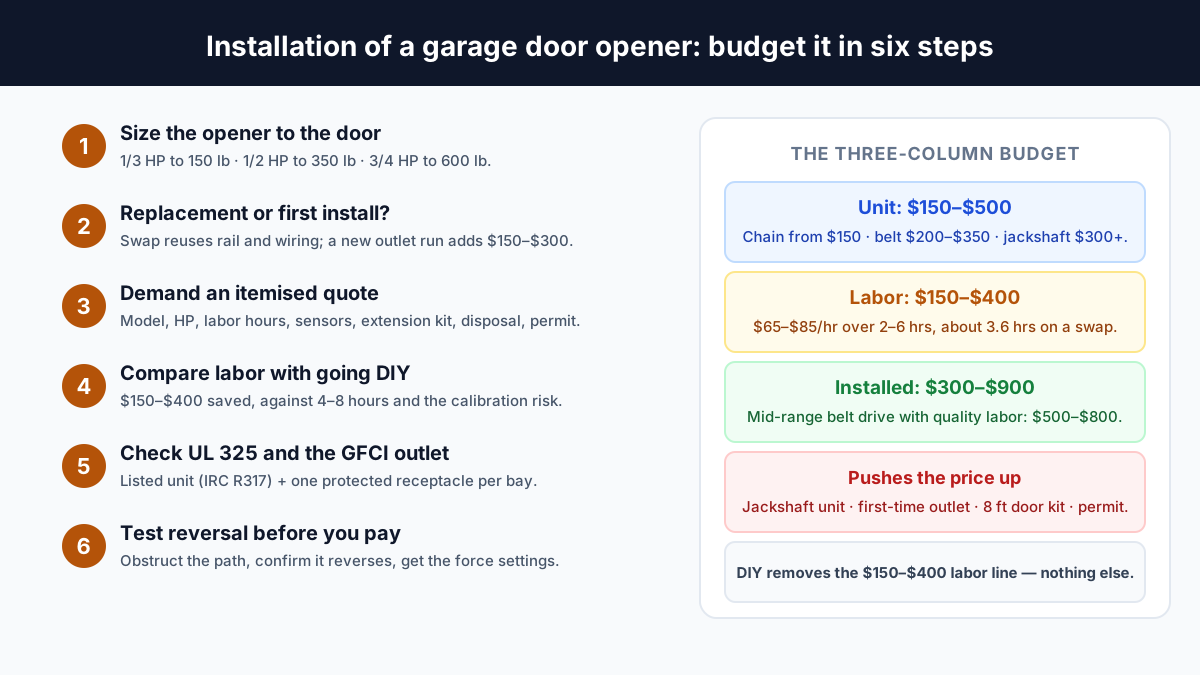
1. Size the opener to the door
- WhyHorsepower is set by door weight - 1/3 HP to 150 lb, 1/2 HP to 350 lb, 3/4 HP to 600 lb, 1 HP to 750 lb, 1-1/4 HP above that - and stepping up costs only about $30-$80. Measure the door height too: over 7-8 ft needs a $45-$100 rail extension kit.
2. Decide replacement or first-ever install
- WhyA replacement reuses the rail, brackets and wiring, so labor stays at the low end. A door that never had an opener needs a GFCI outlet run - $150-$300 with an electrician - plus possible ceiling framing.
3. Get an itemised quote
- WhyModel and horsepower, labor hours at a stated rate, sensors, extension kit, removal and disposal, permit fee. Lump-sum quotes hide which of those you are getting - and comparing a labor-only figure with an installed figure is how homeowners conclude they have been overcharged.
4. Compare the labor charge with the DIY route
- WhyLabor is the only line DIY removes: $150-$400, or 3.6 hours at $190-$404. In exchange you spend four to eight hours and own the travel-limit and force calibration that the reversal test depends on.
5. Check UL 325 and the electrical requirement
- WhyThe opener must be listed and labelled to UL 325 and installed to the manufacturer's instructions. The garage needs one GFCI-protected receptacle per vehicle bay on a circuit serving nothing outside the garage.
6. Require the safety reversal test before payment
- WhyTest the door with an obstruction in its path and confirm it reverses, and have the installer explain the force and travel-limit settings. Keep the documentation and UL listing details until any permit is closed.
What to ask before you sign
Five questions separate a fair quote from a cheap one, and they cost nothing to ask.
- Is the opener UL 325 listed, and does the price include new sensors?If sensors are not included and your existing ones are incompatible, add $25-$100 - and an opener without working obstruction detection does not meet the standard.
- How many labor hours are you quoting, and at what rate?Hourly rates run $65-$85 for a garage door technician and 2-6 hours is the honest spread; a fixed price is fine as long as it names the model and horsepower.
- Does that include removing and disposing of the old opener?Usually yes - some companies bill it as an extra half-hour or a $50-$100 disposal line.
- Do you handle the permit and the electrical work?Where a permit applies ($0-$150) and where a new circuit is needed, the answer tells you whether you are hiring one company or two.
- What does the warranty cover - the unit, the labor, or both?Dealer-installed equipment normally carries the manufacturer's parts warranty plus a labor warranty; DIY keeps the unit warranty but places calibration on you.
Frequently asked questions
How much does installation of a garage door opener cost in 2026?
Most homeowners pay $300-$900 installed for a standard opener, with a common quality mid-range band of $500-$800. That splits into $150-$500 for the unit and $150-$400 for labor. Labour-only quotes run $218-$540 and average about $379, while a straightforward chain-drive opener that never had one can land as low as $220-$450 all in and a dealer-installed premium unit with permits can exceed $1,000.
How much is labor to install a garage door opener?
Labor runs $150-$400, or $65-$85 an hour for a two-to-six-hour job. Measured as a unit of work, a basic opener installation is about 3.6 hours at $190-$404. Replacing an existing opener costs less in labor than a first-time install because the rail, mounting brackets and wiring usually carry over.
Is it cheaper to install a garage door opener yourself?
Yes, by roughly the labor line - $150-$400 - but that is the whole saving. The unit, safety sensors, brackets and accessories cost the same either way, and a first-time install takes four to eight hours instead of the one-and-a-half to two-and-a-half hours a technician needs. The catch is travel-limit and force calibration: mis-adjusted settings can leave the door closing on objects or failing its safety reversal test, and DIY installation typically leaves warranty and safety calibration with you.
Does installing a garage door opener need a permit?
Usually not for a straight replacement, but the requirement exists: the IRC makes repairs and alterations permit-requiring work and does not exempt garage door work, so some jurisdictions require a permit and treat the opener as an inspection item - typically $0-$150 where one applies. Adding or extending an electrical circuit to feed a new opener is what normally triggers a permit and an electrician.
How long does installation of a garage door opener take?
A professional replacement takes about 1.5 to 2.5 hours on average, with a range of two to six hours for a new installation that includes the rail, brackets, sensors and programming. Homewyse's cost model uses 3.6 hours of basic labor for an opener install. A first-time DIY install commonly takes four to eight hours.
What does Home Depot charge to install a garage door opener?
Home Depot's opener installation program charges a separate install fee of about $127-$199 on top of the unit, which runs $159-$499, putting the bundled total around $297-$737 or roughly $327-$549 for a mid-range belt-drive package. A local garage door company often comes in under that for an opener-only job and can fit a wider range of brands and models.
Do I need new safety sensors when the opener is replaced?
Often yes. New sensors cost $25-$100, or $25-$50 for a pack of two, and a new opener is not guaranteed to be compatible with your existing sensors. A quote that keeps the old sensors should say so explicitly, because the sensors are what makes a closing door reverse - and that function is required by UL 325.
How much more does a belt-drive opener cost installed than a chain drive?
About $50-$100 on the unit, and roughly $50-$100 installed: chain-drive units cost $220-$450 installed, belt-drive $270-$550. Belt drives use a steel-reinforced rubber belt instead of a metal chain, so they run noticeably quieter, which is why they are the usual upgrade for an attached garage with a bedroom above it.
A note on accuracy
This is general homeowner guidance, not a substitute for an on-site quote. Cost, labor and permit figures are national-average ranges for 2025-2026 and vary by region, door weight, existing wiring and opener brand.