The short version
- Garage floor resurfacing costs $1,200-$3,000+ for a standard 2-car garage ($3-$8 per sq ft), against $6,000-$15,000+ to break out and replace the slab.
- Resurface when the concrete is failing - widespread spalling, pitting, salt scaling or shallow dips. Coat it when the slab is sound and flat and the problem is only cosmetic.
- A coating is not a repair. Epoxy and polyaspartic bond to what is underneath, so defects telegraph straight through the film and become the first places it wears or peels. Reputable crews will not coat a failing slab.
- Prep is the whole job. An overlay needs a profile of CSP 3-5 (ICRI 310.2R), verified slab moisture (ASTM F1869 or F2170), and every hollow spot sounded out and removed. Skip that and resurfacing can fail in 1-3 years instead of lasting 8-15.
- Walk on it in hours, park on it in a week. Foot traffic returns in 2-4 hours and many compounds accept a car after 16-24 hours, but plan on 7 days before regular vehicle traffic.
Garage floor resurfacing is the fix for a floor whose concrete has failed, not one that just looks tired. The distinction matters, because the two problems have different answers and the wrong one wastes money: a coating over a spalled or pitted slab peels within a season, while a bonded overlay placed on a floor that is still settling cracks along exactly the same lines as the slab underneath.
This guide sorts the three outcomes - coat, resurface, replace - then prices each one for 2026, walks the six-stage sequence a crew actually follows, and lists the checks that separate a quote worth signing from one that will fail inside three years.
What garage floor resurfacing actually is
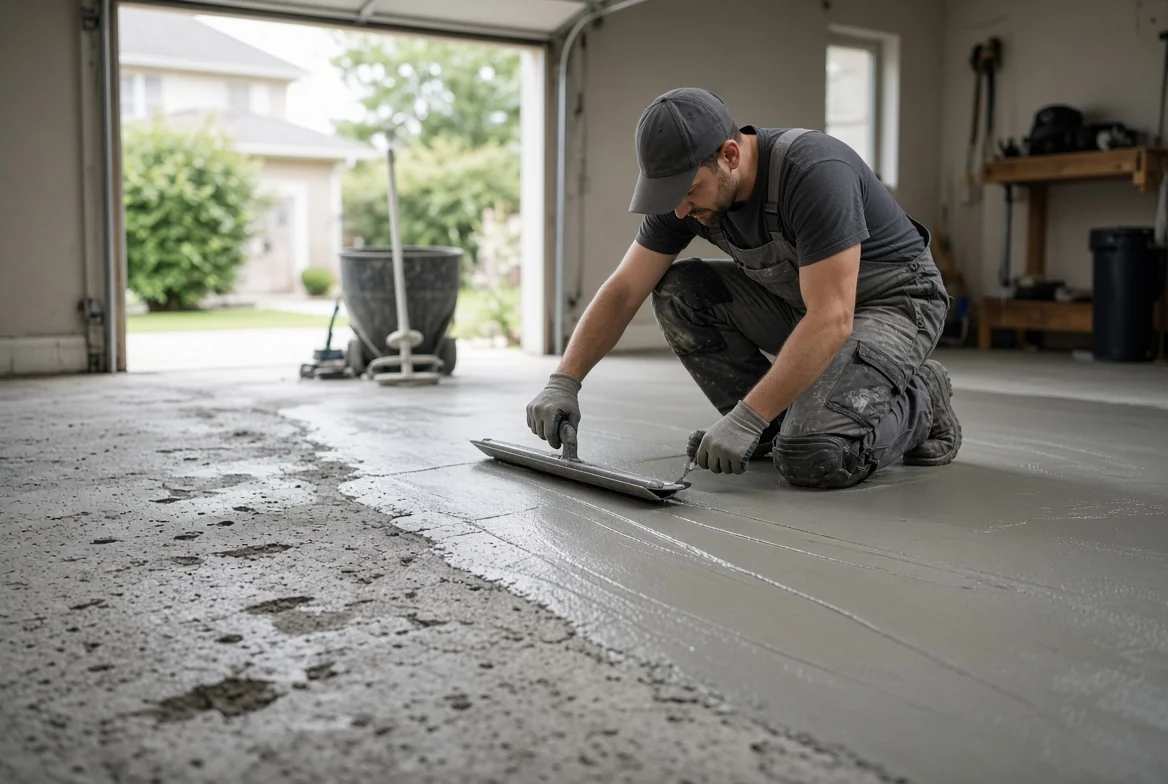
Garage floor resurfacing is a new bonded wear layer placed over your existing slab - not a sealer, not a paint, and not the same thing as a coating.
The sequence is always the same shape: clean and strip the concrete, repair what is broken in it, mechanically open the surface so a new layer can grip, then bond that layer on and cure it. What you end up with is a floor whose top eighth of an inch is new - a fresh wear course that takes the salt, the tyres and the jacks - sitting on the slab you already own.
That is why resurfacing can rescue a floor that looks finished. SUNDEK, which installs decorative overlays across the US, states that in about 90% of cases, as long as there is a viable substrate, resurfacing is more cost-effective than tearing the concrete out and starting again. You are keeping the part of the floor that was expensive - the slab, the base and the reinforcement - and replacing only the part that wore out.
Coat, resurface or replace: the decision
Everything on this page reduces to one question: is the slab sound? If it is, you are choosing a finish. If it is not, you are repairing concrete, and a coating is not on the menu yet.
| What the floor is doing | Right answer | Typical cost |
|---|---|---|
| Sound, flat, dry - dull, stained, scratched | Coat it. Epoxy or polyaspartic over a prepared slab | $4-$10 per sq ft |
| Pitted, spalling, flaking, salt-scaled across the field | Resurface it. Bonded cementitious overlay | $3-$8 per sq ft ($1,200-$3,000+) |
| Sound but dished or out of level in spots | Resurface or level it. Self-levelling overlay over a deeper profile | $3-$25 per sq ft |
| Wet from below; odd damp patches; coating keeps blistering | Mitigate, then resurface. Moisture-mitigation primer first | $2-$10 per sq ft added |
| Actively sinking, height difference across a crack, hollow all over | Replace it. An overlay inherits the defect | $6,000-$15,000+ |
Two facts explain the whole table. First, a coating bonds to whatever is under it - so if what is under it is flaking, the coating flakes with it. Thin films telegraph slab defects straight through, and those defects become the first places the finish wears through. Second, an overlay bonds to what is under it too, so an overlay over a slab that is still moving reproduces the movement through the new surface.
A coating over a failing slab is money thrown away
"Our contractors will not apply a coating to a surface that's failing, as it is in everyone's best interest to have it removed." That is SUNDEK's own published position, and it is the industry norm - not a sales tactic. If a contractor offers to coat a floor that is spalling, pitting or scaling, get a second quote.
Signs your garage floor needs resurfacing, not a coating
Spalling and pitting are the two words that decide the job. Spalling is the loss of thin layers or chips from the slab's surface; pitting is small crater-like holes that let water in - and both expose weaker aggregate underneath while the damage slowly spreads.
- Flaking, peeling or scalingThin layers lifting off the surface, often in a patchwork of shallow craters. The classic sign that the top layer of concrete - not the finish - has failed.
- Pitting and small cratersLittle holes that hold water and grit. Water sitting in them freezes, expands and takes more surface with it each winter.
- Salt damage and white stainingRoad salt carried in on tyres and left on the floor. Thin layers of the surface scale away, and it is one of the most common causes of a flaking garage floor in cold-weather states.
- Exposed aggregateYou can see the stones where the cement paste around them has gone. The wear layer is already gone; there is nothing left to coat.
- Shallow dips, hollows and uneven patchesA coating cures to the shape of the floor it was poured on. Low spots need filling, not painting over.
- A coating that already peeledUsually the coating failed because of what was under it - weak or contaminated surface, or moisture coming up through the slab. Re-coating without fixing that repeats the failure.
What causes it is worth knowing, because the cause shapes the repair. The most cited drivers are freeze-thaw cycling (water in the pores freezes, expands and pries the surface off), de-icing salts, and how the slab was originally finished - an over-troweled or over-watered mix leaves a weak, low-density top layer, and concrete that was not properly cured never develops its intended surface strength. Corroding reinforcement sitting too close to the surface also pushes the cover concrete off.
If your damage is a handful of long cracks rather than a failing surface, it is a different (and cheaper) conversation - we cover the width thresholds and the repair costs in cracks in garage floor.
The resurfacing options compared
"Resurfacing" is a family of products, not one. The right one depends on how deep the damage goes and how flat the slab is.
| Option | Build | Best for |
|---|---|---|
| Bonded cementitious overlay (full resurfacing) | ~1/4 in to 1/2 in | A floor that is pitted, spalled, scaled or uneven across most of its area. The default "resurfacing" and what most quotes mean. |
| Microtopping / skim coat | Thin, decorative | A sound slab that only needs a new finish. Cosmetic - it will not bridge movement. |
| Self-levelling overlay | Poured flat | Dished or out-of-grade slabs that need re-flattening while being rebuilt. |
| Spot patching only | Trowel-applied | Isolated cracks, spalls or holes. The cheapest route - repair rather than resurfacing. |
| Epoxy or polyaspartic coating | 10-40 mil film | A sound, flat, dry slab that needs protection and colour. Never a substitute for repairing a failing surface - see epoxy vs. polyaspartic. |
| Slab replacement | New pour | Settlement, widespread delamination, or unresolved moisture. The last resort. |
The most common real-world answer is the first row plus the fifth: resurface the slab, then coat the new surface. Resurfacing is frequently paired with an epoxy or polyaspartic topcoat for appearance and extra chemical resistance, and because you are coating a brand-new, properly profiled and dry surface, the coating finally has something worth bonding to.
What garage floor resurfacing costs in 2026
Garage floor resurfacing costs $1,200 to $3,000+ for a standard 2-car garage, or roughly $3 to $8 per square foot. Across all slab types and finishes, Angi reports a project range of $600 to $13,000 with an average near $2,000, and decorative or stamped overlays run $6 to $20 per square foot.
| Scope | Typical cost |
|---|---|
| Resurfacing a 2-car garage | $1,200-$3,000+ |
| Per sq ft, basic overlay | $3-$7 |
| Per sq ft, decorative or stamped overlay | $6-$20 |
| Per 100 sq ft (national average) | ~$500 |
| 24 x 24 ft garage or driveway | $1,700-$2,900 |
| Concrete overlay, mid-range design | $7-$12 per sq ft |
That headline price is a package of smaller line items, and knowing them is how you read a quote. These are the national ranges for the individual repairs that make up a resurfacing job.
| Line item | Typical cost |
|---|---|
| Cleaning and pressure washing | $150-$500 |
| Oil stain removal | $100-$250 |
| Crack patching or filling | $200-$1,000 |
| Hairline crack repair | $200-$800 |
| Spalling repair | $500-$3,000+ |
| Pitted floor repair | $500-$2,000 |
| Salt damage repair | $200-$750 |
| Crumbling floor repair | $750-$3,000 |
| Levelling an uneven floor | $3-$25 per sq ft ($500-$2,500 per job) |
| Polyjacking / mudjacking (whole garage floor) | $1,100-$5,400+ |
| Moisture mitigation | $2-$10 per sq ft |
| Sealer after resurfacing | $1-$3 per sq ft |
| Full slab replacement (comparison) | $6,000-$15,000+ |
Two things move the number more than floor size. Labour is 50-70% of the bill at $50-$100+ per hour, and most of that labour is preparation - grinding, crack routing, patching, vacuuming and testing - which is invisible in the finished floor. And moisture: a slab that fails a moisture test needs a mitigation primer quoted as its own line item (roughly $1.50 per sq ft in materials), not absorbed into a "we'll make it work" price.
Read the quote for prep, not for finish
A resurfacing quote that lists the overlay product but not grinding, crack routing, moisture testing or a bonding primer is not cheaper - it is incomplete. Those steps are the difference between a floor that lasts 8-15 years and one that fails in 1-3.
Not sure whether your floor needs a repair or a resurface?
A technician can sound the slab, test it for moisture and tell you which of the three answers is honest.
Request ServiceHow the job is done: profile, moisture, bond
A resurfacing job succeeds or fails before the overlay is ever opened. The six stages below are the sequence a professional crew follows - and the four checks in the middle are what separates a 15-year floor from one that peels in one.
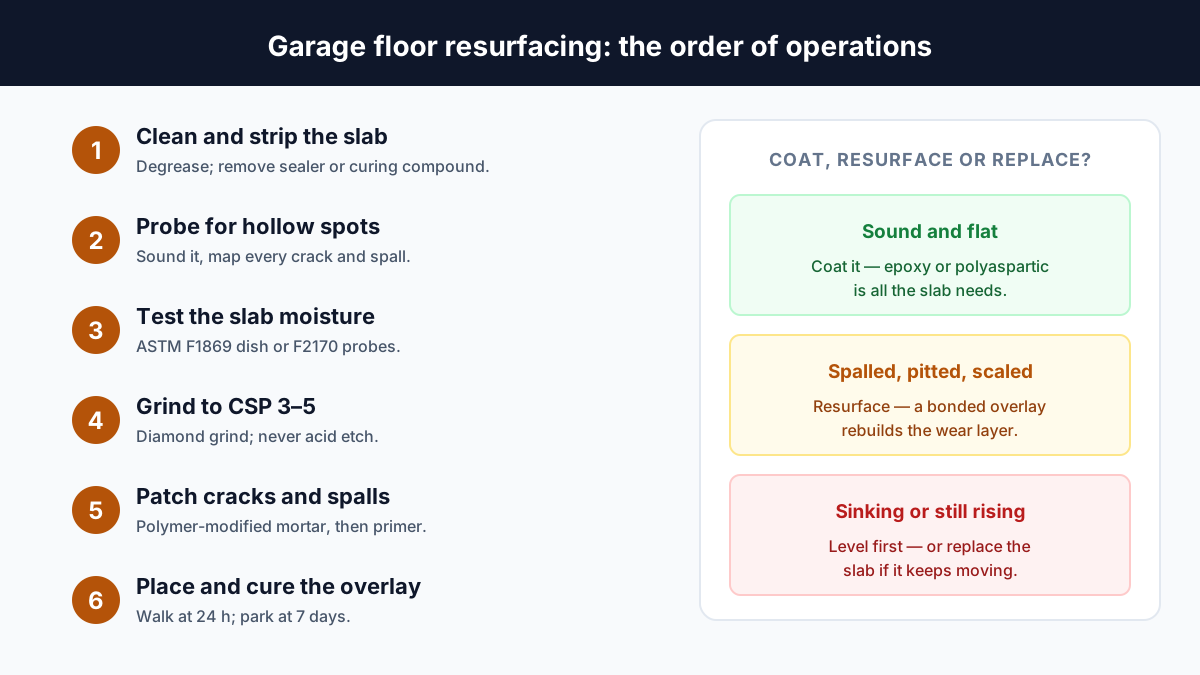
1. Clean and strip the slab
- What happensVacuum and pressure-wash, degrease oil and salt staining, and remove anything already sitting on the surface - old sealer, paint, curing compound or a failed coating. A bonded overlay has to reach bare, sound concrete.
2. Probe the slab for hollow areas
- What happensA sounding survey - chain drag or hammer - finds hollow, delaminated areas that will not hold an overlay, and a crack map records every crack's location, width and any height difference across it. Both are marked and quantified before the job is priced.
3. Test the slab's moisture
- What happensTwo ASTM tests govern this, and they measure different things. ASTM F1869 is a sealed calcium chloride dish left on the slab for 60-72 hours; it reads surface moisture-vapour emission, needs three tests minimum for the first 1,000 sq ft, and typically passes at 3 lb/1,000 sq ft/24 hr for epoxy or 5 lb for polyaspartic. ASTM F2170 reads relative humidity inside the slab with probes set to 40% of slab depth, equilibrated for 24 hours, typically passing at 75% RH for epoxy and 80% for polyaspartic. The two results do not convert into one another.
4. Diamond-grind to the required surface profile
- What happensThe floor is mechanically opened to a concrete surface profile of CSP 3 to 5 per ICRI Technical Guideline 310.2R - the roughness an overlay needs to key into - and verified on the slab against ICRI replica chips rather than by eye. Diamond grinding, shot blasting and scarifying each cut a measurable profile; acid etching cannot produce or prove one and leaves residue that blocks the bond.
5. Patch the cracks and spalls, then prime
- What happensDormant cracks and spall craters are filled with a polymer-modified repair mortar that bonds to the old slab and cures stronger than the concrete around it, low spots are corrected so the overlay cures to even thickness, and existing control and expansion joints are honoured and carried through the new layer. Then the whole floor is vacuumed and the bonding primer specified by the overlay maker goes down.
6. Place and cure the overlay
- What happensThe overlay is placed at the manufacturer's scheduled thickness - typically about 1/4 in to 1/2 in - finished while plastic, and cured as specified. Foot traffic returns within 2-4 hours; plan on 7 days before regular vehicle traffic.
Where bond is in question, a contractor can verify it rather than assume it: ASTM C1583 pull-off testing at three or more locations measures whether the prepared surface will actually hold the new layer. Overlay specifications are written against a small set of published standards - ICRI 310.2R and 310.1R for surface profile, ACI 546R for concrete repair, ASTM C1583 for bond, and ASTM F1869 / F2170 for moisture. A contractor who can name them is working from a spec; one who cannot is guessing.
How long it lasts and when you can park on it
With proper preparation and a professional install, resurfacing lasts 8 to 15 years, and consistent maintenance can extend that to 20 years or more. Angi's consumer data puts the average closer to 8 years with a 5-12 year typical band; Concrete Network notes that with good prep and upkeep, resurfaced concrete can reach 25 years.
- Good prep, good materials8-15 years, extendable to 20+ with regular cleaning and resealing.
- Poor prep or bargain materialsFailure in as little as 1-3 years. This is the range that separates quotes - not the finish colour.
- Maintenance premiumRoutine cleaning and resealing every few years can add 5-10 years to the life of the surface.
- Compared with replacementA new slab lasts 20-30 years but costs several times more up front - $6,000-$15,000+ versus $1,200-$3,000+.
Curing: when the cars can come back
Foot traffic is fine within 2-4 hours. Many resurfacing compounds accept a vehicle after 16-24 hours, but the published advice from Concrete Network is to leave at least 7 days before standard vehicle traffic, and that is the number to plan the week around. Keep the surface dry, keep it above freezing, and do not park tyres on it early just because it looks hard - the surface reaches full strength well after it looks finished.
Repair-only jobs: cracks, spalls and oil
Not every damaged floor needs a full resurface. Isolated damage on a slab under about 20 years old with a sound base is usually cheaper to patch than to rebuild - spot repairs run $200-$1,000 for cracks and $500-$2,000 for limited spalling, against $1,200-$3,000+ for a full overlay.
The rule of thumb: patch when the damage is localised, resurface when it is distributed. Two or three cracks and one spalled patch by the door is a patching job. A floor where the surface is flaking across the whole field, or where you can see aggregate everywhere, is not - there is nothing sound left on top for a patch to key into, and the patches will simply outline the next failures.
Repairs are also the right first move for epoxy garage floor repair specifically. When a coated floor develops cracks, chips or a peeling patch, the fix is to route and fill the damage, grind back to sound concrete, and re-coat the affected area - the coating is only ever as good as the concrete under it.
When to replace the slab instead
An overlay bonds to what is under it and inherits its problems, so there are three findings that make replacement - not resurfacing - the honest answer:
- Active differential settlement. One side of a crack sitting visibly higher than the other, or a floor that keeps moving. The slab needs levelling or replacement, not a cosmetic layer.
- Widespread delamination. A sounding survey that finds hollow, unbonded concrete across large areas. There is not enough sound surface left to bond to.
- Unresolved moisture intrusion. Water getting in from below with no fix at the source. A coating or overlay over a wet slab blisters and releases, and the moisture problem is still there.
Placing a bonded layer over any of those buys a season of appearance and then reproduces the original defect through the new surface. Full slab replacement runs $6,000 to $15,000+ for a garage - commonly $6-$12+ per square foot, or $2,400-$6,900+ for a 2-car slab before finishes - which is exactly why resurfacing is worth doing properly the first time when the slab is sound.
A note on accuracy
This is general homeowner guidance, not a substitute for an on-site inspection. Cost figures are national-average ranges for 2025-2026 and vary by region, slab condition and repair method. The prep standards quoted (ICRI 310.2R, ASTM F1869, ASTM F2170, ASTM C1583) are the ones overlay manufacturers write their own specifications against - ask your contractor which numbers they are working to.
Hiring a garage floor repair company
Because most of a resurfacing job is invisible prep, you cannot judge a quote by the finish. You judge it by whether the prep is priced at all.
- Ask what surface profile they are targetingThe correct answer for an overlay is CSP 3-5 per ICRI 310.2R, verified against replica chips - and that they grind or shot-blast rather than acid-etch.
- Ask how they test for moistureASTM F1869 or ASTM F2170, with the readings documented. "It looked dry" is not a test.
- Ask them to sound the slabHollow or delaminated areas need to be found and removed before pricing, otherwise you are paying to bond a new layer to a defect.
- Ask what happens to existing jointsControl and expansion joints should be honoured through the overlay, not filled - filling them causes random cracking around them.
- Ask for the warranty in writing, and what it excludesLook specifically for whether moisture and substrate conditions are excluded, since those are the two most common causes of failure.
- Get three written estimates and compare line itemsThe cheapest quote is usually the one that omitted grinding, testing or priming.
Frequently asked questions
What is garage floor resurfacing?
Garage floor resurfacing is the process of bonding a new cementitious wear layer over an existing concrete slab so the floor looks and performs like new. The old floor is cleaned and stripped, cracks and spalls are patched, the surface is ground to a rough profile for grip, a bonding primer is applied, and then the resurfacing compound is placed and cured. Unlike a coating, the new layer is a wear course in its own right - it rebuilds the surface rather than just sealing it.
How much does garage floor resurfacing cost?
Resurfacing a standard 2-car garage runs $1,200 to $3,000+, which works out to roughly $3 to $8 per square foot. A basic single-colour overlay sits at the low end and decorative or stamped finishes run $6 to $20 per square foot. Across all types of concrete, Angi puts the total project range at $600 to $13,000 with an average around $2,000. Resurfacing beats full replacement, which starts around $6,000 and often runs to $15,000 or more.
When should I resurface my garage floor instead of coating it?
Resurface when the concrete itself is failing - widespread spalling or flaking, pitting, salt scaling, or shallow depressions - because a coating bonds to whatever is underneath and will telegraph those defects through the film until it peels. A coating is enough only when the slab is sound, flat and dry and the problem is cosmetic: dullness, light staining or wear marks. Professional resurfacing contractors will not coat a slab that is failing; the failing surface has to be removed or rebuilt first.
How long does garage floor resurfacing last?
With good surface preparation and a professional install, resurfacing lasts 8 to 15 years, and consistent maintenance can push that to 20 or even 25 years. The flip side is unforgiving: jobs with poor prep or cheap materials can fail in as little as 1 to 3 years. Cleaning and resealing the surface every few years is the single biggest factor in getting the long end of that range.
How long before I can park on a resurfaced garage floor?
Plan on 7 days before regular vehicle traffic. Resurfacing compounds are usually hard enough to walk on within 2 to 4 hours and many product datasheets allow driving over them after 16 to 24 hours, but Concrete Network advises letting newly resurfaced concrete cure for at least 7 days before it takes standard vehicles. Keep the floor dry and out of freezing weather during that window.
Do I need to repair the cracks in my garage floor before resurfacing?
Yes - filling them is part of the job. Any crack wide enough to hold a repair material gets routed out and filled with a polymer-modified mortar or epoxy patching compound before the overlay goes down, otherwise the new layer spans a void and cracks along exactly the same line. Existing control and expansion joints are different: they must be honoured and carried through the new surface rather than filled.
Can a garage floor be too far gone to resurface?
Yes. Resurfacing is the wrong answer when a slab is actively settling with a visible height difference, when a sounding survey finds widespread hollow, delaminated concrete, or when moisture is getting in from underneath and has not been fixed at the source. An overlay bonds to what is under it and inherits its problems, so in those cases the slab is levelled first or replaced - full replacement runs $6,000 to $15,000+.