The short version
- An insulated garage door cost typically lands between $1,100 and $4,200 installed in 2026, with a national average near $1,500. Uninsulated, the same door averages about $1,200 - so the insulation is usually $100 to $500 of the price, not the whole bill.
- The figure to weigh is the premium over a comparable uninsulated door: roughly $100 to $1,200 depending on core and construction. That is the money the energy saving has to repay.
- R-6 to R-9 is polystyrene, R-12 to R-18 is polyurethane. Polyurethane delivers about R-6.5 per inch against roughly R-4 for polystyrene, and because it is injected it also stiffens and quiets the panel.
- The garage's relationship to the house decides everything. An attached garage with living space above is where the maths works ($100–$200 a year, often re-paying the premium in 3–5 years). A detached, unheated garage in a mild climate saves $20–$40 a year - fix the seals instead.
- Seal before you insulate. A door with a dead bottom seal leaks more air than a lower-R door with fresh seals, and a 16-ft threshold kit costs $50–$120.
- Ask for whole-door R-value, not the foam number. Two doors sold as "R-16" can differ once layer count and thermal breaks are counted.
- A heavier door needs balanced springs. Insulation adds mass, and the springs and opener have to be checked or re-rated.
Most quotes for an insulated garage door quote the whole door, which makes it hard to see what you are actually paying for the insulation. It is usually a small slice: depending on the source, the insulated core adds anywhere from $100 to $500 to a comparable door, or an $800 to $1,200 premium when you are moving from a single-layer steel door to a genuine mid-grade polyurethane one.
That premium is the number worth arguing with, because it is the number the energy saving has to repay. Whether it does depends far more on where the garage sits in the house than on the R-value printed on the box.
Insulated garage door cost in 2026
Across the 2026 cost guides, an insulated garage door installed runs $1,100 to $4,200, with a national average near $1,500. A comparable uninsulated door averages about $1,200, which is why the honest way to price the upgrade is as a premium rather than as a full-door figure.
| Tier | R-value | Installed cost (16×7) | What you get |
|---|---|---|---|
| Uninsulated single-layer steel | R-0 to R-2 | $800–$1,400 | One steel skin, no core, no thermal break - the baseline |
| Entry insulated (polystyrene) | R-6 to R-9 | $1,200–$1,800 | Foam board sandwiched between two steel skins |
| Mid-grade (polyurethane) | R-12 to R-18 | $1,500–$3,200 | Injected foam bonded to both skins; stiffer, quieter, better seal |
| Premium insulated | R-18+ | $2,500–$5,000+ | Thicker sections, higher-grade seals, upgraded hardware |
The insulation premium - what you pay above a like-for-like uninsulated door - is where the guides diverge, and the difference is mostly what counts as "comparable":
| Basis | Insulation premium | Source framing |
|---|---|---|
| Core spec on a build sheet | $100–$500 | Polystyrene adds $100–$300; polyurethane $200–$500 to the same door |
| Whole-door upgrade, steel → mid-grade polyurethane | $800–$1,200 | The premium used in the payback maths |
| Door price premium (R-13 spec) | $200–$600 + $25–$75 labour | Combined upfront premium $225–$675 |
| Family Handyman single-door range | $750–$2,300 typical | Size-driven: one-car $700–$1,550, two-car $2,400–$2,900 |
Two further lines turn up in almost every real quote and are worth budgeting for: old-door removal and disposal (about $100) and a permit ($40–$120 where one is required). Insulated door installation labour runs $300 to $500 and the job takes three to six hours.
Not sure which R-value your garage actually needs?
We match the door spec to the garage - attached or detached, heated or not, ceiling insulated or bare - so you are not paying for R-value the rest of the envelope throws away.
Request ServiceWhat R-value really means on a garage door
R-value measures how well a material resists heat flow, and the number on a garage door is normally a calculated figure for one door section - not a measurement of the whole installed door.
That distinction is set out in DASMA's technical guidance, and it matters more on garage doors than on anything else in the house. A fitted door is not one panel: it is multiple sections coupled together, plus track, hardware, hinges and weather seals. Section joints, stiles and steel edges create what the standard calls a "thermal shortcut" around the insulation, so the real performance of the assembly is lower than the centre-panel figure suggests.
- R-value is calculated, U-factor is testedR-value describes an individual door section. U-factor is measured on the complete installed assembly under ANSI/DASMA 105, and the two are not comparable - they are not even reciprocals of each other.
- Building codes speak U-factorWhere a jurisdiction has adopted the 2021 energy code, the garage door requirement on an attached garage is expressed as a U-factor threshold, not an R-value.
- Thermal breaks do the unglamorous workA non-conductive spacer between the inner and outer skins at the panel edges stops the steel conducting outside cold straight into the garage. Without one, the centre-panel R-value is largely undone at the seams.
- Two-layer and three-layer are different productsTwo-layer means foam board behind a skin; three-layer means the foam is captured between two skins. Two doors can both be sold as "R-16 foam" and perform differently.
- Condensation is the tellWater beading on the interior steel in winter usually means there is no proper thermal break at the panel edges, or the interior humidity is out of control - the skin has dropped below the dew point.
Ask for the whole-door figure
When you compare quotes, ask for the whole-door R-value - or better, the tested U-factor where a label exists - rather than the foam core rating. It is the single question that separates two doors with the same marketing number.
Polystyrene vs polyurethane: which core to buy
Polyurethane is the better insulator and the more rigid panel, and it costs 15 to 30 percent more than polystyrene for exactly that reason.
| Core | R-value per inch | Typical whole-door R | Strengths | Trade-offs |
|---|---|---|---|---|
| Polystyrene (EPS/XPS board) | About R-4 | R-6 to R-9 | Cheaper, lighter, will not strain springs, less prone to bowing in sun | Rigid boards leave micro-gaps at rails and stiles; no structural gain |
| Polyurethane (injected) | About R-6.5 | R-12 to R-18 | Bonds both steel skins: stiffens the panel, resists denting, noticeably quieter, no internal air gaps | Costs 15–30% more, heavier (spring capacity matters), more prone to thermal bowing in intense sun |
The per-inch gap is what people miss: a two-inch polyurethane door reaches roughly R-13, while a two-inch polystyrene door lands closer to R-8. That is the difference between the entry tier and the mid tier, and it is where most of the real thermal performance lives.
The honest caveat on polyurethane is thermal bowing - a documented behaviour in doors with a bonded core, and more common in intense, high-altitude sun. Polystyrene, being lighter and unbonded, is less prone to it. If you are framing a dark, south-facing door in a very sunny climate, that is a genuine argument for the lighter core.
What an insulated garage door actually saves
The physics is not in dispute. For a standard 16×7 door - 112 square feet - with a 38°F difference between garage and outside, an uninsulated door loses roughly 4,256 BTU per hour, while the same door at R-18 loses about 237 BTU per hour. That is a 94% reduction in heat transfer through the panel.
What that is worth depends entirely on the garage. The figures below are national-average ranges from the 2026 cost guides, and the spread between them is the real story:
| Configuration | Annual saving | Typical payback |
|---|---|---|
| Attached, hot-summer climate, R-0 → R-18 | ~$313/yr ($385 → $72) | ~3.2 years on a ~$1,000 premium |
| Attached, extreme climate (Phoenix, Minneapolis) | Same saving, larger differential for more hours | Under 2 years |
| Attached, cold climate, R-12 core | $150–$210/yr heating | 1.5–2.5 years |
| Attached, moderate climate | $60–$150/yr | 4–8 years |
| Attached, Midwest to Ontario | $75–$200/yr | 3–7 years |
| Detached, unheated, mild climate | $20–$40/yr | 8–15 years - usually not worth it |
There is no ENERGY STAR rating for garage doors
Unlike windows and appliances, garage doors have no standardised energy-savings label and no ENERGY STAR category. That means any single "you will save $X a year" claim is somebody's model, not a certified figure. Treat R-value ranges and your own climate as the citable comparisons, and be sceptical of a sales sheet that leads with a dollar saving.
Two further benefits are real even when the arithmetic is weak. Temperature moderation: an insulated door keeps a garage roughly 10 to 12°F warmer in winter and around 25°F cooler in summer, which is why an uninsulated attached garage that hovers at 10–20°F on a cold night can sit at 25–35°F with an R-12 door. Rooms above the garage: insulating the door can cut cooling costs for a room over the garage by 20 to 30%, and it is the most common fix offered for the classic "the room over the garage is always cold" complaint.
The garage is the real variable, not the R-value
A door is one surface. On a typical attached garage it is maybe 150 square feet of a garage envelope that also includes 500 to 800 square feet of wall, ceiling and slab - and if those are bare, the door is not the bottleneck.
That is why the same door upgrade can pay back in under two years for one homeowner and 15 years for another. The decision rules the 2026 guides converge on:
- Attached, with a bedroom or living space aboveThis is the strongest case. Heat rises out of the garage into the floor above and cold radiates down. Target R-12 to R-16 polyurethane, and treat the garage ceiling (R-30 to R-38 above conditioned space) as part of the same job.
- Attached, unheated, parking onlyStill a buffer between you and the weather. R-8 to R-12 is a sensible spec; a retrofit kit may be enough if the door is otherwise sound.
- Heated workshop or converted spaceInsulation pays back fastest here, and the door is only one part of it. Target R-16 to R-18 and plan the walls and ceiling too.
- Detached, unheatedThere is no temperature differential to maintain, so there is no thermal benefit to buy. Spend on seals and a kit for the noise and comfort if you use the space; otherwise keep the money.
- Anything above R-16Returns flatten unless the surrounding walls and ceiling are also insulated. An R-18 door in a framed opening surrounded by R-12 walls still loses most of its heat through the wall and the perimeter seal.
The single most useful piece of advice in the whole comparison is the one nobody sells you: insulating the garage ceiling usually returns more per dollar than moving the door from R-12 to R-20. If you are going to spend money on the envelope, budget the whole envelope.
Seal the door before you insulate it
R-value describes heat moving through the panel. It says nothing about air moving around it - and on a windy day, that is the bigger loss.
A 20 mph wind puts roughly 1.6 pounds per square foot of pressure on a 16×7 door, about 180 pounds of force pushing air through every gap, and it can roughly triple infiltration compared with calm conditions. An R-18 door with a dead bottom seal can leak like a screen porch. Air leakage alone can negate up to 40% of an insulation system's effectiveness.
- Bottom U-sealLasts five to ten years before the rubber loses its compression memory and stops pressing flat to the floor. This is the first thing to replace and the cheapest.
- Jamb weatherstrippingTen to fifteen years before the vinyl stiffens. A kerf-in seal cut into the frame compresses more evenly than nail-on strip, which gaps at the corners.
- Threshold seal kit$50 to $120 for a 16-foot door. Combined with a fresh bottom seal, it restores the perimeter sealing that panel insulation depends on.
- Foam tape on the panel jointsOn an uninsulated door this cuts air infiltration 15 to 20% for under $30 - a stopgap, not a substitute, but a real one.
The order matters: if your door is more than five years old and the seals have never been replaced, do that before you spend anything on panel insulation. It is the highest-return money on a garage door.
Retrofit kit or a new insulated door?
A retrofit kit is genuinely useful and genuinely limited. It costs a fraction of a new door and it cannot deliver the same result.
| Route | Cost | R-value added | Best for |
|---|---|---|---|
| DIY foam board kit (EPS) | $50–$80 (1-car) · $90–$150 (2-car) | R-4 to R-6 | Sound door, detached or mild-climate garage |
| Reflective foil panels | $60–$100 · $100–$180 | R-6 to R-8 | Hot climates, radiant heat |
| Polyurethane foam panels | $80–$150 · $150–$300 | R-8 to R-13 | Attached garage, mild to moderate climate |
| Professional kit install | Add $100–$200 · $150–$300 | Same | Door you want left correctly balanced |
| New factory-insulated door | $1,100–$4,200 installed | R-6 to R-18 | Old, damaged or out-of-balance door; heated garage; envelope upgrade |
In practice a kit takes a single-skin steel door from roughly R-2 to about R-6 or R-7. It will not reach R-12 whatever the packaging says, because the thin skin and the seams around each panel cap the real-world result. Installation is a one-to-three-hour job for a one-car door, two for a double.
The honest summary of kits: they take the worst of the cold off, cut the road noise noticeably, and bridge the years until door replacement makes sense. They will not save hundreds of dollars in heating, and they will not fix a garage that is not otherwise sealed. If you are replacing the door anyway, or the door is 15-plus years old or out of balance, a factory-insulated door is the better spend - a kit on a dead door is paying twice.
What R-value do you actually need?
The right target starts with your climate zone and ends with what the rest of your garage envelope can support.
| Climate zone | Example regions | Garage door R-value |
|---|---|---|
| 1–2 (hot) | South Florida, Texas coast, Hawaii | R-6 to R-8 |
| 3–4 (mixed) | North Carolina, Tennessee, most of California, Oklahoma, Virginia | R-8 to R-10 |
| 5–6 (cold) | New York, Ohio, Pennsylvania, Colorado, Washington | R-10 to R-13 |
| 7 (very cold) | Minnesota, Wisconsin, Maine, Montana, Alaska | R-13 and above |
Layered on top of the zone is the garage's own situation. For an attached garage with conditioned space above or beside it, R-12 to R-16 is the practical target, and some jurisdictions that have adopted the 2021 energy code require the door to hit a U-factor of 0.35 or better in the colder zones. In very cold mountain climates, R-16 to R-18 is realistic - a door below R-10 will frost on the inside during a deep cold snap.
Above roughly R-16 you are into diminishing returns on a standard residential door unless the walls and ceiling are insulated to match. That does not make an R-18 door wrong; it makes it the second-best use of the money if the ceiling above it is bare.
Noise and comfort: the second payback
Insulation's second benefit does not show up on a utility bill, and for a lot of homeowners it is the one that justifies the upgrade.
An uninsulated steel door has a sound transmission class around 18 to 20 - it blocks very little sound. A closed-cell polyurethane core adds mass and damping to the panel, and manufacturers put the reduction at roughly 15 to 20 dB, with multi-layer construction performing better than a single skin with a board behind it. Polyurethane's denser core is the best of the cores for this.
If a bedroom, office or living room sits above or beside the garage, that reduction is noticeable in daily use, and it is often the reason homeowners in mild climates - where the energy saving is thin - still choose an insulated door. It is also worth saying plainly that insulation damps noise through the panel; it does not quiet a rattling track, worn rollers or a noisy opener. Those are separate fixes.
How to choose an insulated garage door, step by step
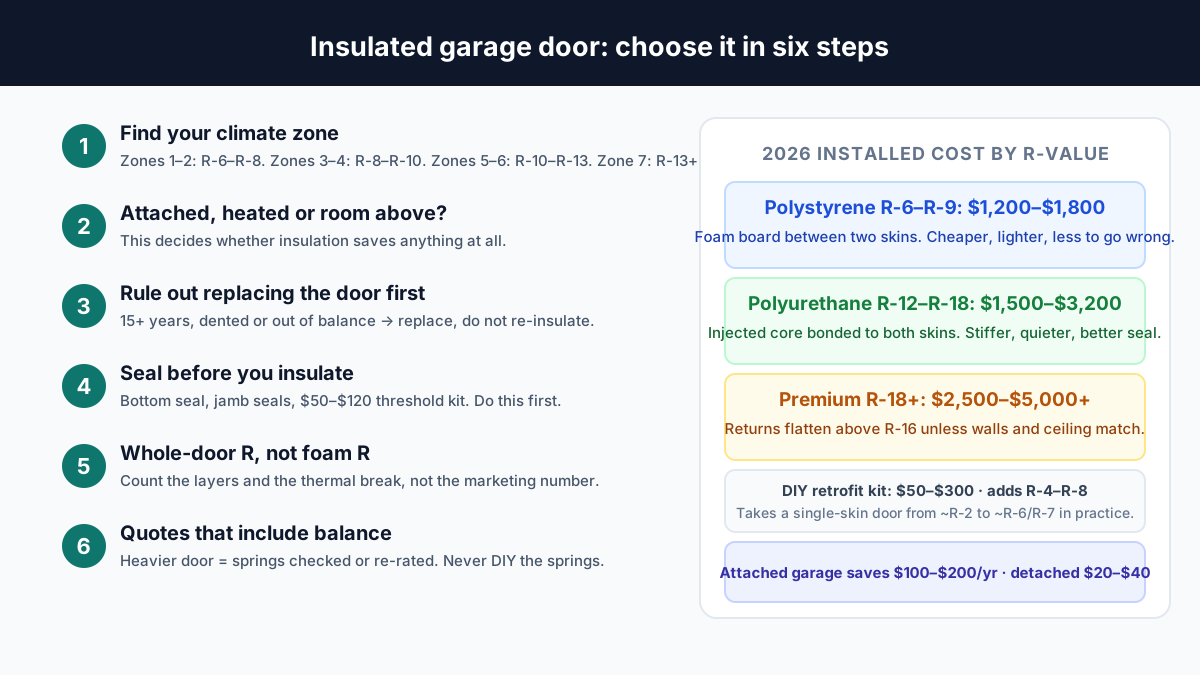
1. Find your climate zone and the R-value it calls for
- WhyClimate zone decides which price tier you are shopping in before you look at a single door. Hot zones 1–2 want roughly R-6 to R-8, mixed zones 3–4 want R-8 to R-10, cold zones 5–6 want R-10 to R-13, and very cold zone 7 wants R-13 or more. Look up your zone rather than guessing from last winter.
2. Decide whether the garage is attached, heated, or has living space above it
- WhyThis is the single question that decides whether insulation saves money. An attached garage shares walls with conditioned space and acts as a thermal buffer; a detached, unheated garage has no differential to maintain and the energy maths collapses. Living space above the garage is the strongest case for the upgrade, and the strongest case for also insulating the ceiling.
3. Rule out replacing the whole door first
- WhyIf the door is 15 or more years old, dented, rusting, warped or out of balance, plan a replacement rather than adding insulation to it. A kit caps out around R-4 to R-8 and cannot seal like a bonded factory section. Spending on a kit now and a door later is the most expensive route there is.
4. Fix the perimeter seals before you pay for panel insulation
- WhyA high-R door with a worn bottom seal leaks more than a mid-R door with fresh seals. Replace the bottom U-seal and jamb weatherstripping, add a threshold kit if the gap to the floor is uneven, and only then decide whether panel insulation is the next dollar. A 16-foot threshold kit is $50 to $120.
5. Compare whole-door R-value and U-factor, not the foam marketing
- WhyAsk for the whole-door figure rather than the foam core number, and where a tested U-factor label exists under ANSI/DASMA 105, prefer it - it is measured on the complete installed assembly and accounts for the thermal bridges at the seams and hardware that a centre-panel R-value ignores. Check layer count and whether the sections have a thermal break at the panel edges.
6. Get itemised quotes that include the balance and spring check
- WhyAny heavier door - or a retrofit kit that adds mass - changes what the springs and opener have to lift, and torsion springs are matched to the exact weight of the door. Ask each quote to state the door model and R-value, which seals are being replaced, old-door removal and disposal, and that the springs will be checked or re-rated and the door left balanced before the technician leaves.
⚠ Do not touch the springs yourself
If a new or heavier door leaves the door heavy, drifting or unwilling to hold position, it is out of balance - and the fix is a spring adjustment, not a DIY job. Torsion springs store enough energy to cause serious injury, and adding insulation weight is one of the most common reasons a door that used to be balanced no longer is. Book a professional and have the balance verified.
Frequently asked questions
How much does an insulated garage door cost installed in 2026?
Installing an insulated garage door runs $1,100 to $4,200, with a national average around $1,500. Single-car doors generally land between $500 and $2,500 and double doors between $750 and $4,000, depending on size, material and R-value. The insulation portion itself is usually $100 to $500 of the door price, or an $800 to $1,200 premium when you are upgrading a whole single-layer steel door to a mid-grade polyurethane one.
Is an insulated garage door worth it?
It is worth it when the garage is attached to the house, especially if it has conditioned living space above or beside it - that is where the door is part of the building envelope and the savings are real. On a detached, unheated garage in a mild climate the energy saving is small, and the money is better spent on perimeter seals. Many homeowners in mild climates still choose insulation for the noise reduction and comfort, which are genuine even when the payback is not.
What R-value do I need for my garage door?
For an attached garage with living space above it, R-12 to R-16 is the practical target. Hot climates (zones 1-2) are fine with R-6 to R-8, mixed zones 3-4 with R-8 to R-10, and cold zones 5-6 with R-10 to R-13. Above roughly R-16 the returns flatten unless the garage walls, ceiling and shared wall are insulated too - an R-18 door in a garage with uninsulated walls is money spent on the wrong surface.
Polystyrene or polyurethane - which garage door insulation should I choose?
Polyurethane is the better insulator and the more rigid panel: it delivers about R-6.5 per inch against roughly R-4 per inch for polystyrene, and because it is injected as a liquid that bonds to both steel skins it adds strength and quiet. Polystyrene is lighter, cheaper and less prone to thermal bowing in direct sun. For an attached garage in a climate with real temperature swings, polyurethane at R-12 or higher earns its premium; for a mild-climate detached garage, polystyrene is the sensible buy.
Can I just insulate my existing garage door instead of replacing it?
Yes, if the door is sound and you accept the ceiling on performance. Retrofit insulation kits cost about $50 to $200 for materials ($150 to $400 fitted) and add roughly R-4 to R-8, taking a single-skin steel door from about R-2 to R-6 or R-7 in practice. They will not reach R-12 no matter what the packaging claims, and they do not improve the air seal around the door. If you are heating the space, a factory-insulated door is the better route.
Will an insulated garage door lower my energy bills?
On an attached garage, yes - modestly. Typical figures are $100 to $200 a year for a standard attached garage, and $150 to $300 a year in a cold climate if the door is part of the envelope and the rest of the garage is insulated too. On a detached, unheated garage the saving is often only $20 to $40 a year. Door insulation also keeps the garage roughly 10 to 12 degrees warmer in winter and 25 degrees cooler in summer, which is comfort rather than cash.
Do I need new springs if I add garage door insulation?
You need the springs checked, and quite possibly re-rated. Torsion springs are matched to the exact weight of the door, so a heavier replacement door - or a retrofit that adds meaningful mass - changes what they have to lift. A door that is suddenly heavy, drifts or will not hold position is out of balance, and that is a professional adjustment. Do not wind, unwind or adjust torsion springs yourself; they store enough energy to cause serious injury.
A note on accuracy
This is general buying guidance, not a substitute for a quote. Cost figures are national-average ranges for 2025–2026 and vary by region, door size, material and what an on-site assessment finds. Energy-saving estimates depend on your climate, the rest of the garage envelope and how the space is used - treat any single figure, including the ones above, as a range to sanity-check locally rather than a promise.