The short version
- Commercial garage door repair runs $150-$350 for minor fixes and $400-$1,000+ for major component work; installation runs $1,500-$7,000 per bay for standard doors and up to $25,000+ for high-speed or fire-rated systems.
- Service commercial doors by cycle count, not the calendar — quarterly for high-duty doors over 7,500 cycles a year, down to annually for low-traffic doors.
- Use the 50% rule to decide repair vs. replace: if a repair estimate is half or more of a new door's cost, or the frame is structurally twisted, or the operator lacks UL 325-compliant sensors, replace it.
Commercial garage doors do a different job than the one on a house. A busy loading dock door might cycle thousands of times a year, carries far more steel and torque, and answers to safety codes that don't apply to residential units at all. That means commercial garage door repair, installation, and maintenance all need to be planned differently — and priced differently. Here's what a facility manager or business owner actually needs to know for 2025-2026: repair and installation costs by door type, maintenance schedules that match real usage, the UL 325, ANSI/DASMA, and NFPA 80 codes that govern compliance, how to weigh repair against replacement, and what separates the major commercial brands.
Types of commercial garage doors
The right commercial door depends on the building's usage pattern, environment, and required opening speed — not just the opening size.
- Rolling steel (coiling) doorsInterlocking steel slats coil around an overhead barrel, eliminating ceiling track runs. Common on warehouses, distribution centers, and loading docks where crane space or overhead piping rules out a sectional door. High resistance to impact and forced entry.
- Sectional steel doorsHinged panel sections travel on vertical and horizontal tracks into an overhead position. Used in vehicle bays, fire stations, cold storage, and logistics hubs. Best energy efficiency via polyurethane or polystyrene insulation cores, and lower upfront cost than rolling steel.
- High-speed doorsReinforced PVC curtains or articulated aluminum slats open at 40 to over 100 inches per second. Used in cleanrooms, food processing, and high-traffic distribution hubs to cut thermal exchange and keep climate control tight.
- Fire-rated rolling steel doorsClose automatically on fire or smoke detection using fusible links and mechanical drop governors. Certified under UL and NFPA standards, and required in fire-wall openings and industrial division walls.
Commercial vs. residential doors
Commercial door systems are built to survive far more cycles and higher loads than anything installed on a house — specifying residential-grade hardware on a commercial opening leads to premature failure.
| Parameter | Residential | Commercial |
|---|---|---|
| Steel sheet gauge | Light gauge (25-27) | Heavy gauge (18-24) |
| Track assembly | 2-inch light-gauge, bracket-mounted | 2-3 inch heavy-duty, angle-mounted |
| Spring cycle rating | 10,000 cycles standard | 25,000-100,000+ cycles |
| Spring architecture | Extension or light enclosed torsion | Heavy exposed torsion bars on pillow blocks |
| Operator rating | Intermittent light-duty motors | Continuous-duty industrial (115V-460V) |
Commercial torsion springs are engineered for high-frequency use — standard commercial packages are rated 25,000-50,000 cycles, with heavy-duty systems exceeding 100,000. Commercial panels use 18-24 gauge steel with external strutting and double-end stiles to resist wind load and fatigue, versus 25-27 gauge residential panels. Commercial operators run as continuous-duty jackshaft, gear-head, or chain-hoist units across single- or three-phase power, where residential openers are light-duty trolley motors built for a handful of daily cycles.
2025-2026 commercial garage door repair costs
Standard non-emergency commercial repairs baseline between $150 and $350 for minor mechanical adjustments; major component failures run $400 to over $1,000. Commercial technicians charge $100-$300 per hour, and a standard diagnostic or service-call fee of $50-$100 is usually credited toward the repair. Emergency or after-hours dispatch — what most people are searching for with "commercial repair near me" — adds $50-$150 to the standard fee, or doubles the hourly rate.
| Repair | Parts & materials | Total installed cost |
|---|---|---|
| Commercial spring replacement (paired) | $150-$300 | $300-$500+ |
| Operator / motor repair | $75-$300 | $180-$500 |
| Sectional panel replacement (per section) | $200-$600 | $250-$1,000 |
| Track alignment & repair | $40-$120 | $75-$300 |
| Lift cable replacement (paired) | $50-$100 | $100-$350 |
| Roller & hardware renewal | $50-$100 | $100-$200 |
| Safety sensor realignment / repair | $50-$150 | $85-$250 |
Spring failure is the most common cause of a sudden dead door. Because of the mass involved, technicians replace both commercial torsion springs together — leaving one aged spring in place causes shaft deflection and premature motor wear. Track damage is usually from forklift or equipment strikes near the floor line; if the vertical stiles and side tracks are still plumb, individual panel or track sections can be replaced, but distorted framing calls for full replacement.
Door stuck or off track at your facility?
A technician can diagnose commercial repairs and dispatch fast — don't force a jammed door or keep running the opener against a broken spring.
Request Service2025-2026 commercial garage door installation costs
Standard commercial installations run $1,500-$7,000 per bay; heavy industrial, fire-rated, or high-speed systems run $8,000 to over $25,000. Installation labor typically makes up 30-40% of total project cost.
| Door system | Size (W×H, ft) | Insulation | Installed cost |
|---|---|---|---|
| Sectional steel, non-insulated | 10×10 | Uninsulated (R-0) | $1,500-$3,000 |
| Sectional steel, non-insulated | 12×12 | Uninsulated (R-0) | $2,200-$4,200 |
| Sectional steel, non-insulated | 14×14 | Uninsulated (R-0) | $3,000-$5,500 |
| Sectional steel, insulated | 10×10 | Polyurethane (R-12.1-R-18.4) | $2,200-$4,000 |
| Sectional steel, insulated | 12×12 | Polyurethane (R-12.1-R-18.4) | $3,200-$5,500 |
| Sectional steel, insulated | 14×14 | Polyurethane (R-12.1-R-18.4) | $4,500-$7,000 |
| Rolling steel coiling door | 10×10 | Uninsulated / insulated slat | $2,500-$4,500 |
| Rolling steel coiling door | 12×12 | Uninsulated / insulated slat | $3,500-$6,500 |
| Rolling steel coiling door | 14×14 | Uninsulated / insulated slat | $5,000-$8,500 |
| High-speed roll-up door | 10×10 to 12×12 | Reinforced PVC / light slat | $5,000-$12,000 |
| High-speed roll-up (heavy industrial) | 14×14+ | Insulated fabric / aluminum | $12,000-$25,000 |
| Fire-rated rolling steel (NFPA 80) | 10×10 | Standard fire core | $3,500-$5,500 |
| Fire-rated rolling steel (NFPA 80) | 12×12 | Standard fire core | $4,800-$7,000 |
| Full-view aluminum / glass | 10×10 to 12×12 | Insulated glazing options | $2,500-$7,500 |
What pushes the price up: structural framing work when the opening needs new wall-angle anchoring into reinforced CMU or steel jambs; custom track geometry for high-lift or roof-pitch profiles; electrical infrastructure for 208V/230V/460V three-phase power, loop detectors, or keypads; and permitting, since most municipalities require certified wind-load engineering drawings before issuing an installation permit.
Maintenance schedule & cost
Commercial maintenance should be scheduled by cycle volume, not by a fixed calendar date.
| Facility type | Cycle volume | Service cadence |
|---|---|---|
| Type A — high-duty | Over 7,500 cycles/year | Quarterly |
| Type B — medium-duty | 3,000-7,500 cycles/year | Semi-annually |
| Type C — standard-duty | Under 3,000 cycles/year | Annually |
Type A covers high-volume distribution hubs, automated parking structures, and continuously running transit terminals. Type B covers auto repair bays, dealerships, and regional freight transfer points. Type C covers municipal utility garages, fire stations, and low-traffic storage.
A Planned Maintenance Agreement (PMA) typically costs $100-$235 per door per visit and includes scheduled inspection, priority emergency dispatch, waived diagnostic fees, and labor discounts. A full PM visit covers torsion shaft calibration and lubrication, cable and drum integrity checks, track and fastener alignment, roller and hinge servicing, safety-sensor diagnostics, operator drive diagnostics, and perimeter weatherstrip evaluation.
Safety codes & compliance
Commercial doors answer to several overlapping standards that don't apply to residential installs.
- UL 325Governs commercial operator safety. Operators built for momentary-contact (single-touch) closing need two independent monitored entrapment-protection systems — inherent force sensing plus a monitored external sensor. External photo-eyes must be mounted no more than 6 inches above the floor; mounting higher violates the standard. Without monitored sensors, the operator is restricted to manual constant-pressure closing.
- ANSI/DASMA 102, 108, 109, 204DASMA's ANSI-approved standards cover sectional overhead door construction (102), wind-load testing (108), thermal performance testing (109), and fire-rated rolling door assemblies (204).
- NFPA 80Requires an annual functional drop test on every commercial rolling fire door, performed by a trained technician. The door must close completely at a controlled speed of 6-24 inches per second. Initial acceptance test records must be kept for the life of the door; annual inspection records for at least 3 years, for the local Authority Having Jurisdiction.
⚠ Non-compliance is a liability issue
A commercial operator without monitored entrapment protection, or photo-eyes mounted above the 6-inch UL 325 limit, exposes the business to workplace-safety liability and can affect commercial insurance underwriting. This is a fix, not a wait-and-see item.
Repair or replace a commercial garage door?
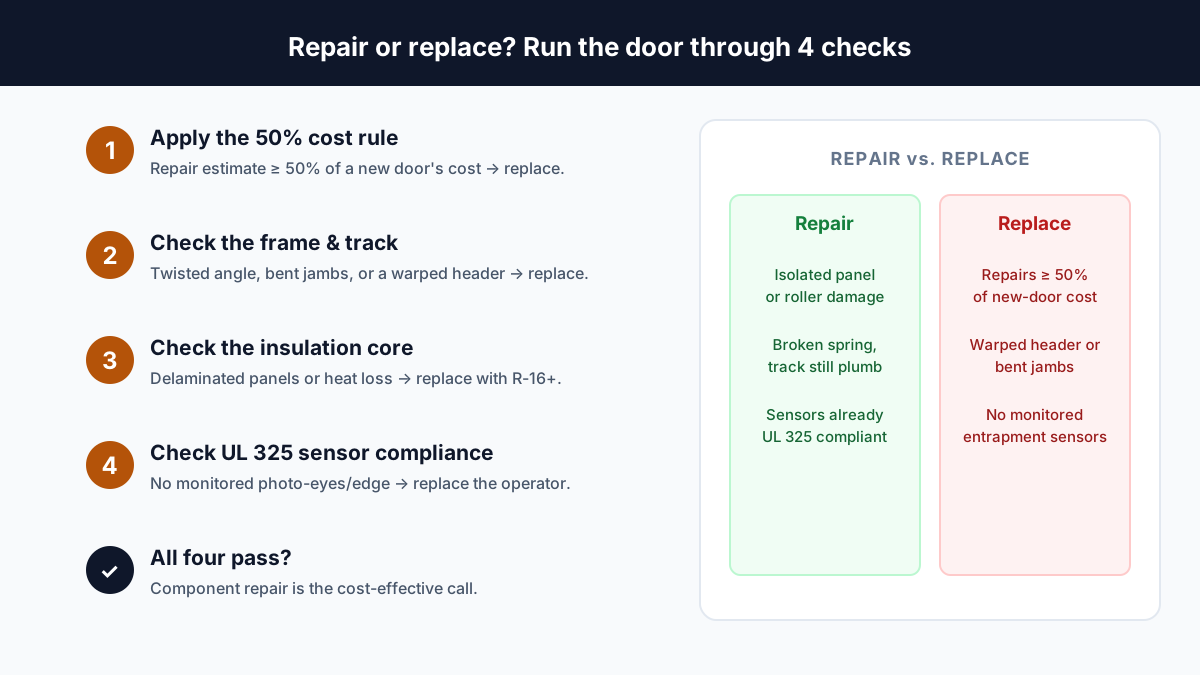
Run the door through these four checks in order.
1. Apply the 50% cost rule
- What to doGet a repair estimate. If it's 50% or more of the cost of a comparable new door, replace rather than continuing to invest in aging hardware.
2. Check the frame and track
- What to doMinor track misalignment or an isolated dent is repairable. Twisted structural angle, bent jambs, or a warped header mean the opening's structural integrity is compromised — replace.
3. Check the insulation core
- What to doIntact insulated panels that still meet energy standards are fine to keep. Delaminated panels or high heat loss point to replacement with an R-16+ polyurethane-insulated door — the energy savings in a climate-controlled facility often pay back the cost in 3-5 years.
4. Check UL 325 sensor compliance
- What to doConfirm the operator has monitored entrapment protection — photo-eyes or a monitored sensing edge. An older operator that lacks monitored sensors should be replaced, both for safety and to avoid liability exposure.
Choosing a commercial garage door contractor
| Credential | What to look for |
|---|---|
| Industry accreditation | Active IDEA Dealer Accreditation or manufacturer factory certification |
| Licensing & insurance | Active state specialty license and $1M-$5M commercial liability coverage; request a Certificate of Insurance naming the facility as additional insured |
| Field staff certifications | OSHA 10/30 cards; NFPA 80-certified fire door technicians for fire-rated doors |
| Emergency response SLA | Guaranteed 2-4 hour emergency dispatch with fully stocked service vehicles |
Prioritize contractors accredited by the Institute of Door Dealer Education and Accreditation (IDEA) — it signals adherence to industry installation and safety standards and ongoing technical training. For fire-rated doors specifically, confirm the technician has documented manufacturer or industry training to perform NFPA 80 drop tests, not just general repair experience.
Brand comparison
| Brand | Core series | Insulation core | R-value range |
|---|---|---|---|
| Overhead Door Corp. | Thermacore Series | Injected polyurethane | R-12.7-R-17.5 |
| Wayne Dalton | ThermoMark Series | Bonded polyurethane | R-12.0-R-18.0 |
| Clopay Commercial | Model 3720 / Architectural | Intellicore polyurethane | R-18.4 (max R-20.4) |
| C.H.I. Overhead Doors | Model 3200 Series | Polystyrene / polyurethane | R-10.29-R-17.54 |
Overhead Door Corporation's Thermacore Series is an industry benchmark, with continuous polyurethane insulation, thermal breaks, and high-cycle spring options suited to severe-weather and high-frequency logistics use. Wayne Dalton's ThermoMark Series (a division of Overhead Door) balances commercial performance with competitive pricing, using exposed industrial torsion systems rather than the TorqueMaster enclosed springs found on Wayne Dalton's residential lines. Clopay Commercial is North America's largest garage door manufacturer, and its Intellicore insulation technology reaches the highest R-values in this comparison, with strong style and custom-sizing options. C.H.I. Overhead Doors has a reputation for structural engineering flexibility and custom panel sizing, making it a common choice for non-standard openings and harsh industrial environments.
Frequently asked questions
How much does commercial garage door repair cost?
Minor repairs like sensor realignment or roller replacement typically run $150-$350. Bigger jobs — spring replacement, motor repair, or a sectional panel swap — usually run $400 to over $1,000. Commercial labor rates run $100-$300 per hour, and a standard diagnostic/service call fee is $50-$100.
How much does a commercial garage door installation cost?
Standard commercial installations run $1,500-$7,000 per bay depending on door type and size. Heavy industrial, fire-rated, or high-speed doors run $8,000 to over $25,000. Installation labor is typically 30-40% of the total project cost.
How often should a commercial garage door be serviced?
It depends on cycle volume, not the calendar. High-duty doors (over 7,500 cycles a year, like busy loading docks) should be serviced quarterly. Medium-duty doors (3,000-7,500 cycles) need semi-annual service, and standard-duty doors (under 3,000 cycles) can go annually. A planned maintenance agreement typically costs $100-$235 per door per visit.
What safety codes apply to commercial garage doors?
UL 325 governs commercial operator safety, requiring monitored entrapment protection such as photo-eyes mounted no higher than 6 inches off the floor. ANSI/DASMA 102, 108, 109, and 204 cover structural, wind-load, thermal, and fire-rated door performance. NFPA 80 requires an annual drop test for fire-rated rolling doors, with closing speed between 6 and 24 inches per second and inspection records kept at least 3 years.
Should I repair or replace a commercial garage door?
Use the 50% rule as a starting point: if the repair estimate is half or more of a new door's cost, replace it. Also replace if the frame or track is structurally twisted, the insulation core is failing, or the operator lacks UL 325-compliant monitored safety sensors.
What's the difference between a commercial and residential garage door?
Commercial doors use heavier 18-24 gauge steel versus 25-27 gauge residential steel, 2-3 inch heavy-duty tracks instead of light 2-inch tracks, and torsion springs rated for 25,000-100,000+ cycles compared to a residential door's standard 10,000. Commercial operators are continuous-duty industrial motors, not intermittent-duty residential ones.
Which brands make commercial garage doors?
Major commercial manufacturers include Overhead Door (Thermacore Series, up to R-17.5), Wayne Dalton (ThermoMark Series, up to R-18.0), Clopay Commercial (Model 3720/Architectural with Intellicore insulation up to R-18.4), and C.H.I. Overhead Doors (Model 3200 Series, up to R-17.54). Each differs mainly in insulation core, steel gauge options, and customization.
A note on accuracy
This is general facility-management guidance, not a substitute for an on-site inspection or a licensed contractor's quote. Cost figures are national-average ranges for 2025-2026 and vary by region, door size, and site conditions. Fire-rated door testing and UL 325 compliance work should always be verified by a qualified technician.