The short version
- A garage door cable came off the drum means the cable is usually still whole - it has jumped the grooves of the spool on the torsion shaft. It is the milder of the two cable failures: the cable is often reusable and the repair typically costs $125–$300.
- Stop using the door. The cable shared the spring's stored tension, so once it leaves the drum the door is no longer balanced. Running the opener from that point is what turns a re-seat into a racked door, a bent track and a $200–$350 cable-and-drum job.
- Diagnose it in three questions: one side or both? was there a loud bang? is the cable frayed or just loose? Crooked door + visibly loose cable = a cable. Loud bang + heavy but level door = a spring.
- The causes are almost never the cable itself. A broken or unevenly tensioned spring is the most common reason a cable leaves its drum; a worn drum, a seized roller, a misaligned track or an obstruction in the door's path all do it too.
- Cables are replaced in pairs ($100–$350), and drums as a matched pair, because both sides have taken the same cycles - fixing one half of a matched system just books a second visit.
- This is not a homeowner repair. Unseating a drum set screw or a bottom bracket while the spring is wound is one of the more commonly cited ways people are badly hurt. Disconnect the opener and call a technician.
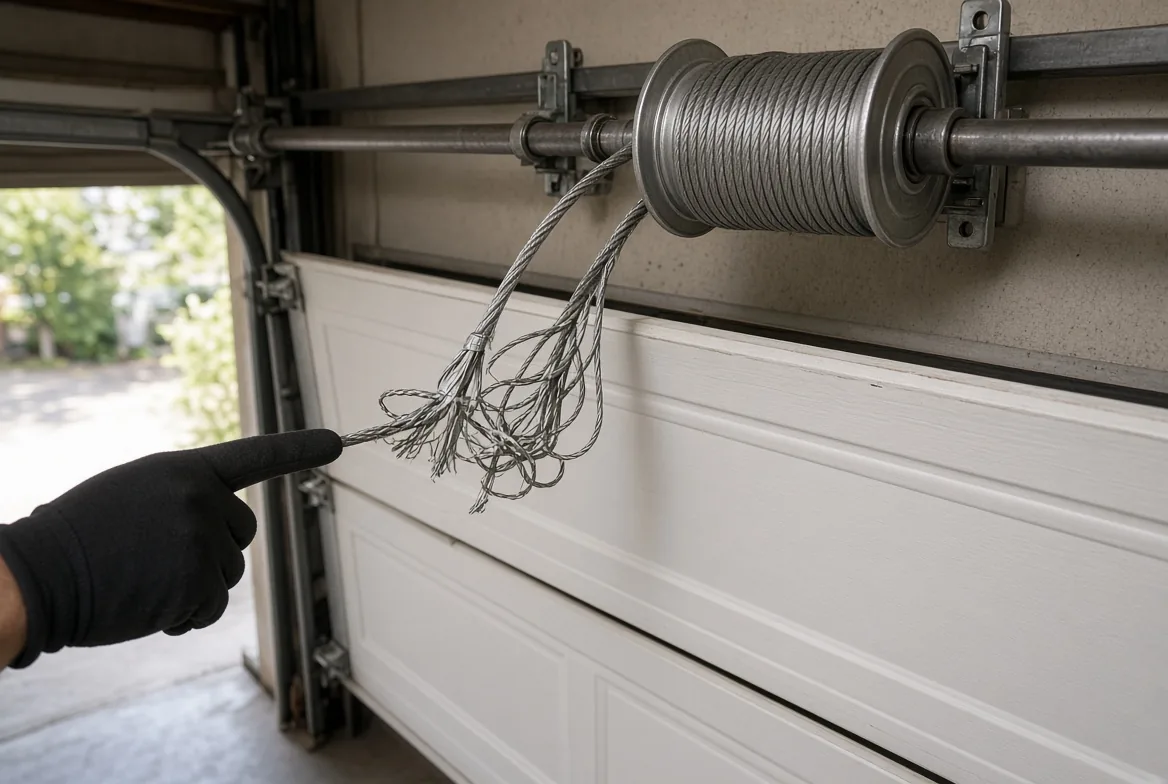
"Cable off the drum" is the phrase technicians use for a very specific failure: the lift cable has unspooled out of the grooves on its drum but has not parted. It looks alarming - a loop of steel cable hanging beside the torsion shaft, the door sitting visibly crooked - and it is genuinely a stop-using-the-door problem, but it is also the cheaper of the two cable failures to put right.
This guide is about diagnosis first. In 2026 there are three failures that get confused with each other after a cable event - cable off the drum, snapped cable, and broken spring - and they are quoted differently, so working out which one you have before you call is worth more than any price list.
Garage door cable came off the drum: what that actually means
On a torsion-spring door a steel lift cable runs from the bottom corner bracket up the side of the door and wraps into the grooves of a cable drum - a grooved spool mounted on each end of the shaft above the door. As the door closes the cables wind onto the drums; as it opens, the springs pull them back off. When a garage door cable came off the drum, it has jumped those grooves and is sitting slack, looped or tangled beside the drum, or you can see an empty groove where it should be wound.
The important distinction is that the cable has not snapped. Cost guides treat the two separately for exactly that reason: re-seating an intact cable and re-tensioning both sides typically lands at $125–$300, while replacing a parted cable pair runs $100–$350 plus a service call fee. If the cable is whole and simply out of its groove, you are usually paying for an hour of skilled labour rather than for new parts.
What you must not do is treat it as cosmetic. The cable is part of the same tensioned system as the spring, and while it is off the drum one side of the door is being carried by nothing. That is why every source on the subject opens with the same instruction: disconnect the opener and do not run the door.
Not sure which failure you have?
A technician confirms whether this is a cable, a drum or a spring before quoting, and re-balances the door so the other side is not left carrying the load alone.
Request ServiceSigns a cable has left the drum
The visual and audible signs are specific enough that most homeowners can identify this failure from the doorway, which is exactly why a technician will ask you to describe what you see.
- A cable hanging in a loop or coiled near a bottom cornerThe clearest sign of all: the cable is off its drum and lying slack instead of running taut up the side of the door.
- One side of the door sits lower than the otherWith one cable out of the system, only one side is being carried. The door looks crooked when closed and binds or jams on a single side as it moves.
- An empty groove on one drumLook at the drums on the shaft at each top corner - one neatly wound cable and one bare, grooved spool is a fairly unambiguous diagnosis.
- A sharp ping, pop or snap from the headerOften a frayed strand catching on the drum flange - the failure that comes before the cable walks off.
- The opener strains, hums or reverses on its ownThe opener's force sensors read the uneven load from a slipping cable as an obstruction, so a door that reverses for no reason is sometimes a cable fault rather than an opener fault.
- The drum spins without lifting the cableIf the drum's set screws have stripped or backed out, the shaft turns but the drum slips on it and that side barely moves - a hard mechanical failure that needs a new drum.
- Frayed strands near the bottom bracket or the drumBroken wire strands sticking out like whiskers mean the cable is on borrowed time, whether or not it has left the drum yet.
Why a cable comes off the drum
Across every source consulted, the same cause heads the list, and it is not the cable: a broken or unevenly tensioned torsion spring. When a spring breaks it stops counterbalancing the door, the cables lose tension instantly and unwind off the drums. Two springs set to mismatched tension do the same thing more gradually.
| Cause | What it looks like | What the repair includes |
|---|---|---|
| Broken or uneven spring tension | Loud bang, or a door that has been getting heavier for months; cable slack on one or both sides | Spring replacement, usually both springs, plus cable re-seat and balance |
| Worn or damaged cable drum | Cracks or chips at the hub, grooves chewed deeper than spec, cable jumping the same groove each time | Matched pair of drums plus the cable work |
| Frayed or broken cable | Broken strands, a kinked or flattened section, a parted end | Both cables replaced as a pair |
| Misaligned or bent track | Door binds in one spot, roller out of the rail, uneven travel | Track realignment or replacement, then cable reset |
| Obstruction in the door's path | Door stopped abruptly on something left in the opening, then went slack | Remove the obstruction, inspect for damage, re-seat and re-tension |
| Seized roller | One roller skidding instead of rolling; door racks as it moves | Roller replacement plus cable re-tension |
| Door out of balance | Heavy to lift by hand, will not stay put halfway up | Spring tension adjustment, then cable re-seat |
| Rust and corrosion | Orange discolouration or pitting in the bottom 12 inches of cable | Cable replacement; rust is why coastal and northern garages see this more |
Note what that list means in practice: if a cable keeps coming off the drum, the cable is the symptom. A technician who only re-seats it and leaves the worn drum or the weak spring in place is guaranteeing a repeat call. Ask what caused it.
One side or both sides?
This single question narrows the diagnosis faster than anything else you can observe. One side dropping points at the cable and its drum; both sides going slack at once points at the spring.
| What you see | Most likely cause | Typical job |
|---|---|---|
| Cable off the drum on one side only | One cable has slipped or failed, or that drum is worn or has crept along the shaft | Re-seat and re-tension both cables, inspect and replace the drum if needed |
| Both cables slack or off at once | Almost always a spring - either a broken spring or mismatched tension between a pair | Spring replacement (usually both) plus cable and drum service |
| Crooked door, cable visibly whole | Cable off the drum but not damaged | Re-seat, re-tension, balance test - $125–$300 |
| Crooked door, frayed or parted cable | Snapped or about-to-snap cable | Replace the cable pair - $100–$350 plus trip fee |
Whichever side failed, expect the technician to replace or re-tension both cables. They were installed together, have cycled together and have aged together; the extra cable itself is only $30–$50, and leaving the worn mate in place is what produces the second service call a few weeks later.
Cable off the drum, snapped cable, or broken spring?
These three arrive looking similar from a distance and cost different amounts to fix, so it is worth running the comparison before you call. San Antonio Door's observation checklist and the Boise and Royal diagnosis guides all come down to the same cues.
| What you see or hear | Failure | What it needs | 2026 cost |
|---|---|---|---|
| Cable looped, coiled or slack beside the drum; door crooked on one side; cable appears whole | Cable off the drum | Re-seat in the drum grooves, re-tension both sides, balance test | $125–$300 |
| Frayed end, broken strands, cable hanging free with a parted end | Snapped cable | Replace the cable pair | $100–$350 + $50–$100 trip |
| Loud bang, door heavy but still level in both tracks, visible gap or break in the spring coil | Broken spring | Spring replacement, usually both springs, with the cable work | $300–$650 bundled |
| Drum cracked, chipped or visibly grooved; cable keeps jumping the same spot | Damaged drum | Both drums replaced with the cable work | +$50–$75 per drum in parts |
The two-second version
A bang and a heavy door that still sits level is a spring. A quiet crooked door with a cable hanging loose is a cable. If you cannot tell, do not test it with the opener - describe both symptoms to the technician and let them confirm it on site.
What it costs to fix in 2026
The repair is mostly labour, which is why the parts look so cheap next to the bill. A pair of lift cables costs $12–$50; the rest is the hour of skill it takes to take the spring's energy out of the system safely, re-seat the cable and re-balance the door.
| Job | Typical range | Notes |
|---|---|---|
| Cable off the drum - reset, re-wind and re-tension | $125–$300 | Cable usually reusable; the whole job if the drum is sound |
| Standard cable replacement (both sides) | $150–$250 (national range $100–$350) | Most common cable repair; Angi's 2026 average is $225 |
| Single cable replaced | $125–$200 | Not recommended - the pair is the right job |
| Cable + drum realignment (door also off track) | $200–$350 | Applies if the cable let go and the door jumped its track |
| Cable replacement with a roller set | $200–$400 | New nylon rollers on the same visit |
| Bottom bracket / drum hardware with cables | $200–$450 | Brackets take the full cable load and often bend with it |
| Complete cable-system overhaul | $200–$400 | Cables plus drum, pulley and spring inspection |
| Cables replaced together with springs | $300–$650 | The common bundled job - one visit instead of two |
| Emergency / after-hours add-on | $75–$200 (up to $300 where flat-billed) | Nights, weekends and holidays |
| Service or trip fee | $50–$100 | Often credited against the repair |
| Technician labour rate | $75–$150 per hour | Angi 2026 data |
Two things move the number up: the door came off its track when the cable went (add $50–$150 in realignment and hardware) and the spring turns out to be broken as well. Costs also run higher on double-wide, insulated and heavy custom doors, which need a heavier cable gauge, and in higher-cost metro areas.
What a fair quote should itemise: the cable or cables, the labour and how many hours, any drum or bottom bracket being replaced with a stated reason, any track work if the door came off, and the service call fee with whether it is credited. Cables themselves are $12–$50, so a quote that charges a premium for "heavy duty cable" is worth a question.
The cable drum itself
A cable drum is the grooved spool at each end of the torsion shaft, and it is the part people most often overlook when a cable comes off. Drums are rated in cycles much like springs - typically 10,000–15,000 cycles, roughly 7–12 years of normal use - and they fail by cracking at the hub, chipping along the rim, or wearing a groove deeper than the cable can track.
- Matched pairsBoth drums are an identical mirrored set that wind at the same speed to keep the door level, so a failing drum is replaced as a pair. Swapping one leaves the door cocked.
- Size and hand matterStandard-lift drums for a 7–8 ft door with 12" radius track carry part numbers like 400-8, 400-96 or 5250-18 depending on wire size and drum style; high-lift and vertical-lift doors use different drums.
- Hardware is door-brand specificCable gauge, drum geometry and bottom brackets follow the door manufacturer - Clopay, Amarr, Wayne Dalton and similar - not the opener badge. LiftMaster, Chamberlain and Genie make the openers; they do not make your lift cable.
- Extension-spring doors differWhere springs run along the horizontal tracks, the cable rides over pulleys at the rear hanger and the same event shows up as a cable off the pulley. Those doors also need a containment safety cable through each spring - code-required in California and strongly recommended elsewhere - so a broken spring cannot fly free.
Why this is not a DIY repair
The lift cable is mechanically part of the same tensioned system as the spring, and whenever the door is closed there is stored spring energy running through it. A cable that is disturbed while loaded can whip hard enough to cut skin or embed itself in drywall or framing.
⚠ Do not do this yourself
Do not run the opener, do not unwind a cable by hand, and do not loosen a drum set screw or a bottom bracket to "get some slack". Those brackets hold the cable ends under spring load - they are not something you back off with a socket set. A technician supports and clamps the door first, then unwinds the torsion spring with proper winding bars until all tension is off the shaft before the drum or cable is touched.
There is a safe middle ground, and it is the one this article is built on: you can look, listen and report. Compare the two sides, note whether you heard a bang, check whether the cable is frayed or merely loose, look at the drums for cracks or grooving, and photograph the drum's part number if you can read it. That is observation, not repair - and it lets the technician bring the right parts on the first visit.
How to diagnose a cable that came off the drum, step by step
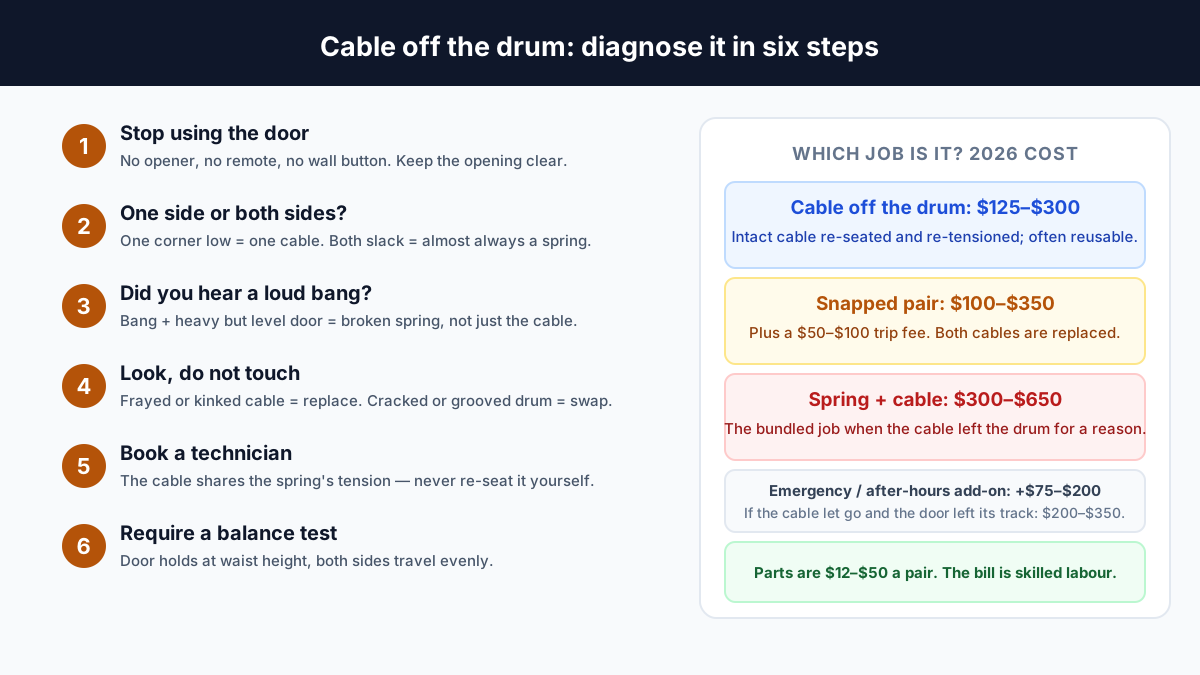
1. Confirm the door is safe to leave where it is
- WhyDo not press the wall button, the remote or the opener again. If the door is down and still, keep people and pets out of the opening and wait for a technician. If it is stuck open, secure it - a door held open by a failing cable is still under full spring load and is the highest-risk scenario.
2. Work out whether one side or both sides is affected
- WhyStand back and compare the two top corners. One corner lower, or an empty groove on one drum with the cable looped beside it, means a single cable has slipped or failed. Both sides slack at once almost always means a spring rather than two independent cable faults.
3. Rule out a broken spring
- WhyLook along the torsion spring above the door for a visible gap or clean break, and remember whether you heard a loud bang. A parted spring leaves the door heavy but still level in both tracks; a cable issue leaves it crooked on one side with the cable visibly loose. This is the answer that changes the whole quote.
4. Inspect the cable and the drum for damage
- WhyLook - do not touch - at the cable where it wraps the drum and at the bottom 12 inches where it loops into the bracket. Frayed strands like whiskers, a kinked or flattened cable, a drum that is cracked, chipped or grooved, or a drum that has crept along the shaft all change what the repair is and which parts the technician needs to bring.
5. Stop using the door and book the repair
- WhyAn intact cable off the drum cannot be re-seated by the homeowner, because it shares the spring's stored tension. Describe what you see when you call - "the left cable is off the drum and the door is sitting crooked" is worth more than "the door looks wrong".
6. Insist on a balance test after the repair
- WhyBefore the technician leaves, the door should be disconnected from the opener, lifted to about waist height and released. A correctly repaired door holds that position instead of drifting up or dropping. Ask to see it, and confirm both sides now travel evenly with no grinding and no cable slipping on the drum.
Preventing the next one
Most cable failures give weeks of warning, and the warning is usually visible from the floor with your eyes only.
- Inspect twice a yearLook at the bottom 12 inches of each cable for rust, pitting and broken strands, and check that one cable is not slack while the other is taut. Fifteen minutes, twice a year, alongside the rest of your garage door maintenance.
- Lubricate properlyCables, rollers, hinges and drum faces take a silicone- or lithium-based garage-door lubricant about twice a year. Not WD-40 - it is a solvent, not a lubricant.
- Fix a crooked door promptlyCorrecting spring tension early is what stops the drum chewing the cable. A door that jams or lags on one corner is telling you the balance has drifted.
- Book the annual tune-upA professional service visit checks spring balance, drum condition and cable seating - the three things that decide whether a cable stays on its drum.
- Never operate past a failureIf a cable or a spring has failed, the door stays shut. That one rule is the difference between a $200 re-seat and a $450 racked-door repair.
What to tell the technician
Three details turn a vague call-out into a prepared one, and they cost nothing to collect.
- Which side, and one or both"Left cable off the drum, door crooked to the left" tells the technician to load cable and possibly a drum for that side.
- Whether you heard a bangA bang points at the spring, which changes the job from a cable re-seat to a spring-and-cable service - and often means parts beyond a cable set.
- Whether the cable is frayed, kinked or merely looseWhole and merely loose usually means a re-seat; frayed or kinked means replacement, and probably both sides.
Frequently asked questions
Is a garage door cable off the drum an emergency?
Treat it as urgent rather than a medical emergency. If the door is already down and sitting still, nothing is at immediate risk - but the door must not be operated until it is repaired, because the cable is no longer carrying its share of the load. A door stuck open with a cable off the drum is the highest-risk version, because the spring is still fully wound.
Can the cable be reused if it came off the drum?
Often yes. If the cable jumped out of its drum grooves without fraying or kinking, the repair is a re-seat and re-tension of the intact cable, which typically runs $125-$300. If the cable is kinked where it came off, or the drum groove is chewed up, the cable should be replaced instead - it is a $12-$50 part inside a job that is mostly labour.
Should I replace both cables or just the one that came off?
Both. The two cables are the same age, have gone through the same cycles and have taken the same load, so one failing means the other is close behind. Replacing only the failed side leaves a worn cable working against a new one, and usually means a second service call within weeks for $30-$50 of extra cable.
How do I tell a cable problem from a broken garage door spring?
A broken spring is a loud bang followed by a door that is suddenly heavy but still level in both tracks. A cable that has come off the drum is usually quieter: one side of the door sits lower, the cable hangs slack, looped or coiled beside the drum, and you can often see an empty groove on that drum. If you are not sure, do not test it with the opener.
Why does my garage door cable keep coming off the drum?
Because something else in the system is wrong. The usual culprits are a weakened, broken or unevenly tensioned spring, a worn or grooved cable drum, a drum whose set screws have loosened so it spins on the shaft, a seized roller, or a bent and misaligned track. A cable that comes off repeatedly is a symptom - ask the technician what is causing it instead of paying to re-seat it again.
How much does it cost to fix a cable that came off the drum in 2026?
Re-seating and re-tensioning an intact cable typically costs $125-$300, and replacing the cable pair runs $100-$350 plus a $50-$100 service call fee. If the cable let go and the door jumped its track, a cable-and-drum realignment runs $200-$350, and a job that also needs a new spring is usually bundled at $300-$650 for the pair.
How long does the repair take?
A straightforward cable re-seat, or a cable-and-drum replacement on accessible hardware, is usually a 45-90 minute job. Add time if the springs are replaced on the same visit or if the door has to be reset back onto its tracks.
A note on accuracy
This is general homeowner guidance, not a substitute for an on-site assessment. Cost figures are national-average ranges for 2025–2026 and vary by region, door weight and what the inspection finds once the spring tension is off the shaft. If a cable or spring has failed, do not operate the door.